

The Bengal tiger (Panthera tigris tigris) lives in four countries: India, Nepal, Bhutan and Bangladesh. Their latest national surveys add up to around 4,370 animals, about three quarters of the wild tigers on Earth.
Key facts
| IUCN status | Endangered (Panthera tigris) |
|---|---|
| Range | India, Nepal, Bhutan and Bangladesh. Camera traps also recorded tigers in Medog county, south-east Tibet, in 2019 and 2022 |
| Estimated wild population | Around 4,370, adding the latest national surveys: India 3,682 (2022), Nepal 429 (2026), Bhutan 131 (2021 to 2022), Bangladesh 125 adults (2023 to 2024) |
| Adult weight (male) | Seven adult males weighed in Chitwan, Nepal, averaged 235 kg (200 to 261 kg) |
| Adult weight (female) | Chitwan females averaged 140 kg (116 to 164 kg). Three Sundarbans tigresses weighed in Bangladesh averaged about 77 kg |
| Lifespan in the wild | 10 to 15 years |
| Diet | Mainly deer, wild cattle and wild pig: chital, sambar, gaur and wild boar. In the Sundarbans, mostly chital |
| Main threats | Conflict with people, poaching of tigers and their prey, roads and canals cutting forest, and sea level rise in the Sundarbans |
Why Bengal tigers carry the type subspecies name
When Linnaeus named the tiger Felis tigris in 1758 he gave its home only as Asia and designated no type specimen. In 1911 the zoologist Oldfield Thomas restricted the type locality to Bengal. That decision is why the Bengal tiger is the nominate form, the one whose scientific name repeats the species name: Panthera tigris tigris.
What the name covers is now in dispute. The IUCN Cat Specialist Group’s 2017 revision recognises only two tiger subspecies and places every mainland tiger, Amur and Indochinese included, under Panthera tigris tigris, which would make the Bengal tiger a regional population. A genome study published the following year (Liu and colleagues, Current Biology, 2018) found six distinct lineages, one of them Bengal. This site uses the six traditional names, as most field reports still do.
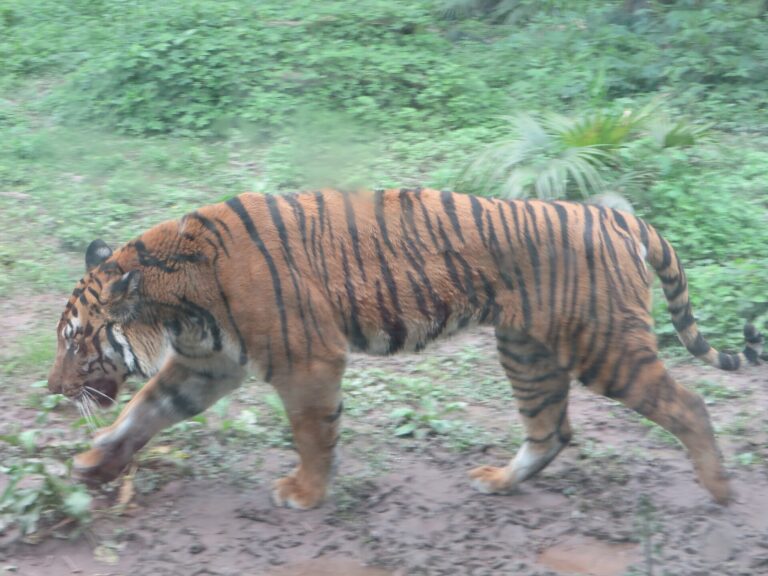
Bengal tigers are orange with black stripes and a white belly, and no two animals share a stripe pattern. That is what lets the surveys below count individuals from camera-trap photographs, and our piece on why tigers have stripes covers what the pattern is for.
Population: four countries, four surveys
There is no single count of Bengal tigers. Each range country surveys its own, in its own year, and the total is those surveys added together.
| Country | Latest estimate | Survey | Earlier estimates |
|---|---|---|---|
| India | 3,682 (range 3,167 to 3,925) | All India Tiger Estimation 2022, published July 2023 | 2,967 (2018), 1,411 (2006) |
| Nepal | 429 (range 402 to 500) | National census, fieldwork December 2025 to April 2026 | 355 (2022), 121 (2009) |
| Bhutan | 131 (range 115 to 146) | National Tiger Survey 2021 to 2022 | 103 (2014 to 2015) |
| Bangladesh | 125 adults (range 100 to 156) | Sundarbans camera-trap survey 2023 to 2024 | 114 (2018), 106 (2015) |
Added up, that is 4,367, or around 4,370, which is roughly three quarters of the Global Tiger Forum’s 2023 world estimate of 5,574. Treat the sum as a guide. The four surveys ran between 2021 and 2026, each figure carries a range, Bangladesh counts adults only, and tigers cross the India-Nepal and India-Bhutan borders.
India holds 84 percent of the total. Its estimate has risen at every four-yearly survey since the 1,411 of 2006, and our page on tigers in India has the full survey table, the state figures and the history of Project Tiger.
Nepal’s count has more than tripled since 2009, in five national parks along the lowland border with India. In the 2026 census one of them, Bardiya, fell from 125 tigers to 112, and another, Banke, held 51 against a carrying capacity modelled at 28. The park by park figures are on our page about tigers in Nepal.
Bhutan has the thinnest spread of the four, 0.23 tigers per 100 square kilometres across the area surveyed, and the highest records, described on our page about tigers in Bhutan. Bangladesh’s tigers all live in one forest, the Sundarbans, and are covered on our page about tigers in Bangladesh. For scale, the Amur tiger of Russia and north-east China numbers in the hundreds.
Where Bengal tigers live: from dry forest to mangrove
Bengal tigers live in sal forest and tall grassland in the Terai along the India-Nepal border, dry teak forest in central India, wet evergreen forest in the Western Ghats, mountain forest in Bhutan, and tidal mangrove in the Sundarbans, where the Ganges and Brahmaputra reach the Bay of Bengal.
At the top of that range, in Bhutan, a camera trap photographed a tiger at about 4,400 metres in Wangchuck Centennial National Park, and pugmarks were found there at 4,600 metres. At the bottom, in the Sundarbans, the land is cut into islands by tidal rivers. Tigers fitted with GPS collars on the Indian side crossed, on average, five channels wider than 30 metres every day. They rarely crossed channels wider than 400 metres, and the widest crossing recorded was 800 metres (Naha and colleagues, PLoS ONE, 2016). Our piece on whether tigers can swim has more.
The Sundarbans and mountain tigers
Sundarbans tigers are the outliers in size. Three adult females weighed in the Bangladesh Sundarbans averaged 76.7 kg, a little over half the figure for tigresses weighed elsewhere in the range (Barlow and colleagues, Mammalia, 2010). The lead author suggested the small deer available in the mangrove as one possible cause. Three animals is a small sample.
Genetically they are Bengal tigers, but the most distinct group within the subspecies. A 2015 study of Indian Sundarbans tigers (Singh and colleagues, PLoS ONE) found low genetic variation, estimated that the population separated from the tigers of peninsular India within the last 2,000 years, and argued that it should be managed as its own conservation unit. It did not find a separate subspecies.
Much less is known about the tigers of the Himalayan slopes. Bhutan’s 2021 to 2022 survey did show that they breed high up. Four of the five tigresses photographed with cubs were above 2,500 metres.
Genetics: diverse overall, inbred in places
Bengal tigers carry more genetic variation than any other tiger. A 2021 study of 65 tiger genomes (Armstrong and colleagues, Molecular Biology and Evolution) found the highest diversity in Bengal tigers and the lowest in Sumatran tigers. The same study found that individual Indian tigers often carry long stretches of DNA in which the copies inherited from each parent are identical, a sign of recent inbreeding. The authors suggest small and fragmented protected areas as a possible cause.
Within India the studies agree on the broad pattern and differ on the detail. Researchers at the National Centre for Biological Sciences in Bengaluru found three genetic clusters in 2017: north-west, south, and a central one that also took in the north and north-east (Natesh and colleagues, Scientific Reports). The 2021 genome study split the north-east off as a fourth group. A 2019 study that used a smaller set of markers drew the lines differently again, grouping western tigers with those of the Western Ghats and the Terai. The genome-scale studies agree that the north-west, which means Ranthambore, is a small population of closely related animals with little variation.
A second 2021 study (Khan and colleagues, PNAS) measured what that isolation costs. Tigers from the small, isolated north-western population had more than half of their genome in such identical stretches. Inbreeding there had removed some of the most damaging mutations but not enough, the authors concluded, to cancel its cost, and the harmful variants that remained had become common.
Similipal in Odisha shows what isolation can do to appearance. Its so-called black tigers, whose stripes are so wide that they run together, carry two copies of one mutation in a gene called Taqpep. A 2021 study found the variant in Similipal and in none of 395 other tigers tested (Sagar and colleagues, PNAS). A count reported in July 2026 put Similipal at 35 tigers, 19 of them black. The white tiger is a comparable case, caused by a single recessive gene, and the last wild one on record was shot in 1958.
Prey and conflict with people
Across most of the range Bengal tigers live on chital, sambar, wild boar, nilgai and gaur. In Nagarhole, in southern India, Karanth and Sunquist (1995) found that tigers preferred gaur, the largest wild cattle, selected prey heavier than 176 kg, and took a disproportionate number of young gaur. The Sundarbans offers less choice. A study of 145 scats and 78 kills in the Bangladesh Sundarbans found that chital made up about 80 percent of the diet and wild boar 11 percent (Khan, 2008). Our piece on what tigers eat has more.
Tiger density follows prey. India’s 2022 estimation put Corbett at 14.65 tigers per 100 square kilometres. The Bangladesh Sundarbans survey of 2023 to 2024 found 2.64, and Bhutan’s national survey 0.23 across the whole area it covered.
Tiger attacks kill people every year in India and Nepal, and in most years in Bangladesh. India recorded 71 deaths in 2025, according to a government answer to Parliament. Nepal’s National Trust for Nature Conservation counted 10 in the 2025 to 2026 fiscal year, against a peak of 21 in 2021 to 2022. In the Bangladesh Sundarbans official records show an average of 23 deaths a year for 2008 to 2015, and the true figure is uncertain, because many of those killed had entered the forest without a permit and go unreported. In Bhutan the conflict is mostly over livestock.
Threats across the range
The pressures differ by country. In India the main worries are forest corridors cut by roads, railways and canals, and conflict as tigers settle outside reserves. In Nepal the parks are filling up. In Bangladesh the threat is the sea.
Two modelling studies have looked at what rising water does to the Bangladesh Sundarbans. Loucks and colleagues (Climatic Change, 2010) found that a 28 cm rise above 2000 sea levels would remove 96 percent of the remaining tiger habitat and leave fewer than 20 breeding tigers. Mukul and colleagues (Science of the Total Environment, 2019) added climate projections and concluded that no suitable tiger habitat would remain there by 2070, with climate change doing more of the damage in their model than sea level rise alone.
Poaching continues. Bangladesh recorded 62 tiger deaths between 2001 and 2023, of which 26 were put down to poachers and 14 to mobs. India’s National Tiger Conservation Authority logged 166 tiger deaths from all causes in 2025.
Related reading
Sources and further reading
- IUCN Red List entry for Panthera tigris
- WWF tiger programme overview
- Status of Tigers, Co-predators and Prey in India 2022 (NTCA and Wildlife Institute of India)
- Armstrong and colleagues 2021, tiger genomes (Molecular Biology and Evolution)
- Khan and colleagues 2021, inbreeding in Indian tigers (PNAS)
- Natesh and colleagues 2017, genetic clusters of Indian tigers (Scientific Reports)
- Naha and colleagues 2016, tiger movement in the Sundarbans (PLoS ONE)
Frequently asked questions
How many Bengal tigers are there?
Around 4,370, adding the most recent national surveys. India’s 2022 estimate gave 3,682, Nepal counted 429 in 2026, Bhutan 131 in 2021 to 2022, and Bangladesh 125 adults in its 2023 to 2024 Sundarbans survey.
Are Bengal tigers and Indian tigers the same?
Yes. Every wild tiger in India is a Bengal tiger. The subspecies also lives in Nepal, Bhutan and Bangladesh, so not every Bengal tiger is Indian.
Is the Bengal tiger endangered?
Yes. The IUCN lists the whole species (Panthera tigris) as Endangered. Bengal tigers are the largest part of it, and India’s estimate rose from 1,411 in 2006 to 3,682 in 2022, but they survive mainly in and around protected reserves.
How big is a Bengal tiger?
Seven adult males weighed in Chitwan, Nepal, averaged 235 kg, and females there averaged 140 kg. Sundarbans tigers are much smaller: three tigresses weighed in Bangladesh averaged about 77 kg.
Where can I see a Bengal tiger?
Bandhavgarh, Tadoba, Ranthambore, Kanha, Pench and Corbett in India are the reserves most often recommended, along with Chitwan and Bardiya in Nepal. Sightings in the Sundarbans and in Bhutan are rare, and no reserve can promise one.
What is the difference between a Bengal tiger and an Amur tiger?
Bengal tigers live in the warm forests of the Indian subcontinent, Amur tigers in the cold forests of the Russian Far East and north-east China. Amur tigers are paler, with a thicker winter coat. Wild Bengal males are the heavier on current evidence: seven weighed in Chitwan averaged 235 kg, against about 176 kg for modern wild Amur males.
Do Bengal tigers swim?
Yes. All tigers swim, and in the Sundarbans it is part of daily life. Collared tigers there crossed about five channels a day that were more than 30 metres wide. They rarely crossed channels wider than 400 metres, and the widest crossing recorded was 800 metres.
What is Project Tiger?
India’s tiger conservation programme, launched on 1 April 1973 with nine reserves. The network now has 58, overseen by the National Tiger Conservation Authority, which also runs the four-yearly All India Tiger Estimation.
Photo: Raghavendra Narayan on Pexels.
Updated 13 September 2026: updated the Bengal tiger total and Nepal’s count, and corrected the Sariska date, Bhutan altitudes and prey density.
Updated 15 November 2026: corrected the origin of the type locality, the weight, diet and swimming figures and the genetics section, and moved India’s history to the Tigers in India page.


We did Bandhavgarh this Feb, 4 safaris, and saw one tigress for maybe 8 seconds crossing the track in Tala zone. My husband has about 400 photos of the bush she walked into. Kids were more excited about the peacocks tbh. Still going back next year, probably Kanha this time. Does anyone know if its less crowded?
Never knew what ‘type subspecies’ meant. Cheers.
Only one line about the Sundarbans?? I’m from Khulna. Our tigers live in mangrove and salt water, completely different life. Please write a separate post.
You’re right, and it’s on my list, promise. Give me a few weeks.