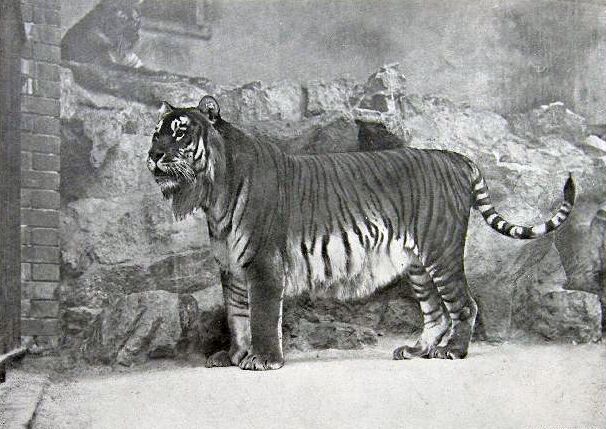
The Javan tiger (Panthera tigris sondaica) ran out of island. Java held about five million people in 1800 and 85 million by 1975, the year before the last confirmed tracks were found. Natural forest covered 23 percent of the island in 1938 and 8 percent by 1975.
Key facts
| IUCN status | Extinct. Assessed as extinct in 2008. |
|---|---|
| Historical range | The island of Java, Indonesia |
| Last confirmed record | Tracks of three to five tigers, Meru Betiri, 1976 |
| Adult weight (male) | 100 to 141 kg |
| Adult weight (female) | 75 to 115 kg |
| Closest living relative | The Sumatran tiger, the last surviving Sunda tiger |
| Disputed evidence | A hair collected in West Java in 2019 was reported in 2024 as matching Javan tiger DNA. Two later analyses found the DNA data unreliable. It is not accepted as proof of survival. |
An island that filled up
Java is about 130,000 square kilometres, roughly the size of England, and it is the most densely populated large island on Earth. It held something like five million people in 1800, 28 million at the start of the 20th century and 85 million by 1975. Today it holds over 150 million.
The growth came out of the forest. Lowland forest went to rice, and after the Second World War what remained was broken up for plantations of teak, coffee and rubber, which hold little wildlife. Bounties for dead tigers were being paid as early as the 1830s. By 1940 the tigers had retreated to remote mountain and forest blocks. Our page on habitat loss and tiger survival covers the same process in the places tigers still live.
Until the mid-1960s tigers survived in three protected areas: Leuweung Sancang, Ujung Kulon and Baluran. Ujung Kulon was thought to hold 10 to 12 in 1960. By about 1970 the only known tigers were around Mount Betiri in the southeast.
The last decades
Three things finished them, on top of the loss of forest. Tigers and their prey were poisoned in many places. The rusa deer, the tiger’s main prey, was lost to disease in several reserves and forests during the 1960s. And during the unrest that followed 1965, armed groups retreated into the reserves and killed tigers there.
Meru Betiri was made a wildlife reserve in 1972, a year after an old female was shot on a plantation nearby. In 1976 tracks found in the east of the reserve pointed to three to five tigers. That is the last record generally accepted. Two large plantations sat in the reserve’s main river valleys, on the best ground for tigers and their prey.
After 1979 nothing was confirmed. Meru Betiri became a national park in 1982. Students from Bogor Agricultural University reported tiger tracks and droppings there in 1987, but camera traps set at 19 points from March 1993 to March 1994 photographed no tiger, and a further year of camera trapping from 1999 produced none either. The IUCN assessed the subspecies as extinct in 2008. Later alarms have not held up. A ranger’s 2017 photograph from Ujung Kulon turned out to show a Javan leopard.
The 2024 hair sample
In 2019 a resident of Cipendeuy village in South Sukabumi, West Java, reported seeing a tiger, and a single hair was collected from a fence nearby. In 2024 a team led by Wirdateti published an analysis in the journal Oryx. They sequenced a stretch of the hair’s mitochondrial DNA and reported that it grouped with a Javan tiger museum specimen collected in 1930, apart from Sumatran tigers and Javan leopards.
The result did not survive checking. A group of tiger geneticists reanalysed the published sequences and concluded, also in Oryx, that they were not genuine mitochondrial DNA at all but copies of mitochondrial genes that sit in the cell nucleus, which can mislead this kind of test. They also found that the hair and the museum sample differed from each other more than two tigers should. A second reanalysis, with Wirdateti among its authors, agreed that the original sequences were nuclear copies. After re-sequencing what DNA was left, it concluded that the animal could have been a tiger but that “the subspecies cannot be confirmed”.
So the position has not changed. One hair that may be from a tiger is not evidence of a Javan tiger population, and we found nothing published by November 2026 that adds to it. Java is crossed by roads and covered by mobile phones, and a breeding group of tigers would be hard to miss.
What it looked like
It was small, like the other island tigers. Males weighed 100 to 141 kg and females 75 to 115 kg, close to the Sumatran tiger and larger than the Bali tiger.
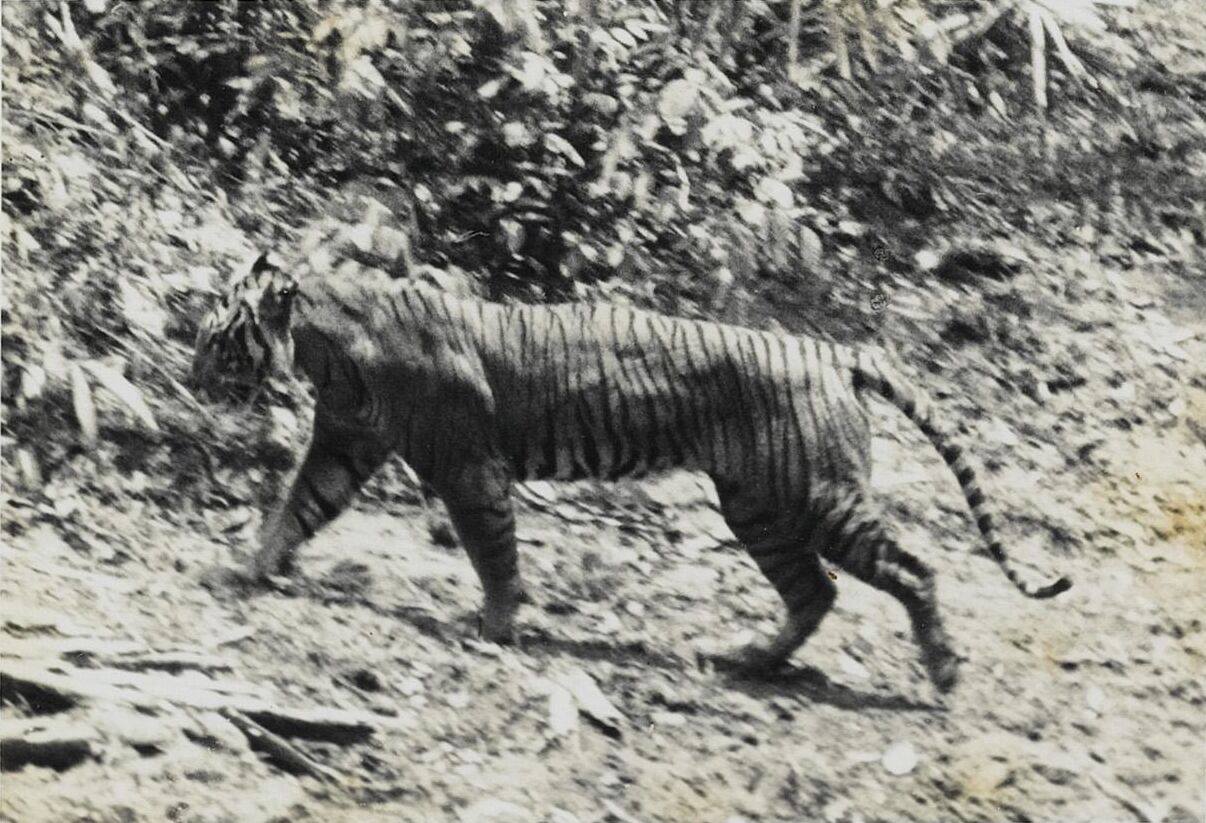
The stripes were long and thin, and slightly more numerous than a Sumatran tiger’s. The nose was long and narrow. A few Javan tigers were kept in Indonesian zoos until the Second World War. Very few photographs exist; the best known were taken by Andries Hoogerwerf at Ujung Kulon in 1938.
Where it sits in tiger taxonomy
The Javan tiger’s closest relatives were the Sumatran tiger and the Bali tiger. Tigers reached the Sunda islands when lower sea levels joined them to the mainland, and were cut off when the sea rose.
Under the IUCN Cat Specialist Group’s 2017 revision, mainland tigers are grouped as P. t. tigris and Sunda island tigers as P. t. sondaica. The Sunda group takes its name from the Javan tiger, for which sondaica was first used in 1844. On that scheme Java’s tigers were a population of the same subspecies that survives on Sumatra.
What is left on Java now
Java still has a big cat. The Javan leopard, Panthera pardus melas, lives only on this island and is the only large predator left on it. It is listed as Endangered, with an estimated 188 to 571 mature individuals. Meru Betiri, where the last tiger tracks were found, still holds leopards.
The leopard is smaller, needs less room and eats a wider range of prey, monkeys included. Our tiger vs leopard guide sets the two side by side.
Related reading
- Sumatran tiger: the last island tiger
- Tigers in Indonesia
- Tigers by country: where wild tigers live
- The six living tiger subspecies
Sources and further reading
- IUCN Red List: Panthera tigris
- Wirdateti et al., Is the Javan tiger extant? (Oryx, 2024)
- Sui et al., No reliable evidence supports the presence of the Javan tiger (Oryx)
- Khan et al., Reanalysis of sequences of alleged Javan tiger (Oryx)
- IUCN SSC Cat Specialist Group, revised felid taxonomy (2017)
Frequently asked questions
When did the Javan tiger go extinct?
The last confirmed record is tracks of three to five tigers found in Meru Betiri in 1976. Camera-trap surveys there in 1993 to 1994 and from 1999 found none, and the IUCN assessed the subspecies as extinct in 2008.
Why did the Javan tiger die out?
Java’s human population grew from about five million in 1800 to 85 million by 1975, and natural forest shrank to 8 percent of the island. Poisoning, a 1960s disease collapse in the rusa deer it hunted, and killing during the unrest after 1965 finished it.
Was a Javan tiger found in 2024?
No. A hair collected in West Java in 2019 was reported in 2024 as matching Javan tiger DNA, but two reanalyses found the sequences were not genuine mitochondrial DNA. The second, which included the original lead author, concluded the hair might be a tiger’s but the subspecies could not be confirmed.
How big was the Javan tiger?
Small. Males weighed 100 to 141 kg and females 75 to 115 kg, similar to the Sumatran tiger and well below mainland tigers.
What is the closest relative of the Javan tiger?
The Sumatran tiger, among living tigers. Under the IUCN Cat Specialist Group’s 2017 revision, mainland tigers are grouped as P. t. tigris and Sunda island tigers as P. t. sondaica. The two are placed in the same subspecies.
Photo: Panthera tigris sondaica by Andries Hoogerwerf, 1938. Public domain, via Wikimedia Commons.
Updated 13 September 2026: corrected Java’s population in 1976, its size, and the Javan leopard’s status.
Updated 15 November 2026: the 1976 record was tracks, not a sighting; corrected the survey history and population figures, and updated the 2024 hair sample with the two published reanalyses.