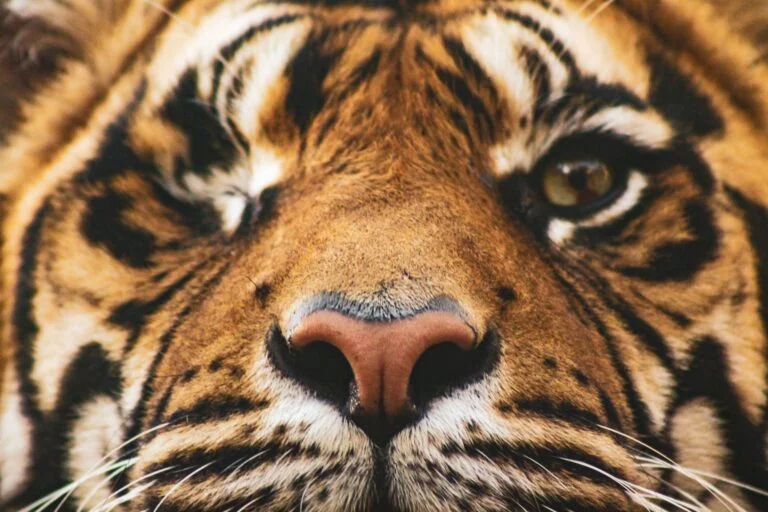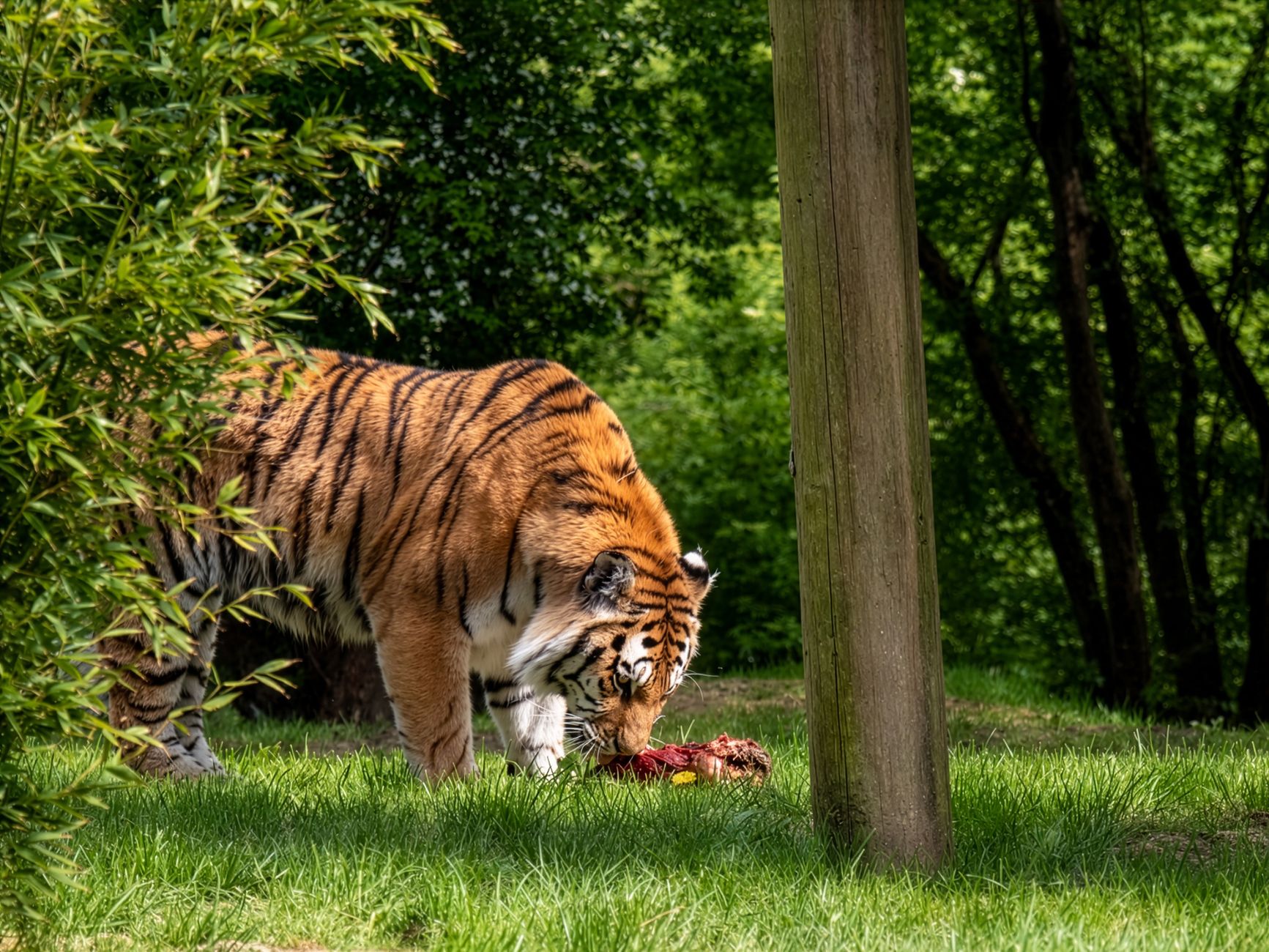
Ask what a tiger eats and most people say deer. That is right as far as it goes. Across Asia the menu runs from sambar down to porcupines and fish, and two studies from Nepal published in 2026 show how tigers choose from it. This page covers the main prey, how researchers find out what tigers have eaten, and what happens when prey runs short.
Big and medium hoofed animals do most of the work
Tigers feed mainly on large and medium-sized hoofed mammals. The Wikipedia species entry lists sambar deer, Manchurian wapiti, barasingha, gaur and wild boar as the core of the diet. No single tiger meets all of those, because the list spans forests from the Russian Far East to southern India. A 2012 review by Matt Hayward and colleagues, covering 3,187 kills and scats, found that tigers prefer prey of 60 to 250 kg, roughly a tiger’s own weight.
Size matters as much as species. Attacks on Asian elephants and Indian rhinoceroses have been reported, but they are occasional events rather than a diet, and the same entry says tigers more often take the more vulnerable calves.
The small stuff counts too
Tigers also take smaller animals when the chance comes up: monkeys, peafowl and other ground birds, porcupines and fish. They occasionally eat vegetation, fruit and minerals too, probably for fibre and supplements. None of this feeds a tiger for long. A porcupine is a snack, and a risky one, since wounds from the quills can kill.
Body size decides what is worth hunting. In Nagarhole National Park in southern India, Ullas Karanth and Mel Sunquist examined kills between 1986 and 1990 and found that the average tiger kill weighed 91.5 kg, against 37.6 kg for leopards and 43.4 kg for dholes (Asian wild dogs). Tiger kills leaned towards adult male chital, sambar and wild pig, and towards young gaur. The three predators share a forest by hunting prey of different sizes. For the two cats head to head, see our tiger vs leopard field guide.
What scat tells us about the real menu
Watching a tiger kill is rare, so researchers read what the animal leaves behind. A 2026 study in the journal Ecology and Evolution, by a team including researchers at Nepal’s Ministry of Forests and Environment and the University of Antwerp, collected 135 scats in Chitwan National Park and its buffer zone during the dry season of 2024. The team used DNA metabarcoding and microscopic hair analysis to identify first which animal had left each scat and then what it had eaten. DNA confirmed 81 of the scats as tiger. Thirteen were leopard.
Spotted deer (chital) dominated. In the national park they made up 60.98 percent of the prey occurrences in the DNA results, and in the buffer zone 80 percent. The park diet also included sambar, hog deer, wild boar, langur, mice and jungle fowl. That makes seven species in the park and only three in the buffer zone, where the diet was only deer. The authors read the wider list as a sign that the park offers more choice. The two methods did not agree with each other. By DNA, chital turned up in about 71 percent of all the scats. Under the microscope the figure was 37 percent, with more sambar and hog deer, and the authors used the DNA results for the rest of their analysis.
The study also checked for livestock. It found none in the scats it analysed. That is one dry-season sample from one area, so it does not prove tigers never kill cattle there. It does show that where wild prey is plentiful, wild prey is what ends up in the scat.
Tigers choose, they do not just eat what is common
The most common prey is not always the most preferred. The Chitwan team used Jacobs’ index, which compares how much of a prey animal ends up in the diet with how much of it is available. Hog deer came out as the most preferred prey, followed by wild boar, followed by spotted deer. The authors conclude that tigers favour medium-sized prey. That differs from the 2012 review, whose preferred band starts at 60 kg, nearly twice the 33 kg the study uses for a hog deer. The authors offer a local reason for passing over the heavier sambar: in Chitwan they are scattered and scarce, so they cost more effort to find.
A tiger also needs the prey to be there when it hunts. A five-year camera trap survey in Bardia National Park, which held 112 of the tigers in Nepal at the 2026 census, ran 50 cameras on a 1.4 km grid from May 2019 to April 2024. It found that tigers and sambar are active both day and night, while chital and muntjac peak at dawn and dusk and hog deer are mostly diurnal. Activity overlapped strongly between tigers and deer, which the authors link to the park’s high tiger density. Combined prey density there is about 90 animals per square kilometre, and chital is the most abundant. Our page on how camera traps count tigers explains the equipment, and how tigers hunt covers how a cat turns that overlap into a kill.
How much a tiger eats, and how often
Estimates of the most a tiger eats at one sitting run from 34 kg (the Smithsonian’s National Zoo) to 50 kg (George Schaller’s figure from Kanha), and 18 to 27 kg in a night is more typical. A large kill is not finished at once. The tiger drags the carcass into cover, usually no more than 183 m away, though 549 m has been recorded, and feeds on it over several days. Little is left for scavengers. A tiger’s teeth, claws and rasping tongue are built for stripping a carcass.
Depending on prey size, a tiger typically kills about once a week. Over a year a tigress needs to kill about 3,000 kg of prey, which works out at 5 to 6 kg of meat a day, and about half as much again when she has cubs. Estimates of hunting success range from 5 to 50 percent, so many hunts end with nothing. Our post on tiger cubs and family life covers what that means for a tigress feeding young.
When the prey runs out
Tigers do take livestock and dogs near settlements, and the Smithsonian’s National Zoo points to the cause. Rising agriculture and overgrazing drive away the typical prey and force tigers to hunt livestock. Wikipedia describes a similar pattern in Kui Buri National Park in Thailand, where a drop in prey numbers left tigers still killing their favoured prey while leopards and dholes ate more small animals.
A tiger population is only as secure as the deer and boar under it. Karanth and Nichols found in 1998 that tiger densities at four Indian sites followed prey densities, except at one site affected by poaching. Protecting prey therefore matters as much as stopping poaching and the illegal tiger trade. For how much ground one tiger needs, see our post on tiger territory and range.
What is still not known is how these local menus add up across the tiger’s range. The two 2026 studies cover two parks in Nepal, and the Chitwan sample is a single dry season. Diets differ from forest to forest.
Sources
- Tiger, Wikipedia
- Diet and Prey Preference of Tigers in and Around Chitwan National Park, Nepal, Ecology and Evolution (2026)
- Activity Patterns and Predator-Prey Temporal Overlap in the High Tiger-Density Area Bardia National Park, Nepal, Ecology and Evolution (2026)
- Tiger, Smithsonian’s National Zoo and Conservation Biology Institute
- Hayward, Jędrzejewski and Jędrzejewska (2012), Prey preferences of the tiger Panthera tigris, Journal of Zoology
- Karanth and Sunquist (1995), Prey selection by tiger, leopard and dhole in tropical forests, Journal of Animal Ecology
- Tiger fact sheet: diet and feeding, San Diego Zoo Wildlife Alliance
Seen a tiger kill, or read a diet study we missed? Add what you know in the comments.
Updated 15 November 2026: named the studies behind the kill weight and feeding figures, added the sample sizes and the disagreement between methods in the 2026 Chitwan study, and gave the range of published meal sizes.