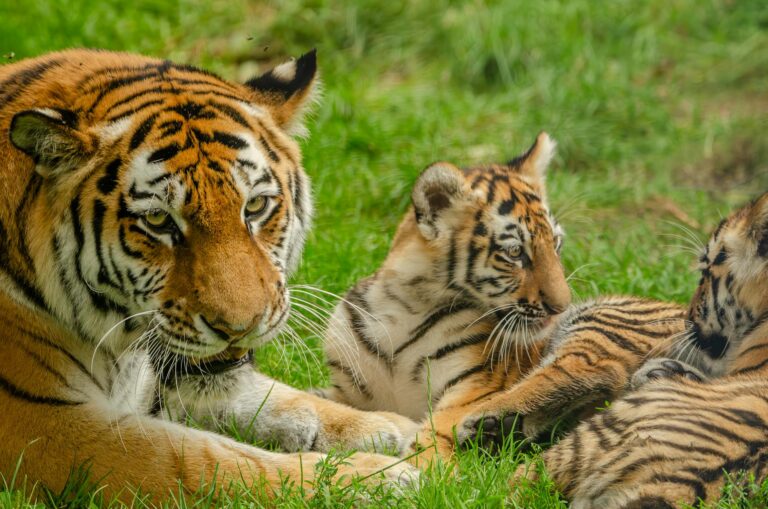
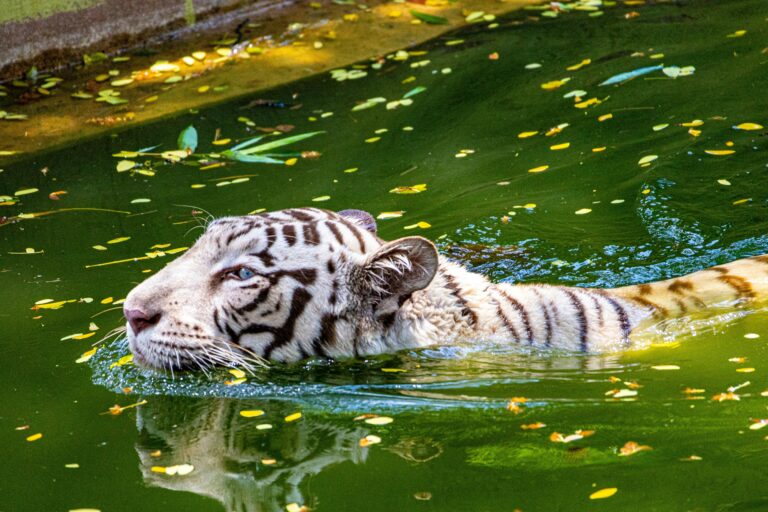
Orange fur with black stripes looks like the opposite of camouflage. A tiger in a zoo catches every eye. In the wild, the same coat helps a heavy ambush hunter get close to deer and wild boar. The stripes are also a personal marker, and in one Indian reserve they have broadened and merged in a way geneticists traced to a single gene variant.
This page sticks to what the published sources say and flags where the evidence is thin.
Why orange hides a tiger
The first clue is in the eyes of the animals tigers hunt. As Andrew Cushing of the University of Tennessee explained in The Conversation in 2020, deer and other hoofed animals cannot see the full range of colours, much like a colourblind human. They process green and blue but not red, so to them a tiger’s coat looks green and matches the background. The image he uses to show this comes from a 2019 paper by J. G. Fennell and colleagues in the Journal of the Royal Society Interface.
So an orange cat can vanish into green and brown cover as far as a deer is concerned. People see a wider range of colours than deer do, which makes us poor judges of tiger camouflage. Cats in general see colour less vividly than people, and our page on tiger senses covers what is known about the tiger’s own eyes.
What the stripes add
The stripes work on shape rather than colour. Cushing describes the vertical stripes, which range from brown to black, as an example of what biologists call disruptive coloration. Dark bars break up the outline of a large body, so it reads as light and shadow among tall grass and tree trunks instead of as one solid animal.
This suits the way tigers hunt. They are solitary and have to get close before the final rush, as described in How Tigers Hunt: Stalk, Ambush, Kill. A tiger that is seen early has lost its main advantage.
The pattern is not simply vertical everywhere. According to the Wikipedia entry on the tiger, the stripes are mostly vertical, but those on the limbs and forehead are horizontal. Stripe tips are generally sharp, and some split, or split and fuse again. Tail stripes are thick bands with a black tip at the end. The same entry notes the tiger is one of only a few striped cat species. Cushing adds that a tiger’s skin carries the same pattern as its fur.
Every tiger has its own pattern
Researchers rely on that variety. In a 2015 Scientific American blog, Arjun Srivathsa and Krithi Karanth, writing about the Wildlife Conservation Society’s work in India, said that every tiger has a unique stripe pattern that lets them identify each individual, and compared it to human fingerprints. The fingerprint comparison is a working assumption that nobody has tested on every tiger. Survey teams have shown something narrower and more useful, which is that the patterns differ enough for software and trained people to match photographs of the same animal taken at different times and angles. The two flanks of one tiger also differ, which is why survey cameras are set in facing pairs.
Tiger counts are built on it. In 2015 the same team was setting up more than 700 camera trap stations a year across 6,000 square kilometres of tiger habitat in India. Their image collection spanned two decades and almost 800 individual tigers. Pattern-matching software called ExtractCompare, developed by the British statistician Lex Hiby, shortlists the closest matches, and trained technicians make the final call. In a 2009 paper titled “A tiger cannot change its stripes”, Hiby and colleagues proposed using the same software to trace a seized skin back to photographs of the living tiger.
Surveys like this are how national figures such as those in How Many Wild Tigers Are Left? Country by Country get built, and our page on how camera traps count tigers explains the statistics. India’s 2022 national survey photographed 3,080 individual tigers.
When the stripes merge: the Similipal tigers
Stripe patterns also vary between populations. In Similipal Tiger Reserve in Odisha, many tigers have wide, merged stripes that make them look much darker. Researchers call this pseudomelanism. A 2021 paper in PNAS by Vinay Sagar and colleagues, including Christopher Kaelin, Meghana Natesh and Uma Ramakrishnan, reports that approximately 37% of the tigers in Similipal show it.
The team traced it to a gene called Taqpep. Among 12 Similipal tigers genotyped from non-invasive samples, the mutation (p.H454Y) had an allele frequency of 0.58, and it was absent from 395 tigers sampled elsewhere. The trait is recessive, so a cub needs a copy from both parents. Camera traps across the tiger’s range found wild pseudomelanistic tigers only in Similipal, which the authors describe as small and isolated. Their simulations fit founding events and genetic drift as the cause, and the low genetic diversity they measured points to inbreeding as well.
So the dark coat is a rare gene variant that became common because the population is small and cut off. Odisha has since tried to widen the gene pool. Two tigresses, Jamuna and Zeenat, were moved from Tadoba-Andhari in Maharashtra to Similipal in October and November 2024, when the reserve was reported to hold 27 tigers, 13 of them pseudomelanistic. In early June 2026 Zeenat was reported to have given birth to four cubs there. White tigers and golden tabby tigers are related stories: Wikipedia describes the white coat as an autosomal recessive trait that is overrepresented in captivity through inbreeding, as covered in why white tigers exist.
What we still do not know
The camouflage explanation rests on models of prey vision. Nobody has measured in a living forest how much sooner a deer spots a plain tiger than a striped one. Whether pseudomelanism helps or harms a Similipal tiger is also unknown. The 2021 paper explains how the variant became common and leaves open whether it matters to the animal. The identification work is on firmer ground, because survey teams test it every year.
If you have watched tigers in the wild or helped with camera trap work, add what you know in the comments.
Sources
- The Conversation: Why do tigers have stripes? (Andrew Cushing)
- Scientific American blog: Along the Tiger’s Trail, It’s All in the Stripes (WCS India)
- PNAS 2021: High frequency of an otherwise rare phenotype in a small and isolated tiger population
- Wikipedia: Tiger
- Fennell and colleagues (2019), Optimizing colour for camouflage and visibility using deep learning, Journal of the Royal Society Interface
- The Tribune, June 2026: Tigress Zeenat gives birth to four cubs in Similipal
Photo: Megaurab09, CC BY-SA 4.0, via commons.wikimedia.org.
Updated 15 November 2026: added the 2024 tigress translocations and the 2026 cubs at Similipal and the sample sizes behind the Taqpep figures, and qualified the claim that stripes are unique like fingerprints.