
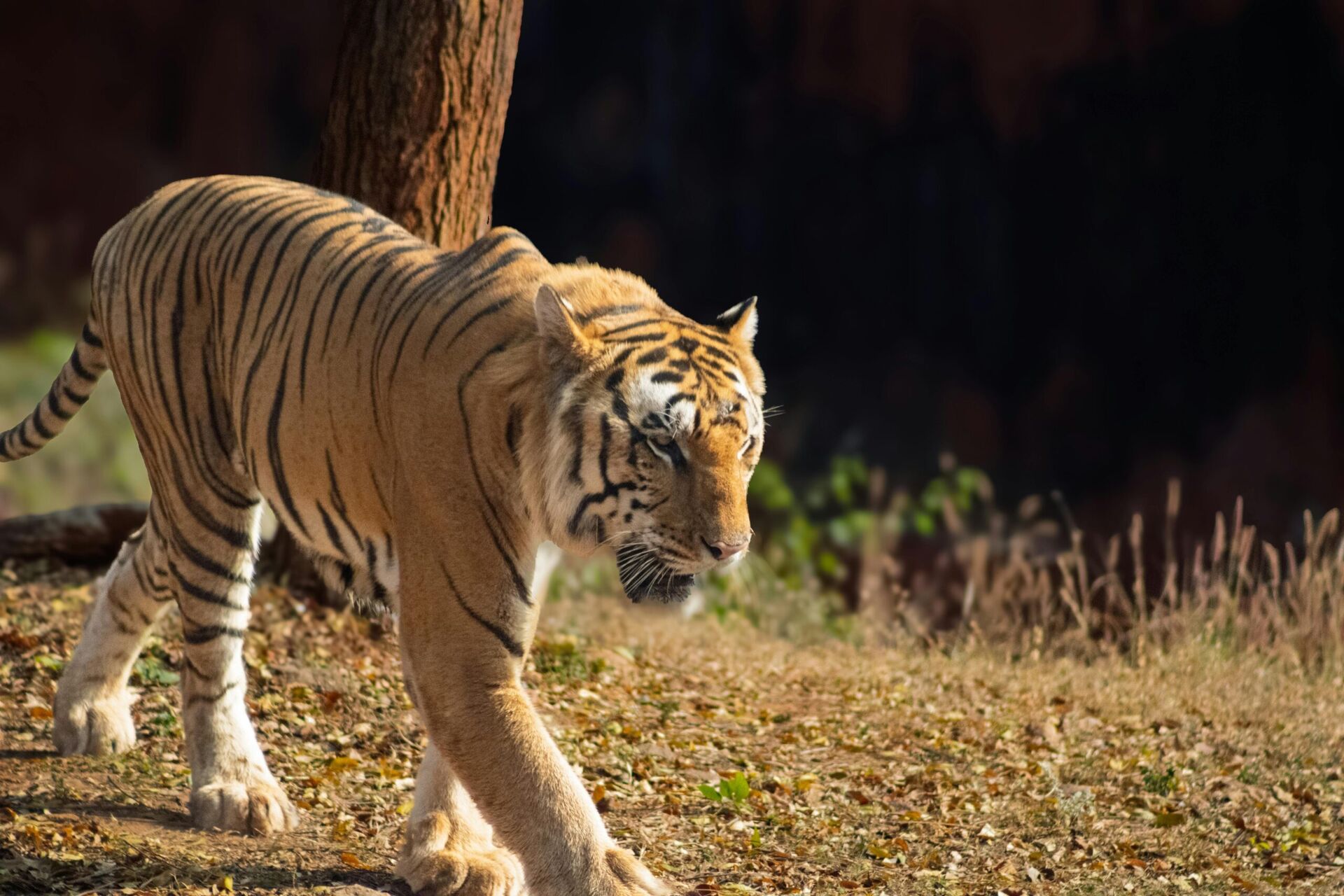
A wild tigress needs about 5 to 6 kg of meat a day and a male 6 to 7 kg, on Mel Sunquist’s 1981 estimates from Chitwan in Nepal. In practice that means killing a deer or a wild boar about once a week. Tigers manage it by stalking to close range and charging over a short distance, and most attempts fail.
The hunting cycle in three parts
A hunt has three parts: finding prey, stalking it and rushing it. Finding takes longest. A tiger walks its range along forest roads and trails, and of the tiger’s senses it is sight and hearing that do the searching, according to George Schaller’s 1967 study in Kanha. Smell plays little part. In hot weather a tiger may skip the walk and wait at a waterhole.
Then comes the stalk. The tiger crouches with its head low, creeps forward and freezes by turns, and uses whatever cover the ground offers. It has to get close: to within about 9 to 24 m according to the San Diego Zoo Wildlife Alliance’s summary of the field literature, or usually within 30 m in Wikipedia’s reading of the same sources. A stalk can be over in seconds. A tiger can also lie in one spot for most of a day and wait for prey to come to it.
The rush is short. A tiger can sprint at about 56 km/h, a figure that goes back to Schaller, but only briefly, and one that is seen early or outpaced gives up instead of chasing. It hits from behind or from the side, grips with its forelimbs and tries to pull the animal off its feet.
Success rate: roughly one hunt in ten
Nobody has a firm number. Schaller watched Kanha tigers make one kill in 12 attempts in the 1960s, which is a small sample. The University of Michigan’s Animal Diversity Web gives one success in 10 to 20 attacks. A 1977 study of Amur tigers by Matyushkin and colleagues put the kill rate below 30 percent, and Wikipedia, citing Mel Sunquist’s 2010 review, gives the spread of published estimates as 5 to 50 percent. None of these sources says how an attempt was defined, and that probably explains much of the spread. A stalk abandoned at 50 m leaves nothing for an observer to count.
A low strike rate is affordable because a kill is large. One sambar or boar feeds a tiger for several days, while a failed rush costs a few seconds of effort. Lions do better in company: in Schaller’s Serengeti study, lions hunting alone killed in 37 of 249 hunts (15 percent) and groups in 82 of 273 (30 percent). Our tiger vs lion comparison covers what else the pride changes.
The pressure is highest on mothers. A tigress with cubs needs about 50 percent more food than one without, on Sunquist’s figures, so she has to kill more often than the weekly average.
Prey selection and hunting hours
A 2012 review by Matt Hayward and colleagues pooled 3,187 kills and scats and found that tigers prefer prey weighing 60 to 250 kg, roughly their own weight. That band takes in sambar, wild boar, wapiti and barasingha. Chital, the commonest deer in many Indian and Nepalese forests, fall below it and are eaten in large numbers anyway, so what tigers eat in any one forest depends on what lives there. Adult gaur and buffalo are killed too, but tigers are sometimes injured or killed by them.
Tigers also choose within a species. In Nagarhole in southern India, where Ullas Karanth and Mel Sunquist examined kills between 1986 and 1990, tiger kills were biased towards adult males among chital, sambar and wild pig, and towards young animals among gaur. The average tiger kill there weighed 91.5 kg, against 37.6 kg for leopards and 43.4 kg for dholes.
There is no single hunting hour. Sunquist’s work in Chitwan concluded that tigers keep the hours their prey keeps, and camera-trap and collar studies since then show how much that varies from place to place.
| Where | Study | When tigers were most active |
|---|---|---|
| Chitwan, Nepal | Carter and colleagues, 2012 (camera traps) | More at night than by day, and away from places people use |
| Indian Sundarbans | Naha and colleagues, 2016 (six collared tigers) | 5 to 10 in the morning, peaking around 7 |
| Shuklaphanta, Nepal | Pokheral and Wegge, 2019 (three-year camera survey) | Dusk until midnight |
| North-east China | Yang and colleagues, 2019 (camera traps) | Dawn, dusk and night, matching their prey |
| Bardia, Nepal | Shrestha and colleagues, 2026 (five-year camera survey) | Day and night alike, in every season |
The killing bite
Tigers kill with one of two bites. Prey weighing less than about half the tiger’s own weight gets a bite to the back of the neck, where a canine is driven between the vertebrae to break the spinal cord. Larger prey gets a bite to the throat that crushes the windpipe. The throat hold takes longer but keeps the tiger clear of horns, antlers and hooves.
How long the canines are depends on who measured what. Published figures run from an average of about 5 cm in one museum study to 10 cm in general references, and our guide to tiger teeth, claws and paws sets the sources side by side. The bite force figures quoted online in pounds per square inch are not traceable to any measurement we could find. The published estimate, 1,234 newtons at the canine tips, was calculated from skulls by Per Christiansen in 2007.
The killing bite is seldom the first contact. The tiger has to bring the animal down first, and large prey is sometimes disabled with a bite to the back of the hock that cuts the tendon.
After the kill: dragging and feeding
Tigers move a kill into cover before feeding. Schaller found that carcasses were usually dragged no more than about 180 m, though one was moved nearly 550 m. The tiger rests, then starts on the hindquarters.
How much a tiger eats at a sitting is another figure that changes with the source. In Sunquist’s account 18 to 27 kg in a night is typical. The Smithsonian’s National Zoo gives up to 34 kg, Animal Diversity Web 40 kg, and Schaller’s upper figure, the one Wikipedia uses, is 50 kg. A large kill lasts several days, and the tiger stays close to it between meals.
Once cubs are eating meat, their mother takes them to her kills. A tigress tracked in Sikhote-Alin in the Russian Far East did this, and she also killed larger prey and returned to her den faster than she had before the cubs were born.
Why hunts fail
Most failures happen before the rush. If the prey spots the tiger before it is close enough, the tiger does not pursue it, on Schaller’s account. A chital that sees a tiger barks an alarm, and the rest of the herd is on watch at once.
Some prey fights back. Gaur, buffalo and wild boar sometimes injure or kill tigers. Sloth bears are the best documented case. Thomas Sharp and colleagues collected 43 videos and photographs of sloth bear and tiger encounters posted online between 2011 and 2023, mostly by tourists in Indian parks, and published the analysis in 2024. The bears typically stood up and charged. In 86 percent of the encounters there was no contact, and four ended with the bear dead. The authors note that dramatic encounters are the ones most likely to be filmed and posted.
A kill is not always the hunter’s alone. Male tigers sometimes share a carcass with the females and cubs in their range, and unlike male lions they let the others feed before they have finished, according to Schaller’s Kanha observations.
Related reading
Tiger-themed gear is sold at our paired store, store.welovetigers.org.
Frequently asked questions
What is a tiger’s hunting success rate?
Low, and not well measured. George Schaller saw one kill in 12 attempts in Kanha, Animal Diversity Web gives one in 10 to 20, and published estimates range from 5 to 50 percent.
How do tigers kill their prey?
With one of two bites: a throat bite that crushes the windpipe and asphyxiates the animal, or a nape bite that severs the spinal cord. The throat bite is used mainly on large prey, the nape bite on smaller prey.
How close does a tiger get before it attacks?
To within about 9 to 24 m by one summary of the field studies, and usually within 30 m by another. Tigers are sprinters and give up quickly if the prey gets a head start.
Do tigers hunt alone?
Yes, with rare exceptions. Tigresses with older cubs sometimes work together, particularly when teaching cubs to take large prey, but adult tigers do not form hunting groups.
What do tigers prefer to hunt?
Hoofed animals of roughly their own weight. A 2012 review found a preference for prey of 60 to 250 kg, such as sambar and wild boar. Smaller deer such as chital are still eaten in large numbers where they are common.
When do tigers hunt?
It depends on the place. Studies have found tigers most active at night in Chitwan, from dusk to midnight in Shuklaphanta, in the early morning in the Sundarbans and around the clock in Bardia.
How often do tigers eat?
A tiger typically kills about once a week and feeds on a large carcass over several days. Averaged out, that is about 5 to 6 kg of meat a day for a tigress and 6 to 7 kg for a male.
Photo: Jayesh Krishna Althi on Pexels.
Updated 13 September 2026: removed an unsupported claim about tides in the Sundarbans and aligned the FAQ with the text.
Updated 15 November 2026: corrected the hunting success sources (Schaller saw one kill in 12 attempts), the sloth bear study figures, the preferred prey weight and the activity times; removed timings and canine lengths that had no source.




Watched Dynasties with the kids at the weekend and wanted to know how often they actually catch something. One in ten!! That poor tigeress.
So basically a sprinter. Like my cat but 200 kilos heavier.
I always wondered why in some videos the tiger goes for the throat and in others the back of the neck. Is it just whatever it can reach?
Mostly it’s about size. Smaller prey usually gets the bite to the back of the neck, and big animals like sambar or gaur get held by the throat until they suffocate. Though I’m sure ‘whatever it can reach’ comes into it sometimes too.