
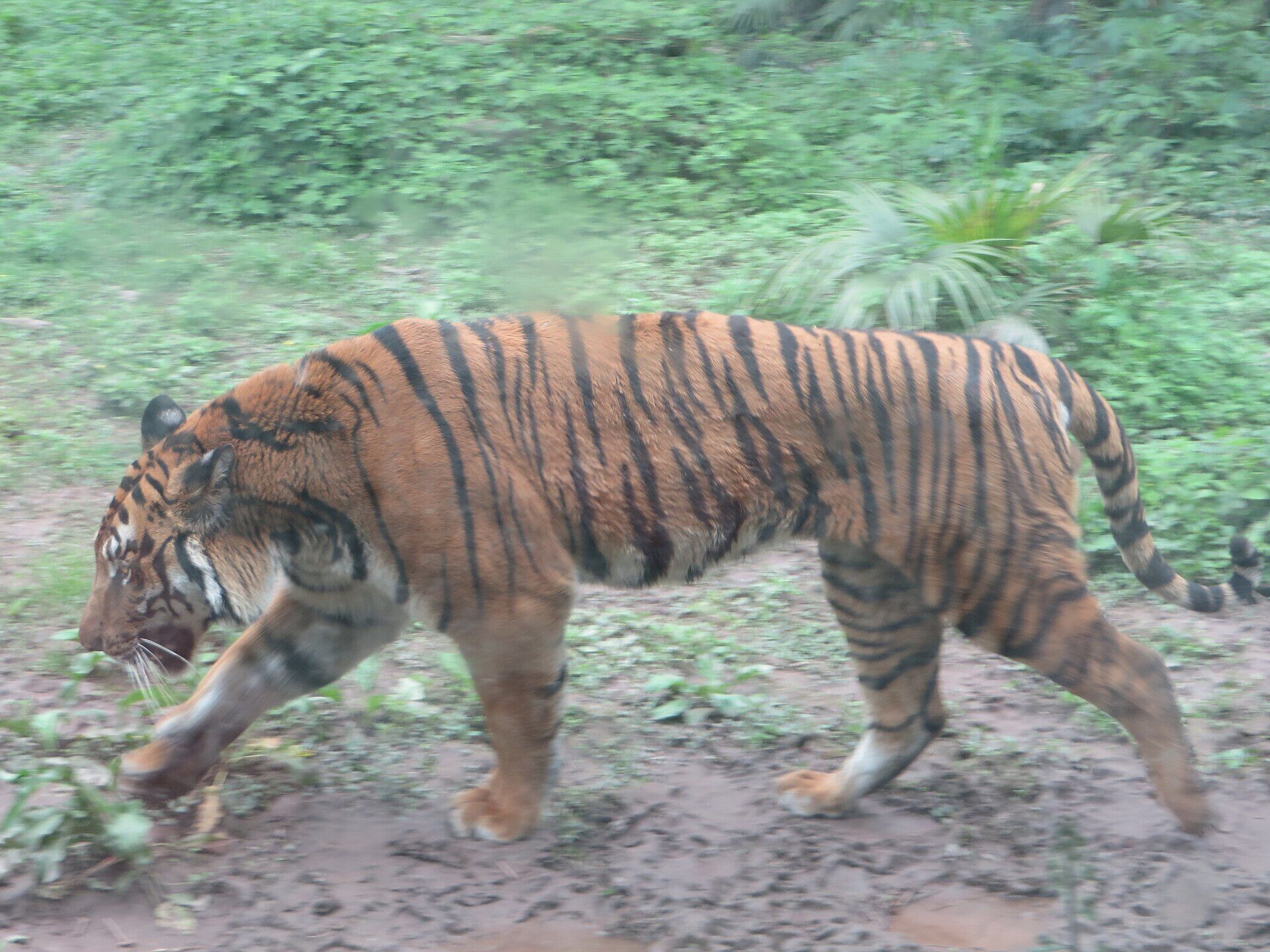
The South China tiger (Panthera tigris amoyensis) has not been seen in the wild since the 1970s. More than 4,000 were thought to be alive in the early 1950s. Today the subspecies survives only in captivity, about 250 animals, all descended from six tigers.
Key facts
| IUCN status | Critically Endangered (Possibly Extinct in the Wild), assessed in 2008 |
|---|---|
| Historical range | Southeastern and central China, across Fujian, Guangdong, Hunan, Jiangxi, Zhejiang and Guizhou |
| Wild population | None confirmed. Not directly observed since the 1970s, according to the IUCN; tracks and unconfirmed sightings were reported into the 1990s |
| Captive population | 247 in China at the end of October 2024, in zoos and breeding centres, plus a group in South Africa |
| Founder animals | Six tigers caught between 1958 and 1970: two males and four females |
| Adult weight (male) | 130 to 175 kg |
| Adult weight (female) | 100 to 115 kg |
How 4,000 tigers became none
The collapse was a matter of policy. During the anti-pest campaigns of the Great Leap Forward in the late 1950s the tiger was declared a pest and hunted. More than 3,000 were killed in the 1950s and 1960s, according to a 2010 review in the journal of the IUCN Cat Specialist Group.
From more than 4,000 in the early 1950s, the estimate fell to 150 to 200 by 1982. Protection arrived in stages: controlled hunting from 1973, a ban on hunting in 1977 and full protection in 1979. By then much of the forest of southern China had been cleared for farms and timber, and the deer and wild boar had gone with it. Our page on habitat loss and tiger survival covers the same process elsewhere.
When Ronald Tilson and Chinese colleagues reviewed the evidence in 1997, officials had not seen a wild tiger for 25 years, and the last one caught alive had been taken around 1970. A 1990 survey found possible tracks and scrapes in 11 reserves and no tiger. In 2001 a team checked eight reserves in five provinces, walked 288 km of trails and ran camera traps for 392 trap days, and found no evidence of tigers. The IUCN’s wording is that the subspecies “has not been directly observed in the wild since the 1970s and is possibly extinct”.
The photograph that was not a tiger
On 3 October 2007 Zhou Zhenglong, a farmer in Zhenping County in Shaanxi, produced 71 photographs of what he said was a wild South China tiger. The provincial forestry department published them and paid him a reward of 20,000 yuan.
Internet users noticed that the tiger was oddly glossy and never changed position between frames, then matched it to an old poster. Shaanxi admitted the pictures were fake in June 2008. Zhou was sentenced to two and a half years for fraud that September, suspended on appeal, and up to 13 officials were sacked or disciplined.
China’s State Forestry Administration had said in 2007 that there was no definite evidence the tiger still existed in the wild. Nothing since has changed that.
Six founders and the inbreeding problem
Eighteen South China tigers were caught and brought into zoos between 1955 and 1970. Only six of them bred: one female from Fujian, and two males and three females from Guizhou. Every captive South China tiger alive today descends from those six.
The cost shows in the studbook. A 1997 review found that 52 percent of cubs died in their first six months. The average inbreeding coefficient, 0.25 at that time, had risen to about 0.36 by 2016. A 2024 study reported the highest cub mortality and the smallest litters of any tiger subspecies.
The line is also not quite pure. A 2004 study found that three of five captive “South China” tigers it sampled were genetically Indochinese, and a 2019 study of 92 animals found traces of other tigers in 18. More recent genome work is less gloomy. A 2023 study of 29 genomes put the outside contribution at between 0.13 and 1.5 percent, and reported that the most harmful mutations had been purged and that genetic diversity was “not as low” as the pedigrees implied.
Whether it is a subspecies at all depends on the scheme. Under the IUCN Cat Specialist Group’s 2017 revision, mainland tigers are grouped as P. t. tigris and Sunda island tigers as P. t. sondaica. That makes the South China tiger a regional population. A 2018 whole-genome study found six distinct living groups, the South China tiger among them, but it had only one captive sample and called the animal’s origin unresolved.
What a South China tiger looks like
It was a mid-sized tiger. The usual published figures are 130 to 175 kg for males and 100 to 115 kg for females, smaller than a Bengal tiger and larger than a Sumatran.
Descriptions of the coat do not agree. Max Hilzheimer, who named the subspecies in 1905, described a lighter, more yellowish coat than the Bengal tiger’s, with narrower, sharper-edged stripes, and a skull with a shorter braincase and eyes set closer together. A charity that works on the subspecies describes the stripes the other way round: short, broad and spaced far apart. With no wild animals to check, and a captive population that carries some Indochinese ancestry, living tigers cannot settle it. Older texts also call it the most primitive living tiger. That rests on skull shape, and the 2018 genome study left the question open.
The South Africa rewilding project
In November 2002 the charity Save China’s Tigers, founded in Britain in 2000 by Li Quan and Stuart Bray, signed an agreement with China’s forestry authorities to prepare captive-born tigers for release in China by 2008. Its base was Laohu Valley Reserve, created that year from 17 defunct sheep farms near Philippolis in South Africa’s Free State. The first two cubs, Cathay and Hope, arrived in September 2003.
The idea was that zoo-bred tigers do not know how to hunt, and that South Africa had the space and the live prey to teach them. It worked as far as it went. The project reported that its tigers learned to hunt, and the first cub was born on the reserve on 23 November 2007.
No tiger has gone back to China. The 2008 date passed, and in 2013 ChinaFile reported that the forestry authorities had not been able to find a place to release them. The reserve held 18 South China tigers in the 2022 studbook. We could not find a reliable report on the project after that. Teaching a tiger to hunt was the smaller problem. A release site needs wild prey and room, and the forests the tiger left were emptied of deer as well.
The captive programme today
The studbook is kept at Chongqing Zoo, and the Chinese Association of Zoological Gardens has run the breeding programme since 1994. In October 2023 the animals were spread over 16 zoos and breeding centres in China and one site abroad. In the 2022 studbook the largest groups of purebred tigers were:
| Institution | Purebred South China tigers, 2022 studbook |
|---|---|
| Luoyang Wangcheng Park Zoo | 57 |
| Nanchang Zoo | 44 |
| Shanghai Zoo | 30 |
| Laohu Valley Reserve, South Africa | 18 |
| Hangzhou Wild Animal Park | 17 |
| Suzhou Zoo | 17 |
| Guangzhou Zoo | 14 |
The count has crept up: 236 purebred animals in 2023 and 247 in China at the end of October 2024. Pairing the least related animals slows the loss of genetic variety but cannot add any, because every pedigree leads back to the same six founders.
Release is still the stated aim. In June 2025 a 100-hectare rewilding base opened at Meihuashan in Fujian, which holds 34 tigers, to train animals for it. No tiger has yet been released.
Related reading
- The six living tiger subspecies
- Tigers in China
- Tigers in South Africa
- Tiger conservation: where we stand
Sources and further reading
- IUCN Red List: Panthera tigris
- IUCN SSC Cat Specialist Group, revised felid taxonomy (2017)
- Tilson and colleagues, Dramatic decline of wild South China tigers (Oryx, 2004)
- Zhang and colleagues, genetic survey of the captive South China tiger (Genes, 2024)
- Wang and colleagues, genomes of 29 South China tigers (BMC Biology, 2023)
- ChinaFile on the South Africa project (2013)
Frequently asked questions
Are South China tigers extinct?
Not entirely. No wild South China tiger has been directly observed since the 1970s, and the IUCN lists it as Critically Endangered (Possibly Extinct in the Wild). About 250 survive in captivity, almost all in China.
How many South China tigers are left?
There were 247 in captivity in China at the end of October 2024, plus a group in South Africa that numbered 18 in 2022. All descend from six wild-caught founders.
Why did the South China tiger die out?
It was declared a pest during the Great Leap Forward in the late 1950s and hunted, with more than 3,000 killed in the 1950s and 1960s, while its forests and prey were cleared. Hunting was banned in 1977, by which time few were left.
Could South China tigers be returned to the wild?
Not yet. Captive-born tigers have learned to hunt in South Africa, and a rewilding base opened in Fujian in June 2025, but no tiger has been released in China.
Is the South China tiger a real subspecies?
By the traditional count, yes. Under the IUCN Cat Specialist Group’s 2017 revision, mainland tigers are grouped as P. t. tigris and Sunda island tigers as P. t. sondaica. A 2018 whole-genome study supported six living subspecies including the South China tiger, on the evidence of one captive sample.
Photo: South China tiger, Chongqing Zoo by Jpbowen, CC BY-SA 4.0, via Wikimedia Commons.
Updated 13 September 2026: corrected the 2018 genetic finding.
Updated 15 November 2026: corrected the captive count (247, October 2024), the decline timeline, the hoax details, the founder records and the holding institutions, and added recent genetic findings and the 2025 rewilding base.




I remember the Zhou Zhenglong photo! It was huge news in China in 2007, everyone was arguing online if it’s real or not. Then somebody found the same tiger on a New Year poster at home. People called him 周老虎 (Tiger Zhou) and it was a big joke online for a long time.