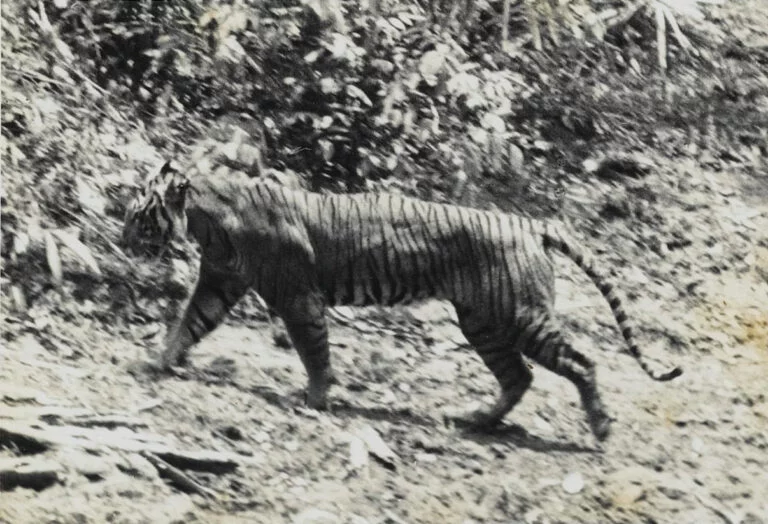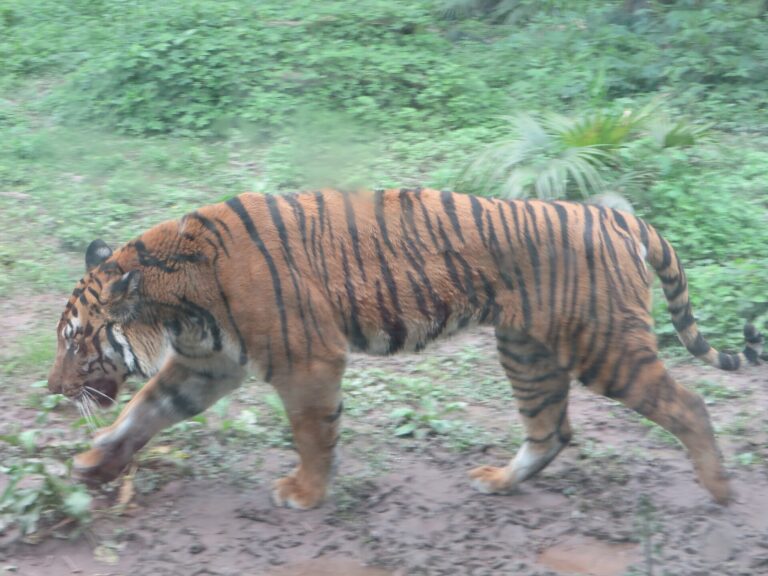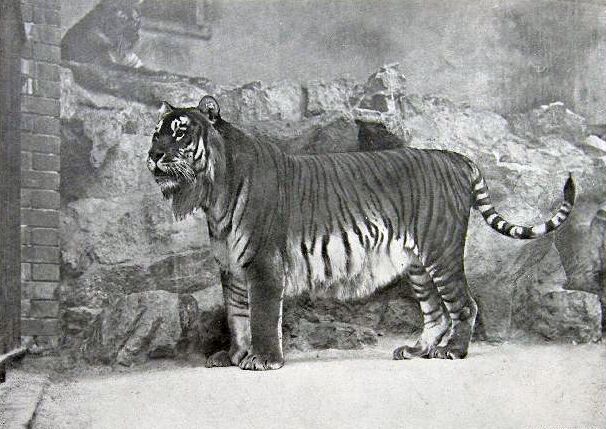
The Caspian tiger (Panthera tigris virgata) ranged from Turkey to western China and was gone by the 1970s. In 2009 genetics showed it was all but identical to the Amur tiger, and that finding is why Amur tigers are being released in Kazakhstan today.
Key facts
| IUCN status | Extinct (assessed in 2003). The last widely accepted record is a tiger killed in eastern Turkey in 1970. |
|---|---|
| Also called | Turan tiger, Hyrcanian tiger, Mazandaran tiger |
| Historical range | Turkey, Iran, Iraq, the Caucasus, Turkmenistan, Uzbekistan, Kazakhstan, Afghanistan and western China |
| Habitat | Tugay riparian forest and reed beds along the Amu Darya, Syr Darya, Ili, Atrek and Tarim rivers, not open desert |
| Adult weight (male) | Around 170 to 240 kg in historical records |
| Genetic status | Nearly identical to the Amur tiger: their main mitochondrial DNA types differ by a single change. The two separated less than 10,000 years ago. |
| Reintroduction | Ile-Balkhash State Nature Reserve, Kazakhstan. Two captive Amur tigers arrived in September 2024; wild Amur tigers were released on 31 July and 31 October 2026. |
A river cat, not a desert cat
The Caspian tiger lived in dry country but not in desert. Its habitat was tugay, the dense belts of poplar, willow, tamarisk and tall reeds that line the rivers of Central Asia. Those belts held wild boar and Bukhara deer, and the tigers stayed in them.
That explains both the range and the weakness. A population strung along river valleys is long and thin. When the valleys were cleared for farming there was nowhere else for it to go.
How it was exterminated
The decline began with the Russian colonisation of Turkestan in the late 19th century. Until the early 20th century the regular army was used to clear tigers and other predators from forests, settlements and land wanted for farming. About 50 tigers a year were killed along the Amu Darya and Pyanj rivers until the First World War, and bounties were paid for skins up to 1929.
Farming did the rest. By 1910 cotton covered nearly a fifth of Turkestan’s arable land, and the river forests were cleared to make room. Wild boar and deer were hunted out as the human population along the rivers grew, and a tiger population without prey does not last.
The tiger went out in pieces, country by country, so there is no single extinction date. The last records usually cited are:
| Where | Last record | Detail |
|---|---|---|
| Iraq | 1887 | Killed near Mosul |
| Georgia | 1922 | Killed near Tbilisi |
| China (Xinjiang) | 1920s | Gone from the Tarim basin; reported from the Manas basin until the 1960s |
| Kazakhstan | 1948 | Ili river, south of Lake Balkhash |
| Turkmenistan | 1954 | Killed in the Sumbar valley in the Kopet Dag |
| Tajikistan | 1958 | Seen in Tigrovaya Balka reserve |
| Iran | 1959 | Killed in what is now Golestan National Park; unconfirmed reports into the 1970s |
| Uzbekistan | 1968 | Unconfirmed sighting near Nukus on the lower Amu Darya |
| Turkey | 1970 | Killed near Uludere in the southeast; skins turned up there in the early 1970s |
The dates come from the standard Soviet-era reference, Heptner and Sludskii’s Mammals of the Soviet Union, and later country reviews. Several rest on a single report. A questionnaire survey in southeast Turkey suggested a few tigers were still being killed there into the 1980s, which has never been confirmed. The IUCN assessed the Caspian tiger as extinct in 2003.
The genetic surprise
In 2009 a team led by Carlos Driscoll sequenced mitochondrial DNA from museum specimens of Caspian tigers collected between 1877 and 1951 and compared it with living tigers. The main Caspian type differed from the single type found in all modern Amur tigers by one nucleotide.
The paper’s explanation is a recent journey. Less than 10,000 years ago tigers moved from eastern China through the Gansu corridor, the route the Silk Road later followed, into Central Asia. Some then spread east across Siberia and became the Amur tiger of the Russian Far East. The two had little time to grow apart.
Under the IUCN Cat Specialist Group’s 2017 revision, mainland tigers are grouped as P. t. tigris and Sunda island tigers as P. t. sondaica. On that scheme the Caspian tiger was never a separate subspecies but a lost western population of the mainland tiger.
Which is why Kazakhstan can bring it back
If the Caspian tiger had been a distinct lineage, its extinction would be final. Because the Amur tiger is so close to it, Kazakhstan can put Amur tigers where Caspian tigers lived.
Kazakhstan announced the plan in 2010 and created the Ile-Balkhash State Nature Reserve in 2018 on the Ili delta and the southern shore of Lake Balkhash, where the country’s last tiger was recorded in 1948. Prey came first, because a tiger needs to kill a deer or a wild boar about once a week (see what tigers eat). Between 2018 and 2024 the reserve released 205 Bukhara deer and moved in more than 100 kulan, a wild ass, and it has been restoring the riverside forest.
Two captive Amur tigers, Bogdana and Kuma, arrived from the Netherlands in September 2024. They live in an enclosure for breeding and will not be released themselves. In May 2026 four wild tigers caught in Russia’s Khabarovsk region were flown in: an adult female, an adult male and two cubs of six to seven months. The female, Umit, was released with a satellite collar on 31 July 2026, the first tiger at large in Kazakhstan since 1948. The male, named Amur, followed on 31 October, by which time the ecology ministry said Umit was hunting for herself. The cubs, Turan and Ussuri, stay in enclosures until they are at least 18 months old. The stated aim is about 50 wild tigers by 2035. Our page on tigers in Kazakhstan follows the releases.
What it looked like
It was a large tiger. Males are reported at 170 to 240 kg, and the top figures come from 19th century hunting accounts that cannot be checked.
Photographs of skins suggest the coat was generally brighter and more evenly coloured than an Amur tiger’s. Museum skins and a small number of photographs of captive animals are most of what remains. One captive tigress, caught in northern Iran and kept from 1924 to 1942, supplied DNA for the 2009 study.
Hyrcanian tigers and Rome
Roman writers knew this animal as the Hyrcanian tiger, after Hyrcania, the forested southern shore of the Caspian in what is now northern Iran. Pliny called the tiger a native of Hyrcania and India, and Virgil and later poets used Hyrcanian tigers as a stock image of ferocity.
The first tigers Romans are recorded as seeing came from the other direction. According to Cassius Dio, an embassy from India presented tigers to Augustus on Samos around 20 BC. Pliny says Augustus was the first to show a tame tiger in Rome, at the dedication of the Theatre of Marcellus in 11 BC, and that Claudius later showed four. Whether the tigers that reached the arena after that were Indian or Caspian, the sources do not say. Unlike lions, they were always rare; our page on how tigers and lions differ has more on the two cats.
Related reading
Sources and further reading
- Driscoll et al., mitochondrial phylogeography of the Caspian tiger (2009)
- WWF, After 70 years, tigers return to Kazakhstan (2025)
- Mongabay, Kazakhstan releases first tiger into the wild in 70 years (August 2026)
- IUCN SSC Cat Specialist Group, revised felid taxonomy (2017)
Frequently asked questions
When did the Caspian tiger go extinct?
In stages through the 20th century. Kazakhstan’s last was recorded in 1948, Turkmenistan’s in 1954 and Iran’s in 1959, and a tiger killed in eastern Turkey in 1970 is the last widely accepted record. The IUCN assessed it as extinct in 2003.
Is the Caspian tiger the same as the Amur tiger?
Very nearly. Their main mitochondrial DNA types differ by one nucleotide, and the two separated less than 10,000 years ago. Under the IUCN Cat Specialist Group’s 2017 revision, mainland tigers are grouped as P. t. tigris and Sunda island tigers as P. t. sondaica. Both fall in the same subspecies on that scheme.
Are tigers being brought back to Kazakhstan?
Yes. The Ile-Balkhash reserve was created in 2018 and prey was restored first. Two captive Amur tigers arrived in September 2024 and four wild ones from Russia in May 2026. A female was released on 31 July 2026 and a male on 31 October 2026. The aim is about 50 wild tigers by 2035.
How big was the Caspian tiger?
Large. Males are reported at 170 to 240 kg, though the top figures come from hunting accounts.
Where did Caspian tigers live?
In riparian tugay forest and reed beds along Central Asian rivers, from Turkey and Iran through the Caucasus and Central Asia into western China. They were not desert animals.
Photo: Panthera tigris virgata, photographer unknown, circa 1895. Public domain, via Wikimedia Commons.
Updated 13 September 2026: added the 2026 Kazakhstan release and corrected the migration route and Roman tiger history.
Updated 15 November 2026: added dated last records by country, the second Kazakhstan release (31 October 2026) and the 2035 target, and corrected the Roman history and the account of the tiger’s extermination.