

The Sumatran tiger (Panthera tigris sumatrae) is the smallest living tiger and the only one left on an island. Tigers also lived on Java and Bali until the twentieth century.
Key facts
| IUCN status | Critically Endangered (assessed 2008). Since 2022 the IUCN has assessed the tiger only as a species, as Endangered |
|---|---|
| Range | Sumatra, Indonesia, in remaining lowland and montane forest on the island |
| Estimated wild population | No agreed figure. The range most often quoted is 400 to 600; the published estimates are compared in the table below |
| Adult weight (male) | 100 to 140 kg (Mazák 1981) |
| Adult weight (female) | 75 to 110 kg (Mazák 1981) |
| Lifespan in the wild | 10 to 15 years |
| Diet | Wild boar, sambar and muntjac; also tapir and pig-tailed macaque |
| Main threats | Forest conversion (palm oil, pulp), poaching, snares, road-cuts |
The last of the Sunda tigers
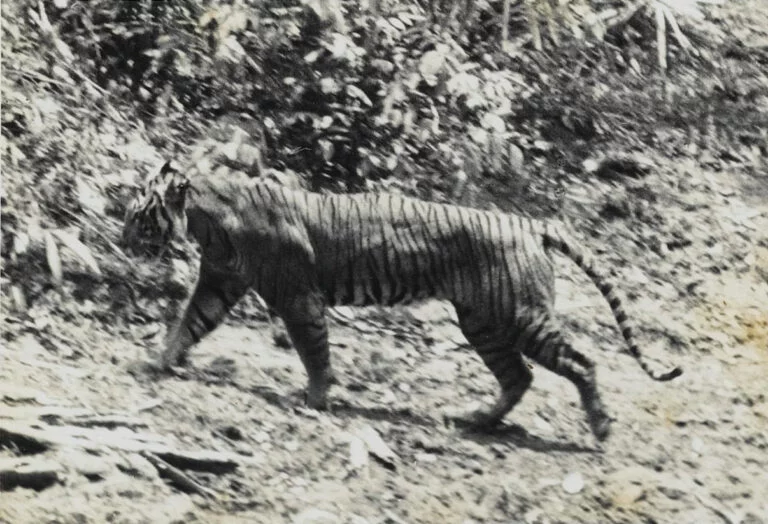
Tigers reached Sumatra, Java and Bali when lower seas joined the islands to the mainland, and were cut off when the sea rose again. The Bali tiger was last confirmed in 1937. The Javan tiger was last confirmed, from tracks, in 1976 and was assessed as Extinct on the IUCN Red List in 2008. The IUCN Cat Specialist Group’s 2017 revision groups all three in a single subspecies, Panthera tigris sondaica, with Sumatran tigers the only living population. The 2018 genome study that the IUCN’s 2022 assessment follows keeps sumatrae as a subspecies of its own.
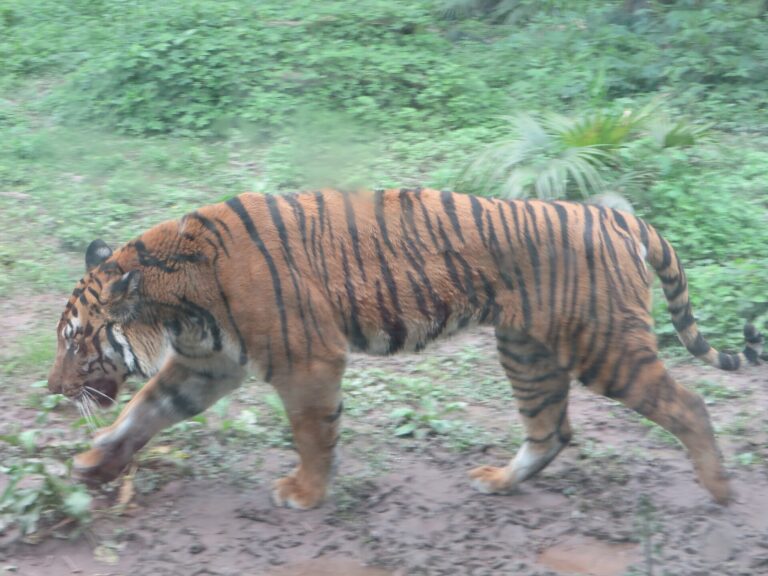
A 1998 genetic study put the isolation of Sumatra’s tigers at between 6,000 and 12,000 years ago. They are darker than mainland tigers, with closer-set stripes and a heavy ruff around the cheeks that is more obvious in males. What the stripes are for is a separate question, covered in why tigers have stripes.
Males weigh 100 to 140 kg and females 75 to 110 kg. At about 120 kg, an average male is roughly two thirds the weight of a modern wild Amur male, which averages about 176 kg. The usual explanation is island dwarfing. We have not found a study that tests it for this tiger.
Range: a shrinking patchwork of Sumatran forest
Sumatran tigers occupy separate forest blocks across the island. The largest populations are in Gunung Leuser National Park in the north, Kerinci Seblat National Park in the central Barisan Mountains, and Bukit Barisan Selatan National Park in the south. Smaller ones are in Berbak-Sembilang and Way Kambas. The parks, and what Indonesia is doing in them, are covered on our page on tigers in Indonesia.
The first island-wide survey, walked between 2007 and 2009, estimated that tigers occupied 72 percent of the forest grid cells it covered (Wibisono and colleagues, 2011), so they were still widely spread. What has changed is how the forest is divided. A 2017 study estimated that only two blocks, Leuser and Kerinci Seblat, could each still hold more than 30 breeding females (Luskin and colleagues). Our page on habitat loss and tiger survival has a section on Sumatra and palm oil.
Home ranges vary with the forest. In the southern lowlands, females used 50 to 70 sq km and a male about 110 (Franklin and colleagues, 1999). In the Leuser mountains, three males used 180, 274 and 380 sq km, more at higher elevation (Griffiths, 1994). Our page on tiger territory and range compares these with other tigers.
Population: five figures and no count
Be careful with the numbers you see quoted for this animal, including ours. None of them is a count. The last survey to cover the island on foot, published by Wibisono and colleagues in 2011, walked 13,511 kilometres of transects between 2007 and 2009 and measured where tigers were, not how many. Every island-wide number since has been modelled: tiger densities from camera traps at a sample of sites, multiplied across the forest that remains. Our page on how camera traps count wild tigers explains the first half of that. A second island-wide survey had covered 657 of its 721 grid cells by 2023, the minister said in March 2024, and its island-wide results have not been published.
| Figure | What it is | Source |
|---|---|---|
| 400 to 600 | The range most often quoted by the environment ministry and conservation groups | No single source |
| 742 (give or take 348) for 2000; 618 (give or take 290) for 2012 | Modelled from forest cover and camera trap densities; a fall of 16.6 percent | Luskin and colleagues, 2017 |
| 568 adults | Population viability analysis covering 23 of 29 tiger landscapes | Pusparini and colleagues, 2019, as cited by the IUCN |
| 439 (192 to 996) for 2008; 393 (173 to 883) for 2017 | Camera trap densities applied to forest cover and the share of it tigers occupy | IUCN Red List assessment, 2022 |
| About 586 adults | Ministry figure from 2013 to 2019 data, given by the minister on 6 March 2024 | ANTARA |
Park figures are firmer and still disagree. A Kerinci Seblat park official put its population at 150 to 180 in July 2024, from camera traps plus track, scat and scratch identification. Fauna and Flora’s surveys of 2019 to 2020 gave 128 in the landscape, 119 of them resident in the park. In the Leuser Ecosystem, a camera trap study published in December 2025 identified 27 individual tigers in its study area, at 1.42 to 2.35 per 100 sq km (Figel and colleagues).
Swimming and the webbed feet claim
One claim about this animal is repeated everywhere: that Sumatran tigers have more webbing between the toes than other tigers. We have not found a peer-reviewed measurement behind it. It appears on zoo and charity pages and seems to have spread from one to the next, so treat it as unconfirmed. They do swim, as all tigers do, and they use the swamp forest of Berbak and the rivers of central Sumatra. Our page on whether tigers can swim covers the Sundarbans tigers, which have the stronger claim to a life in water.
Threats: forest loss, snares and a pig disease
The main threat is the conversion of forest to oil palm and to acacia plantations for pulp. Riau is the clearest case. Its mainland lost 65 percent of its forest between 1982 and 2007, and WWF’s estimate of the province’s tigers fell from 640 to 192 over the same years. Plantation roads also let hunters reach forest they could not reach before.
Wire and cable snares set for deer, wild pig and serow also catch tigers, and poachers set others for tigers directly. Patrol results from Kerinci Seblat and recent prosecutions are on the Indonesia page linked above.
A newer problem is food. The IUCN describes wild boar as the principal prey of Sumatran tigers, and African swine fever has been killing wild pigs on the island. In Kerinci Seblat in 2022, 34 camera stations running for nine months recorded no wild pigs at all, according to Fauna and Flora. What that does to tigers has not been measured. Officials have speculated that it pushes hungry tigers towards villages.
Breeding, zoos and releases
We found nothing that sets Sumatran tigers apart in breeding. As with other tigers, females first breed at about three to four years and, while they hold a territory, raise a litter of two to four cubs every two to three years. Figures for how many cubs a wild Sumatran tigress raises in her lifetime circulate widely, and this page used to give some. We could not find a published source for them and have removed them.
Zoos hold a managed population under the Sumatran Tiger Global Species Management Plan, which the World Association of Zoos and Aquariums approved in 2008. No zoo-bred Sumatran tiger has been released, as far as we could find. The releases that have happened involved wild-caught or sanctuary-born animals. The Tambling Wildlife Nature Conservation reserve, at the southern tip of Bukit Barisan Selatan, had released five tigers captured after conflict with people by 2015. In June 2022 two tigers born at the Barumun sanctuary to parents injured by snares were released in Kerinci Seblat. One of them, Citra Kartini, was found dead the following month.
Related reading
Sources and further reading
- IUCN Red List entry for Panthera tigris
- Fauna and Flora International on the Sumatran tiger
- Wibisono and colleagues (2011), PLOS ONE, the first island-wide survey
- Luskin and colleagues (2017), Nature Communications, on forest loss and tiger numbers from 2000 to 2012
Frequently asked questions
How many Sumatran tigers are left in the wild?
Nobody knows precisely. The range most often quoted is 400 to 600. The IUCN’s 2022 assessment modelled 393 (range 173 to 883), and Indonesia’s environment minister cited about 586 adults in March 2024. None of these is a count.
Why is the Sumatran tiger critically endangered?
Forest loss to oil palm and pulp plantations, snares, and poaching for body parts. The IUCN assessed the Sumatran tiger as Critically Endangered in 2008.
Are Sumatran tigers smaller than other tigers?
Yes. Adult males weigh 100 to 140 kg, about two thirds the weight of a modern wild male Amur tiger. Island dwarfing is the usual explanation.
Can Sumatran tigers swim?
Yes. All tigers swim, and Sumatran tigers use rivers and swamp forest readily. The often-repeated claim that they have more webbing between their toes than other tigers does not appear to have a peer-reviewed source, so we would not lean on it. The Sundarbans Bengal tigers are the closest comparison for genuinely water-adapted behaviour.
Where do Sumatran tigers live?
Only on the island of Sumatra in Indonesia. The largest populations are in Gunung Leuser, Kerinci Seblat, and Bukit Barisan Selatan National Parks. Smaller groups live in Berbak-Sembilang and Way Kambas.
What is the scientific name of the Sumatran tiger?
Panthera tigris sumatrae. Under the IUCN Cat Specialist Group’s 2017 revision, mainland tigers are grouped as P. t. tigris and Sunda island tigers as P. t. sondaica. That grouping puts the Sumatran tiger with the extinct Javan and Bali tigers.
Did Sumatran tigers split from other tigers recently?
A 1998 genetic study dated their isolation to between 6,000 and 12,000 years ago, when rising seas cut Sumatra off from the mainland.
What do Sumatran tigers eat?
Wild boar, sambar and muntjac, and also tapir and pig-tailed macaque. The IUCN describes wild boar as the principal prey, which is why the African swine fever outbreak among Sumatra’s wild pigs matters.
Photo: Petra Ryan on Pexels.
Updated 13 September 2026: corrected the Javan tiger extinction listing, when Sumatra was cut off, and the weight comparison.
Updated 15 November 2026: corrected the diet (no source for orangutan), the home range figures, the claim that no captive-bred tiger has been released, and the Javan tiger record; removed unsourced breeding numbers and the store claim; added a dated table of population estimates.


I am from Pekanbaru, Riau. Thank you for writing about sawit in a fair way. Usually foreign articles only blame the palm oil or they don’t mention it at all. The truth is many families here depend on it, my uncle also. But yes the forest I remember from when I was a child is gone now.
Why is the range so wide, 400 to 600? Has nobody counted properly? Sorry if I missed it in the article.
Not a daft question at all. It’s mainly that nobody has surveyed the whole island in one go. Sumatra is huge and the forest is in pieces, so the total gets put together from surveys done in different places in different years. Some of those are getting old now.
Always the snares. A piece of wire that costs nothing.