
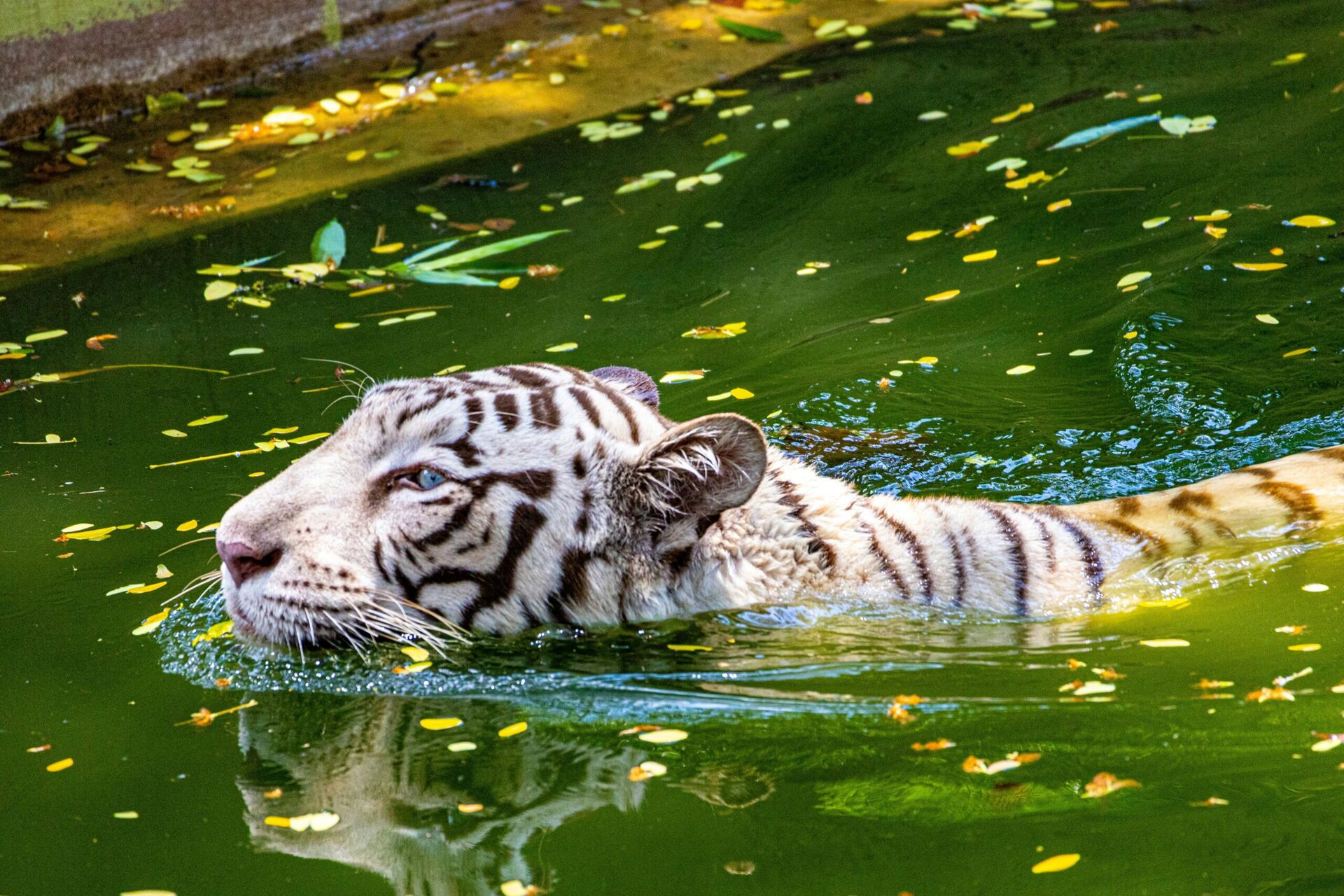
Tigers swim, and they do it by choice. They cross rivers, lie in pools to cool off, and in the mangrove delta of the Sundarbans they swim between islands several times a day. Among big cats only the jaguar is as much at home in water. The tracking data supports much shorter swims than the figures usually quoted, and this page sets the two side by side.
Yes, tigers swim. Most big cats can.
Of the five Panthera species, tigers, jaguars and leopards swim well. Lions can swim but mostly avoid it, and the lions of Botswana’s Okavango Delta, which cross flooded channels regularly, are known for being unusual. Snow leopards rarely meet open water. We found no field study of when wild tiger cubs first swim, so the ages quoted online come without a source.
Much of the tiger’s range has water running through it, from the Amur to the Brahmaputra to the tidal channels of the Sundarbans, and tigers cross it. The University of Michigan’s Animal Diversity Web puts it flatly: water does not usually act as a barrier to their movement.
How far they swim is less clear. The reference works give large numbers with thin sourcing, and the one study that tracked swimming tigers gives small ones.
| Claim | Where it comes from | Basis |
|---|---|---|
| Crosses rivers 6 to 8 km wide | Mazák’s 1981 species account, repeated by Wikipedia, the Smithsonian’s National Zoo and the San Diego Zoo Wildlife Alliance | Reference work, no tracked animal |
| Seen 11 km out to sea | Valmik Thapar (2004), cited by the San Diego Zoo Wildlife Alliance | Observation |
| Known to cross 29 km of water | Animal Diversity Web (2007) | No source given |
| Channels crossed averaged 54 m, and the longest crossing was 800 m | Naha and colleagues (2016), collared tigers in the Indian Sundarbans | Tracking data |
The Sundarbans: the only mangrove tigers on Earth
The Sundarbans, where the Ganges and Brahmaputra meet the sea across the India and Bangladesh border, is the largest single block of mangrove forest in the world. Roughly 100 tigers were camera-trapped on the Indian side in the 2022 All India Tiger Estimation, up from 88 in 2018, and the 2023 to 2024 survey of tigers in Bangladesh counted 125 adults on its side, up from 114 in 2018.
GPS-collar work on the Indian side, published by Naha and colleagues in 2016, is the closest thing to a measurement of how these tigers use water. Six tigers, three of each sex, were collared between 2008 and 2014. They crossed an average of five channels a day, counting only channels more than 30 m across, and the mean width was 54 m. Channels wider than 400 m were seldom crossed, and only two of the six tigers were recorded doing it. The longest crossing in the study was by a male that swam the 800 m Harinbhanga River in June 2010 and settled on Talpatti island on the Bangladesh side. The authors’ reading is that tigers prefer not to cross wide water but that it does not stop them dispersing.
The same study found no effect of tide on how far the tigers moved, which does not fit the popular idea that Sundarbans tigers live by the tide table. Activity peaked between five and ten in the morning, with a spike around seven, which overlaps with the hours people are in the forest. Home ranges averaged about 56 square kilometres for females and 110 for males, each figure from two animals, and the tigers moved 4.6 km a day on average. The paper lists the principal prey as chital, wild pig, rhesus macaque, lesser adjutant stork and water monitor, a different menu from what tigers eat on dry land.
Fresh water is scarce in the mangroves, and how the tigers cope with it has not been worked out. Nothing published shows that their kidneys handle salt differently from other tigers’. For the wider population picture see our Bengal tiger profile.
The climate problem
The Sundarbans population is more directly exposed to climate change than any other group of tigers. Modelling by Mukul and colleagues in 2019 combined projected climate change with sea-level rise and found no suitable Bengal tiger habitat remaining in the Bangladesh Sundarbans by 2070. Climate change did more of the damage in their models than sea-level rise did. Our page on habitat loss and tiger survival covers the pressures on dry land.
That is a projection under two emissions scenarios, and the authors called it a preliminary picture of what could happen without better protection. Naha’s team raised a nearer worry. Tigers that avoid wide channels, growing commercial boat traffic and rising seas could between them split the Sundarbans tigers into isolated groups.
Sumatran tigers and the webbing question
Sumatran tigers, the last surviving island tigers of the Sunda group (Panthera tigris sumatrae), live in swamp forest, peatland and river country, and they get described almost everywhere as having the most pronounced webbing between the toes of any tiger population.
Two caveats apply. All tigers have partial webbing between the toes, so this is a difference of degree. And the claim circulates mostly through zoo and conservation literature, with no measurement study that anyone can point to. Treat it as the standard description, not a proven fact. Our Sumatran tiger profile covers the population properly.
Cooling off: water as thermoregulation
Water is also how tigers keep cool. They are less active in very hot weather, and the larger subspecies often spend much of the day lying half submerged in shaded pools or streams, according to the San Diego Zoo Wildlife Alliance’s summary of the field literature.
Visitors to Indian reserves such as Bandhavgarh, Tadoba and Ranthambore see this in the hot months before the monsoon, when tigers lie up in waterholes through the heat of the day. Waterholes matter for hunting too, because tigers wait beside them for prey on hot days.
Why tigers swim and lions do not
Lions and tigers are close relatives that ended up on different continents. The oldest known big cat fossil, Panthera blytheae, comes from the Zanda Basin in Tibet and is dated to between 4.1 and 5.95 million years ago, which supports an Asian origin for the group. Tigers stayed in Asia. Lions are African in origin.
The usual explanation for the difference is habitat. Tigers live in monsoon forest, floodplain and swamp, where rivers are part of the ground they cover, while lions live mostly on open savanna. That is a reasonable account, but it is an argument from where the animals live, and nobody has tested it. Our tiger vs lion comparison sets out the other differences.
Do tigers hunt in water?
Sometimes. The Smithsonian’s National Zoo says tigers have been recorded hunting in water, and the prey list for the Sundarbans includes water monitors and a wading bird, the lesser adjutant stork. How often a kill is made in water has not been measured, as far as we can tell, and the deer and pigs that make up most of the diet are land animals.
Stories of tigers killing crocodiles are individual cases. The best known is Machli of Ranthambore, who fought and killed a mugger crocodile in 2003 and lost two canine teeth doing it. One famous fight is not a hunting habit, and no tiger population is known to hunt in water the way jaguars do.
What swimming means for conservation planning
Rivers are weak barriers for tigers, so reserve boundaries and cross-border planning have to assume that an animal will cross to reach the next block of forest. The collared male that swam to the Bangladesh side in 2010 did exactly that. The Sundarbans data adds a limit. Tigers there seldom crossed channels wider than 400 m, so a wide, busy shipping channel can divide a population even though a tiger is able to swim it.
Cyclones are the other exposure. After Cyclone Aila in 2009, forest wardens feared that more than a dozen tigers had died, but flooding prevented a proper survey and no confirmed count appears to have been published. One tiger swam into a village and was tranquillised.
Our partner store is at store.welovetigers.org.
Related reading
Frequently asked questions
Can tigers swim?
Yes. With jaguars they are the big cats most at home in water. Collared Sundarbans tigers crossed about five tidal channels a day.
How far can a tiger swim?
The longest swim in the tracking record is 800 m, by a collared male in the Sundarbans in 2010. Collared tigers there usually crossed channels of about 54 m and seldom anything wider than 400 m. Reference works say tigers cross rivers 6 to 8 km wide, and one gives 29 km without a source.
Do tigers like water?
They enter it by choice, which few other cats do. Cooling is the main reason: in hot weather tigers lie half submerged in pools and streams for much of the day.
Why are Sumatran tigers said to have webbed toes?
All tigers have partial webbing between the toes. Sumatran tigers are usually described as having the most pronounced webbing, linked to their swamp forest habitat, but that description comes from zoo and conservation literature rather than from a published measurement.
Do Sundarbans tigers move with the tide?
Apparently not. The 2016 collar study found no effect of tide state on how far tigers travelled. Their activity peaked between five and ten in the morning instead, which is also when people are in the forest.
Do tigers swim to hunt?
Occasionally. Tigers have been recorded hunting in water, and Sundarbans tigers eat water monitors, but most prey is killed on land. Reports of tigers killing crocodiles are individual cases.
Can tiger cubs swim?
Yes, but the age at which wild cubs first swim does not seem to have been studied in the field. The ages quoted online come without a source.
Photo: Regan Dsouza on Pexels.
Updated 13 September 2026: corrected the comparison with other big cats; jaguars also swim habitually.
Updated 15 November 2026: set the tracked swimming distances (longest 800 m) against the reference-book figures, and removed unsourced claims about cub swimming ages, storm surge deaths and winter behaviour.



So all tigers have a bit of webbing, not just the Sumatran ones?? Oops.
Our labrador is 3 and still won’t go past his ankles 😂
At Kolmården in the summer the tigers lie in the pool for hours and everybody says look, they are playing. I think they are just hot, like the rest of us.
I think you’re right. Watch what time of day they get in.