
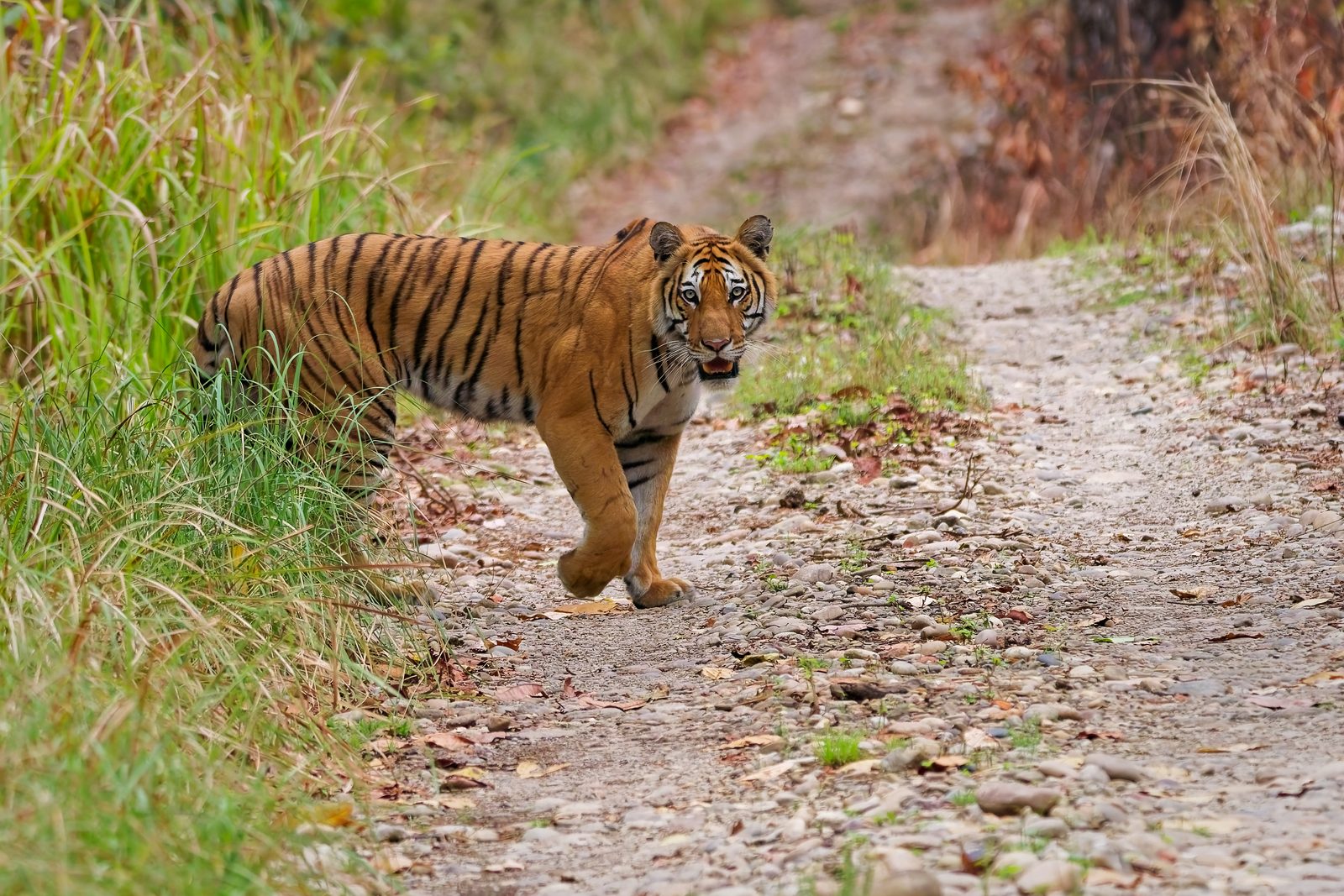
Nepal counted 429 wild tigers in its 2026 national census, up from 355 in 2022 and 121 in 2009. They are Bengal tigers, and they live in five national parks along the Terai, the lowland belt on the Indian border: Chitwan, Bardiya, Banke, Shuklaphanta and Parsa. The forest and grassland run on into India, and so do the tigers. Under the 2010 Global Tiger Recovery Program the thirteen tiger countries pledged to double their wild populations by 2022. Nepal’s went from 121 to 355 in that time, close to a tripling.
| Status | Wild tiger range state |
|---|---|
| Subspecies | Bengal tiger (Panthera tigris tigris) |
| Current wild population | 429 (estimated range 402 to 500), from the national census released on 29 July 2026. The 2009 baseline was 121. |
| Parks with tigers | Chitwan 145, Bardiya 112, Parsa 71, Banke 51, Shuklaphanta 50 (2026 census) |
| People killed by tigers | 10 in fiscal year 2025 to 2026, down from 21 in 2021 to 2022 (National Trust for Nature Conservation) |
Nepal’s tiger counts, 2009 to 2026
Nepal has run five national camera-trap surveys. The latest, with fieldwork from December 2025 to April 2026, identified 373 individual tigers and produced an estimate of 429, within a range of 402 to 500. The Department of National Parks and Wildlife Conservation released it on 29 July 2026. Tigers are told apart by their stripes, and our piece on how camera traps count tigers explains how photographs become an estimate.
| Survey | Nepal | Chitwan | Bardiya | Banke | Parsa | Shuklaphanta |
|---|---|---|---|---|---|---|
| 2009 | 121 | 91 | 18 | not yet a park | 4 | 8 |
| 2013 | 198 | 120 | 50 | 4 | 7 | 17 |
| 2018 | 235 | 93 | 87 | 21 | 18 | 16 |
| 2022 | 355 | 128 | 125 | 25 | 41 | 36 |
| 2026 | 429 | 145 | 112 | 51 | 71 | 50 |
The recovery was not smooth. Chitwan fell from 120 tigers to 93 between 2013 and 2018 before climbing again. The newest parks grew fastest. Banke, created in 2010, went from 4 tigers in 2013 to 51, and Parsa from 4 in 2009 to 71. In 2026 Bardiya fell, from 125 to 112, the only park to do so.
No official reason has been given for Bardiya’s fall. Hari Bhadra Acharya of the department said only that it was the one protected area where numbers declined. A researcher quoted by Mongabay, Shant Raj Jnawali, pointed to drought in parts of the park after a river changed course, though the same report notes that prey density in Bardiya had risen by 74 percent. Some residents think tigers were missed, which the government denies.
Nepal has surveyed every four or five years, so 429 is likely to stand until about 2030. It dates from fieldwork that ended in April 2026.
Nepal’s anti-poaching record is unusually strong. The country went a full year without losing a rhino to poachers in 2011. In the 365 days to 16 February 2014 it recorded no poaching of rhinos, tigers or elephants, which WWF describes as a first for any country.
A short history of tigers in Nepal
The Terai was a malarial forest belt until the middle of the 20th century, which kept settlement thin and left tigers and rhinos a great deal of room. Malaria eradication in the 1950s and 1960s opened the lowlands to settlement, and the forest was cleared fast. Chitwan was declared Nepal’s first national park in 1973. Bardiya was protected in stages: a wildlife reserve in 1976, extended into the Babai valley in 1984, a national park in 1988. Banke followed in 2010. The first national survey, in 2009, found 121 tigers, and every national total since has been higher.
Conservation programmes
The Department of National Parks and Wildlife Conservation manages the parks, and the Nepalese army has guarded them since 1975. The National Trust for Nature Conservation, WWF Nepal and the Zoological Society of London support research, anti-poaching work and the response to conflict. Outside the parks, the Khata corridor, a 13 km strip of forest, links Bardiya to Katarniaghat Wildlife Sanctuary in Uttar Pradesh.
Notable tiger reserves
Chitwan National Park, a UNESCO World Heritage Site since 1984, holds the most tigers (145 in 2026) and is the most visited. Bardiya, in the west, comes second with 112. Banke adjoins Bardiya and Parsa adjoins Chitwan, so the four work as two linked blocks, and Shuklaphanta sits at the far western end of the Terai. Our guide to tiger reserves sets these parks beside those of India and the rest of the range.
Full parks and conflict with people
Nepal’s parks are small, and some now look full. Hari Bhadra Acharya said in July 2025 that the core park areas could support around 400 tigers, and the census a year later found 429. In Banke the 51 tigers counted in 2026 compare with a carrying capacity of 28 modelled from prey density. Prey sets how many tigers a park can feed, and our piece on what tigers eat covers recent scat studies from Nepal. Young tigers that cannot win a place inside a park settle on its edges, where people live.
The deaths rose with the count. Tiger attacks killed 4 people in fiscal year 2018 to 2019, then 8, then 13, then 21 in 2021 to 2022. The toll fell to 12, 10 and 7 over the next three years and rose again to 10 in 2025 to 2026, on the National Trust for Nature Conservation’s count (a department figure reported by myRepublica is lower, at five). Tigers judged dangerous are caught. By September 2026, 19 were being held in the zoo and rescue centres, an arrangement described in the Kathmandu Post as a stopgap, and a 50-hectare enclosure for such animals has been proposed near Chitwan.
The politics have shifted as well. In December 2024 K.P. Sharma Oli, then prime minister, said that 150 tigers would be enough for Nepal and suggested giving the rest to friendly countries. No transfer had been reported by November 2026. The Global Tiger Recovery Program 2.0, which runs from 2023 to 2034, sets no new numerical target.
Related reading
- Bengal tiger profile
- How many wild tigers are left
- External authority: WWF Nepal
Frequently asked questions
How many tigers are in Nepal?
429, with an estimated range of 402 to 500, from the national census released on 29 July 2026. The 2022 figure was 355.
Has Nepal doubled its tiger population?
Yes, and then some. 121 tigers in 2009 became 355 in 2022. The 2010 Global Tiger Recovery Program set Nepal a goal of at least 250 adult tigers in the Terai Arc and a national doubling target of 310, from its own baseline of 155.
Where is the best place to see a tiger in Nepal?
Chitwan holds the most tigers, 145 in the 2026 census, and is the easiest park to reach from Kathmandu. Bardiya, with 112, is the main alternative in the west.
Are tigers in Nepal the same as Indian tigers?
Yes. Both are Bengal tigers (Panthera tigris tigris) and the populations are connected across the open Terai border.
Are tigers a threat to people in Nepal?
Yes, mainly to people who live and work on the edges of the parks. Tiger attacks killed 21 people in fiscal year 2021 to 2022 and 10 in 2025 to 2026. Nepal runs compensation schemes and community programmes in response.
More tiger countries
Nepal’s tigers share the Terai with India’s. Bhutan, Bangladesh and China are the other range countries nearby.
- Tigers in India (wild tigers today)
- Tigers in Bhutan (wild tigers today)
- Tigers in Bangladesh (wild tigers today)
- Tigers in China (wild tigers today)
All 25, grouped by whether tigers still live there: tigers by country.
Hero image: photo by Diego F. Parra on Pexels.
Updated 13 September 2026: updated to the 2026 census (429 tigers) and corrected park figures and conflict numbers.
Updated 15 November 2026: added all five national survey results, updated conflict figures to 2025 to 2026 and corrected the zero poaching dates.
Updated 18 November 2026: corrected the recovery programme target.