

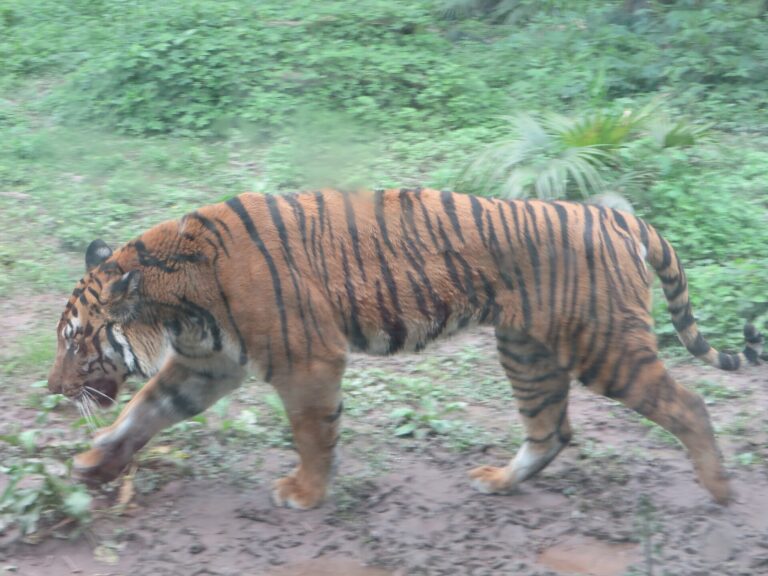
The Malayan tiger (Panthera tigris jacksoni) is the tiger of the Malay Peninsula south of the Isthmus of Kra. It was named in 2004 on genetic evidence alone, and Malaysia’s last national survey (2016 to 2020) estimated fewer than 150.
Key facts
| IUCN status | Critically Endangered (assessed 2015). Since 2022 the IUCN has assessed the tiger only as a species, as Endangered |
|---|---|
| Range | Peninsular Malaysia (Belum-Temengor, Taman Negara, Endau-Rompin) and the Hala-Bala and Bang Lang forests of southern Thailand |
| Estimated wild population | Fewer than 150 in Malaysia (national survey 2016 to 2020), plus at least 11 on the Thai side of the border |
| Adult weight (male) | 47 to 129 kg in 21 males measured in Terengganu (Khan 1986) |
| Adult weight (female) | 24 to 88 kg in 16 females from the same series |
| Lifespan in the wild | 10 to 15 years |
| Diet | Sambar, wild boar, muntjac, occasional sun bear or wild cattle |
| Main threats | Snaring, forest fragmentation, road deaths |
A subspecies defined by DNA
Until 2004 the tigers of peninsular Malaysia were classed with those of Thailand, Myanmar and Vietnam as the Indochinese tiger, Panthera tigris corbetti. That year Shu-Jin Luo, Stephen O’Brien and colleagues at the US National Cancer Institute published a genetic study of tigers from across Asia. Their samples from the peninsula formed a group of their own, and they proposed the Isthmus of Kra, the narrow neck of land between Thailand and Malaysia, as the barrier that had limited gene flow. They named the new subspecies jacksoni after Peter Jackson, a former chair of the IUCN Cat Specialist Group.
The split has never rested on appearance. In 2006 Mazák and Groves compared skulls and coats and argued against treating the Malayan tiger as a subspecies, because it looks like the Indochinese tiger and its range adjoins it. The IUCN Cat Specialist Group’s 2017 revision placed all mainland tigers in one subspecies, P. t. tigris. A whole-genome study in 2018 again separated six living groups, the Malayan among them, and the IUCN’s 2022 assessment describes tiger taxonomy as under review. In practice “Malayan tiger” names a population: the tigers south of the isthmus, which Malaysia counts and manages on its own.
Measurements are scarce. The series usually cited is from Terengganu: 21 males weighing 47 to 129 kg and 16 females weighing 24 to 88 kg (Khan 1986, as cited in later summaries). The low figures suggest that not all were full grown. The 120 to 160 kg often quoted for males, which this page used to give, has no measured source that we could find.
Range: peninsular Malaysia and the Thai border forests
In Malaysia the tigers live along the forested mountains that run down the peninsula and in a few connected lowland forests. The government’s three priority landscapes are Belum-Temengor in the north, on the Thai border; Taman Negara in the centre, at 4,343 sq km the country’s largest national park; and Endau-Rompin in the south. What Malaysia is doing in each is covered on our page on tigers in Malaysia.
Roads and plantations separate the three. Malaysia’s Central Forest Spine master plan, first drawn up in 2009 and revised in 2022, maps the corridors that would have to stay forested for them to work as one population.
The range does not stop at the border. Camera traps have confirmed at least 11 resident tigers in the Hala-Bala and Bang Lang forests of southern Thailand, according to WWF-Thailand, and Thailand’s 2026 national count lists 11 there. A tiger photographed in Bang Lang National Park in 2025 was the second confirmed there in two years. We found no published record of an individual tiger crossing the border.
Population: from about 3,000 to fewer than 150
Every estimate for the Malayan tiger has been lower than the one before. They were not made the same way, so the size of each step is uncertain: the early figures rest on limited data, and the 2014 and 2022 figures come from camera traps, the second over far more ground. Our page on how camera traps count wild tigers explains the method.
| When | Estimate | Basis |
|---|---|---|
| 1950s | About 3,000 | Historical estimate, as cited by TRAFFIC in 2009 |
| 2009 | About 500 | Figure in use when the 2008 to 2020 action plan was adopted (TRAFFIC) |
| September 2014 | 250 to 340 | Camera traps at seven sites, 2010 to 2013 (wildlife department and MYCAT) |
| March 2019 | Fewer than 200 | Interim result of the national survey, given by the minister |
| January 2022 | Fewer than 150 | First National Tiger Survey, fieldwork 2016 to 2020 |
| July 2026 | No figure | Minister says numbers are rising and a new figure is due (The Star) |
Snares did most of it. Belum-Temengor had the highest tiger density in Malaysia when WWF-Malaysia first surveyed it in 2009 to 2011. By 2018 its tigers had fallen by about half, and WWF put the loss down largely to snaring. A study in the Kenyir area of Taman Negara identified three separate poaching problems, from Vietnamese, Thai and Cambodian groups.
Malaysia’s response (a task force chaired by the prime minister, a police wildlife crime bureau, joint operations and community patrol teams) is set out on the Malaysia page linked above. The ministry’s stated aim is to stabilise the population at 400 by 2030. The plan that ran to 2020 aimed for 1,000.
Threats: snares, plantations and roads
Wire and cable snares set for sambar, wild boar and sun bear catch tigers as well, and they remove the prey a tigress needs to raise cubs. In November 2026 WWF-Malaysia said the remaining tigers were struggling to breed.
Forest loss to plantations is the second threat and roads are the third. Malaysia’s wildlife department recorded five tigers killed on roads between 2023 and 2025, one of them hit by a lorry on the East-West Highway, which runs through Belum-Temengor, on 9 November 2024. Whether crossing structures reduce such deaths is examined on our sister site’s page on elephant wildlife crossings.
The Malaysian Conservation Alliance for Tigers (MYCAT), formed by the Malaysian Nature Society, TRAFFIC, WCS-Malaysia and WWF-Malaysia, has run volunteer patrols called CAT Walks in the Sungai Yu corridor. We could not confirm how active it was in 2026.
What the evidence says about recovery
The one site with a published before and after is Kenyir. A 2023 study by Panthera and the wildlife department put tiger density there at 0.48 per 100 sq km in 2014 and 0.53 in 2021. Key females survived and bred, and the authors still judged the population to be below what the forest could hold. So several years of protection at a well guarded site stopped the decline without producing growth.
The other evidence comes from newly protected forest. The Al-Sultan Abdullah Royal Tiger Reserve in Pahang, gazetted in 2023, recorded an estimated 10 to 13 tigers in its first survey, reported in July 2026, including cubs and juveniles. What happens to a mainland tiger when the decline is not stopped is on our page on the South China tiger.
Harimau: the tiger as a national symbol
Harimau is the Malay word for tiger. Two tigers support the shield on Malaysia’s national coat of arms and on Johor’s state arms, and the national football team is nicknamed Harimau Malaya (for mascots elsewhere, see tigers in popular culture). In Royal Belum, Jahai Orang Asli of the Menraq patrol team now work as tiger rangers. The team won an IUCN WCPA International Ranger Award in 2023.
Related reading
Sources and further reading
- Luo and colleagues (2004), PLoS Biology 2(12): e442, the study that named the Malayan tiger
- Mazák and Groves (2006), A taxonomic revision of the tigers of Southeast Asia, Mammalian Biology 71
- Lam and colleagues (2023), Frontiers in Conservation Science, on counter-poaching and tiger density in Kenyir
- IUCN Red List entry for Panthera tigris (2022)
Frequently asked questions
Is the Malayan tiger a separate subspecies?
Yes, as Panthera tigris jacksoni since 2004, and a 2018 whole-genome study supported it. Under the IUCN Cat Specialist Group’s 2017 revision, mainland tigers are grouped as P. t. tigris and Sunda island tigers as P. t. sondaica. Either way, the Malayan population is still treated as a distinct conservation unit because it is geographically separate and genetically distinguishable.
How many Malayan tigers are left?
Fewer than 150 in Malaysia, on the First National Tiger Survey (fieldwork 2016 to 2020, announced in January 2022), plus at least 11 on the Thai side of the border. The estimate was 250 to 340 in 2014 and about 3,000 in the 1950s.
Where do Malayan tigers live?
On the Malay Peninsula south of the Isthmus of Kra. In Malaysia the three priority landscapes are Belum-Temengor, Taman Negara and Endau-Rompin. At least 11 live in the Hala-Bala and Bang Lang forests of southern Thailand.
Why are Malayan tigers so endangered?
Snaring, set partly for tigers and partly for their prey, has been the main cause, with forest loss and roads behind it. In Kenyir, counter-poaching work cut poaching incursions by 40 percent between 2015 to 2016 and 2018 to 2019 and tiger density held steady, so enforcement can stop a decline. No growth has yet been published.
Are Malayan tigers smaller than other tigers?
Probably, though measurements are scarce. The heaviest of 21 males measured in Terengganu weighed 129 kg, well below the 150 to 195 kg range given for male Indochinese tigers. The two cannot be told apart by eye.
What is the scientific name of the Malayan tiger?
Panthera tigris jacksoni. Under the IUCN Cat Specialist Group’s 2017 revision, mainland tigers are grouped as P. t. tigris and Sunda island tigers as P. t. sondaica. The Malayan label is still used in conservation policy and the national species recovery plan.
Can I see a Malayan tiger in the wild?
Realistically, no. The one site with a published density has about one tiger per 200 sq km, and tigers avoid people.
What is MYCAT?
The Malaysian Conservation Alliance for Tigers, formed by WWF-Malaysia, WCS-Malaysia, the Malaysian Nature Society and TRAFFIC. It has run volunteer CAT Walk patrols in the Sungai Yu corridor. We could not confirm its activity in 2026.
Photo: Mehmet Turgut Kirkgoz on Pexels.
Updated 13 September 2026: corrected the taxonomy note, state emblems, the Belum decline and the population figure.
Updated 15 November 2026: corrected the naming history, the body weights, the 2014 estimate, the task force dates and the findings of the 2023 Kenyir study; removed the store claim and a dead IUCN link.



Less than 150. Harimau is on our jata negara and the national football team is literally called Harimau Malaya. But the real one almost nobody here has seen, and soon nobody will. Sedih 😢
When I was in school in the 90s the textbook said about 500 harimau. My dad says in his time it was in the thousands. Now under 150. That’s all inside my lifetime and I’m not even that old lah.
That’s the bit that gets me too Trevor. Most tiger declines happened before anyone alive now was paying attention. This one didn’t.