
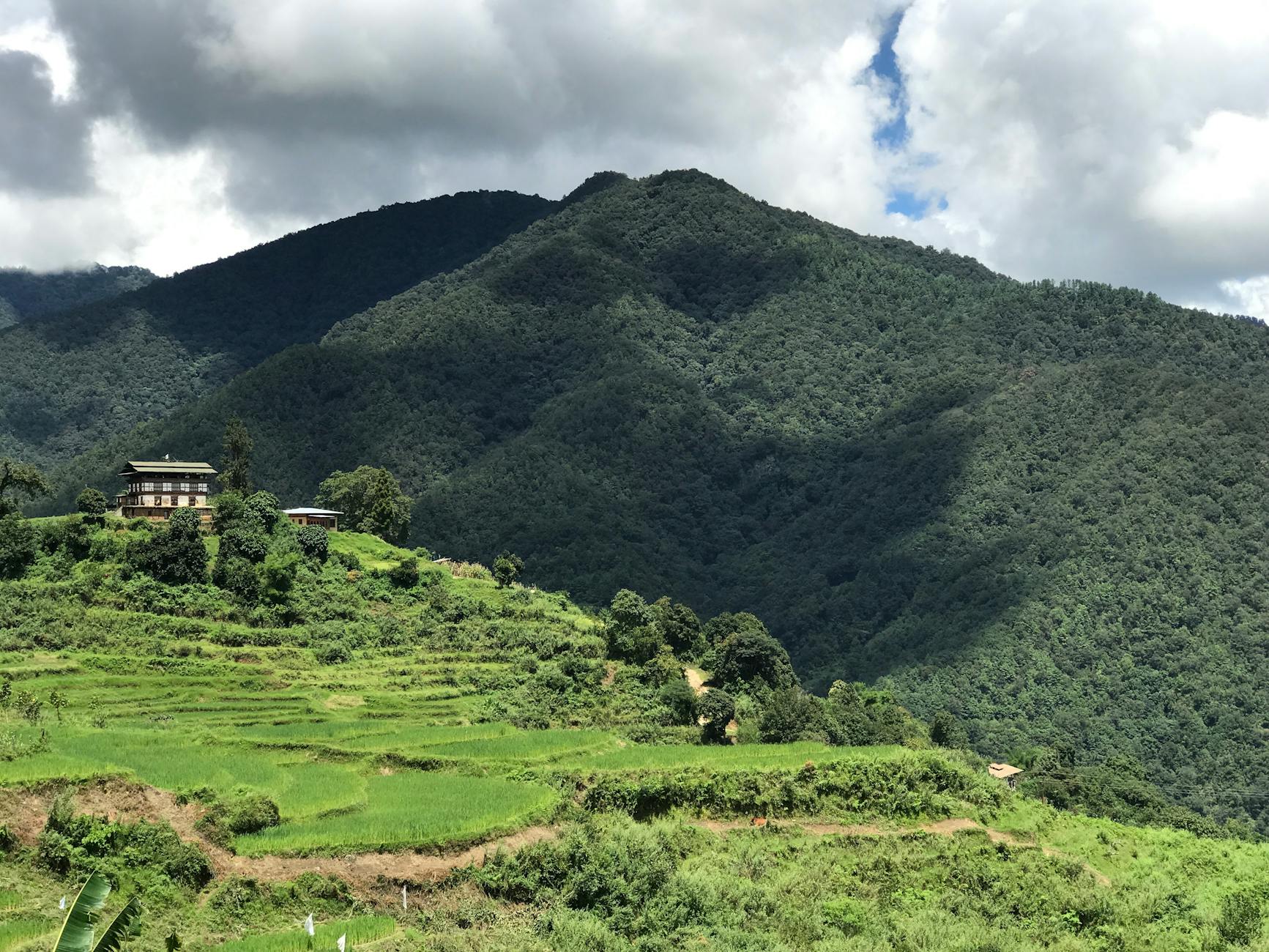
Bhutan has the highest altitude tiger population on Earth. Camera traps have recorded tigers at over 4,000 metres, in habitat more commonly associated with snow leopards, and a lactating female was filmed at about 4,100 metres in 2010. The population is small, 131 at the last national survey. It matters because Bhutan’s forest connects the lowlands on the Indian border to the Eastern Himalayan slopes, one of the few places where Bengal tigers can still move across that whole range of altitude.
| Status | Wild tiger range state |
|---|---|
| Subspecies | Bengal tiger (Panthera tigris tigris) |
| Current wild population | 131 (range 115 to 146), from the National Tiger Survey 2021 to 2022, a 27 percent rise on the 103 counted in the first systematic survey in 2014 to 2015. |
Current status
The National Tiger Survey 2021 to 2022, run by the Bhutan Tiger Center of the Department of Forests and Park Services with support from WWF, estimated 131 wild tigers, within a range of 115 to 146. That is 27 percent up on the 103 counted in the country’s first systematic survey in 2014 to 2015. The team set cameras at 1,201 stations and identified individual animals by their stripes, the method described in our piece on how camera traps count tigers. Royal Manas National Park, on the Indian border, had the most, 29 individuals against 15 in the first survey. Two forest divisions came next, Bumthang with 21 and Zhemgang with 14, ahead of every other national park.
Roughly half of Bhutan’s land surface sits inside protected areas or the biological corridors linking them, and tigers use both. Overall density is low, at 0.23 tigers per 100 square kilometres across the 32,800 square kilometres surveyed. The altitude records are what make this population unusual. WWF describes Bhutan as holding the world record for tiger sightings at elevation, above 4,400 metres. The highest come from Wangchuck Centennial National Park, where a tiger was photographed at about 4,400 metres and pugmarks were found at 4,600 metres. Tigers breed high up as well. Four of the five tigresses photographed with cubs in the 2021 to 2022 survey were above 2,500 metres.
A short history of tigers in Bhutan
Bhutan has no record of an intensive tiger hunting era of the kind that devastated Indian and Russian populations. Low human population density, difficult mountain terrain and a Buddhist tradition of protecting wildlife have kept tigers present throughout. Systematic counting is recent. The first national camera trap survey ran in 2014 to 2015.
Conservation programmes
Bhutan for Life is the funding engine. Signed in November 2017, it is Asia’s first Project Finance for Permanence deal: a fund of 43 million US dollars from donors, with the Bhutanese government committing 75 million over 14 years, after which the country is to fund its protected area network itself. The design is meant to stop the money ending when donor interest does.
The Bhutan Tiger Center, set up in 2017 under the Department of Forests and Park Services, is the government’s tiger research unit and ran the 2021 to 2022 survey. Its base at Royal Manas National Park was completed in 2021. Human wildlife conflict here is mostly tigers killing livestock, not attacks on people. Bhutan’s Tiger Action Plan 2024 to 2033 records 560 livestock killed by tigers in Trongsa district alone between July 2019 and July 2021. Insurance-based community schemes operate in conflict hotspots, 13 of them across the country, covering about 800 households. In April 2024 Bhutan hosted a conference in Paro at which it and the Tiger Conservation Coalition committed to catalysing an additional one billion US dollars for tiger landscapes over ten years.
Notable tiger habitat
The 2021 to 2022 survey photographed tigers in eight protected areas: Royal Manas National Park (continuous with India’s Manas Tiger Reserve), Jigme Singye Wangchuck, Phibsoo, Jigme Dorji, Wangchuck Centennial, Phrumsengla, Sakteng and Jomotshangkha. None were photographed in Bumdeling or the Jigme Khesar Strict Nature Reserve. Our guide to tiger reserves sets Royal Manas beside the parks of India and Nepal.
What this means for tiger conservation
131 tigers is a small number, and its importance lies in where they are. Bhutan’s forest runs unbroken from the lowlands on the Indian border up into the Eastern Himalaya, one of the few places where tigers can still move across a full range of altitude without being penned into a lowland reserve. Royal Manas sits directly against India’s Manas Tiger Reserve, so the two populations are one population as far as the animals are concerned.
That connection is what Bhutan adds to the wider picture. A tiger dispersing out of a crowded reserve in north-east India needs somewhere to go, and the Bhutanese corridors offer a route north. If roads or hydropower projects cut them, the reserves on India’s side become more isolated, the pattern described in our piece on habitat loss and tiger survival.
Related reading
- Bengal tiger profile
- Tiger territory and range
- External authority: WWF on Bhutan
Frequently asked questions
How many tigers live in Bhutan?
131, recorded by the National Tiger Survey 2021 to 2022. That is up 27 percent on the 103 counted in 2014 to 2015.
How high have tigers been recorded in Bhutan?
Above 4,000 metres in the northern parks, with WWF citing sightings over 4,400 metres as a world record for the species. The highest records come from Wangchuck Centennial National Park.
Which subspecies are Bhutan’s tigers?
Bengal tigers (Panthera tigris tigris), the same subspecies as in India, Nepal and Bangladesh.
Is tiger tourism allowed in Bhutan?
Wildlife tourism is allowed but tightly managed. Sightings are rare. The 2021 to 2022 survey found 0.23 tigers per 100 square kilometres, in dense forest.
What threats do Bhutan’s tigers face?
Habitat fragmentation, occasional retaliatory killing after livestock predation, and prey base pressure are the main current threats.
More tiger countries
Bhutan’s southern parks join India’s. Nepal, Bangladesh and China are the other range countries nearby.
- Tigers in India (wild tigers today)
- Tigers in Nepal (wild tigers today)
- Tigers in Bangladesh (wild tigers today)
- Tigers in China (wild tigers today)
All 25, grouped by whether tigers still live there: tigers by country.
Hero image: photo by Karen W Lim on Pexels.
Updated 13 September 2026: corrected the source of the high altitude records.
Updated 15 November 2026: corrected the Bhutan Tiger Center dates, the breeding altitude claim and the list of parks with tigers.