

The Indochinese tiger (Panthera tigris corbetti) is the tiger of mainland Southeast Asia north of the Isthmus of Kra. It once lived in six countries. It is now confirmed in two, Thailand and Myanmar, and almost every animal counted in recent years was in Thailand.
| IUCN status | Endangered at species level (Panthera tigris, 2022). The last separate assessment of the Indochinese tiger, made in 2010 and published in 2011, also listed it as Endangered |
|---|---|
| Range | Thailand and Myanmar. Lost from Vietnam, Cambodia, southern China and Laos |
| Estimated wild population | No current total. Thailand identified at least 210 tigers in 2026, about 11 of them Malayan tigers in the far south. Myanmar’s last count, from surveys that ended in 2018, was at least 22 |
| Adult weight (male) | 150 to 195 kg (Mazák 1981) |
| Adult weight (female) | 100 to 130 kg (Mazák 1981) |
| Lifespan in the wild | 10 to 15 years |
| Diet | Sambar, gaur, banteng, wild boar, muntjac |
| Main threats | Snaring, loss of prey, forest loss, armed conflict in Myanmar |
What defines the Indochinese tiger
The Czech zoologist Vratislav Mazák described the Indochinese tiger in 1968 and named it for Jim Corbett, the hunter and naturalist who wrote about the tigers of northern India. His type specimen is the skin and skull of a male from Quang Tri in central Vietnam, held by the Natural History Museum in London. Mazák separated it from the Bengal tiger on three points: a darker ground colour, more numerous stripes that are short and narrow, and a smaller skull.
The definition has been narrowed once since. In 2004 a genetic study by Shu-Jin Luo, Stephen O’Brien and colleagues found that tigers south of the Isthmus of Kra, the narrow neck of the Malay Peninsula, formed a separate group. Those became the Malayan tiger, and the name Indochinese has covered only the northern animals ever since. In 2017 the IUCN Cat Specialist Group went the other way and placed every mainland tiger in one subspecies, P. t. tigris. A whole-genome study the next year (Liu and colleagues, 2018) again found six living groups, the Indochinese among them, and the IUCN’s 2022 assessment describes tiger taxonomy as under review.
Body measurements are thin. Mazák’s 1981 summary gives males a total length of 2.55 to 2.85 metres and a weight of 150 to 195 kg, and females 2.30 to 2.55 metres and 100 to 130 kg. He rated his skull measurements as the most reliable part of the data, and the weights mix his own records with older literature. We found no large modern sample of weighed wild Indochinese tigers, so the ranges are a guide and no more.
The range collapse, country by country
The specimen that defines the subspecies came from Vietnam, which has had no confirmed wild tiger since one camera trap photograph in 1999. The table gives the last confirmed record for each country in the historical range, earliest loss first. Official estimates lagged well behind: as late as 2010 the IUCN’s assessment still credited Vietnam and Cambodia with about 20 tigers each and Laos with 17.
| Country | Last confirmed wild record | Source | In 2026 |
|---|---|---|---|
| Vietnam | One camera trap photograph in Pu Mat National Park, Nghe An, on 21 December 1999. The last accepted sign is a measured footprint in Song Thanh National Park, February 2002 | Pu Mat park director, quoted by Vietnamnet in 2022; IUCN Red List 2022 | No wild tigers. Tigers in Vietnam |
| Cambodia | A female on a camera trap in what is now Srepok Wildlife Sanctuary, Mondulkiri, November 2007 | Gray and colleagues 2012, cited in the IUCN Red List 2022 | No wild tigers; declared functionally extinct in 2016. Tigers in Cambodia |
| China (Yunnan) | Three tigers recorded in the Shangyong part of Xishuangbanna between 2004 and 2009, one of them photographed by a camera trap in May 2007. A man who shot a tiger in Mengla County in February 2009 was jailed for 12 years that December | IUCN Red List 2022; Cat News, 2010; GoKunming court report, December 2009 | No Indochinese tigers. The country’s wild tigers are Amur tigers in the north-east: tigers in China |
| Laos | Two tigers on camera traps in Nam Et-Phou Louey, 2013 | Rasphone and colleagues 2019 | No wild tigers. Tigers in Laos |
| Myanmar | Still present. At least 22 detected by surveys that ended in 2018 | Government announcement, 29 July 2019 | Present; no national count since the 2021 coup. Tigers in Myanmar |
| Thailand | Still present. At least 210 identified in the 2025 to 2026 survey | Department of National Parks, 29 July 2026 | Present; 148 to 189 in 2022, 210 to 257 adults in 2026. Tigers in Thailand |
Laos has the best documented ending. Camera traps in Nam Et-Phou Louey photographed two tigers in 2013 and none in the four further years of surveys. Rasphone and colleagues, who published the result in 2019, linked the loss to an “exponential increase in snaring” inside the park. The IUCN calls those two animals the last confirmed tiger records from the country and from Indochina. Snares, and the trade they feed, are the subject of our page on poaching and the illegal tiger trade.
Thailand: where most of them live
Thailand’s Department of National Parks announced on 29 July 2026 that its 2025 to 2026 camera trap survey had identified at least 210 tigers, and estimated the adult population at 210 to 257. Its earlier estimates were 148 to 189 in 2022 and 179 to 223 in 2024. The department’s breakdown puts 182 in the Western Forest Complex, about 18,000 sq km of connected protected areas along the Myanmar border, and 12 in the Dong Phayayen-Khao Yai forests in the east.
Not all of them are Indochinese tigers by the 2004 definition. Eleven were in the Hala-Bala and Bang Lang forests on the Malaysian border, well south of the Isthmus of Kra, and WWF-Thailand describes the resident tigers there as Malayan. That leaves about 200 identified Indochinese tigers in Thailand. The core is Huai Kha Khaeng Wildlife Sanctuary and the two Thung Yai Naresuan sanctuaries beside it, where a long camera trap study estimated about 143 tigers in 2023. Huai Kha Khaeng alone went from 40 in 2007 to 79 in 2023; the Thailand page linked in the table has the detail.
Ecology in the surviving range
Most of what is known about how Indochinese tigers live comes from Huai Kha Khaeng. A study of 150 kill sites made by eight collared tigresses between May 2013 and June 2015 found that sambar, banteng and gaur made up 95.1 percent of prey biomass (Pakpien and colleagues, 2017). Banteng and gaur are wild cattle, and both are much heavier than the tigresses that killed them. How that diet compares with tigers elsewhere is covered in what tigers eat.
The same sanctuary supplies the home range figures. Eleven tigers wore GPS collars there between 2005 and 2011; the four males used 267 sq km on average and the seven females 70 sq km (Simcharoen and colleagues, 2014). Density in Huai Kha Khaeng reached 2.86 tigers per 100 sq km in 2023. For how that compares with other tigers, see tiger territory and range.
Myanmar, and where tigers could return
Myanmar is the only other country with confirmed Indochinese tigers, and its numbers are close to unknown. The government’s 2019 figure of at least 22 came from camera traps covering about 8 percent of potential tiger habitat, and no national estimate has been published since the coup of February 2021. The strongest evidence is from Tanintharyi in the south, where eight tigers were detected between 2015 and 2019 and breeding was recorded, in forest that connects to Thailand’s western parks.
Three governments have plans that bear on where the Indochinese tiger lives next. Thailand named the Phu Khieo-Nam Nao forests in July 2026 as its priority recovery area and intends to move wild tigers there once prey has recovered. Laos signed a recovery plan for 2026 to 2035 whose first priority is Nam Poui, on the Thai border, in the hope that tigers arrive from Thailand unaided; the plan calls reintroduction from distant populations “expensive and risky”. Cambodia has chosen that route anyway, with tigers from India.
The Cambodian plan has a consequence for the name. The founders would be Bengal tigers, so a successful release would put tigers back in the Cardamom Mountains without restoring the Indochinese tiger there. Under the 2017 classification the distinction disappears, because both are P. t. tigris. Under the 2004 and 2018 genetic studies it stays. In September 2026 India and Cambodia postponed the first transfer to 2028, because prey in the release area is still too scarce.
Related reading
- South China tiger, the mainland subspecies with no confirmed wild animals left
- The six living tiger subspecies
- Tigers by country: the latest count for every range state
Sources
- Mazák (1981), Panthera tigris, Mammalian Species 152.
- Luo and colleagues (2004), PLoS Biology 2(12): e442, the study that separated the Malayan tiger.
- Mazák and Groves (2006), A taxonomic revision of the tigers of Southeast Asia, Mammalian Biology 71.
- Kitchener and colleagues (2017), A revised taxonomy of the Felidae, Cat News Special Issue 11.
- Liu and colleagues (2018), Current Biology 28, a whole-genome study of the world’s tigers.
- Goodrich and colleagues (2022), Panthera tigris, IUCN Red List of Threatened Species, with its supplementary country accounts.
- Rasphone and colleagues (2019), Global Ecology and Conservation, on Nam Et-Phou Louey.
- Duangchantrasiri and colleagues (2024), Global Ecology and Conservation 53, on Huai Kha Khaeng and Thung Yai.
- Simcharoen and colleagues (2014), Oryx 48(3), and Pakpien and colleagues (2017), Tropical Conservation Science 10, on Huai Kha Khaeng.
- Thai PBS World, 29 July 2026, for the Department of National Parks count.
Frequently asked questions
How many Indochinese tigers are left?
Nobody has a current total. Thailand identified at least 210 tigers in its 2025 to 2026 survey, about 11 of them Malayan tigers on the Malaysian border. Myanmar’s last published count, from surveys that ended in 2018, was at least 22. Vietnam, Cambodia, Laos and southern China have none.
Where do Indochinese tigers live?
Thailand and Myanmar. In Thailand most are in the Western Forest Complex along the Myanmar border, with a small group in the Dong Phayayen-Khao Yai forests in the east. In Myanmar the firmest recent evidence comes from Tanintharyi in the south and Htamanthi Wildlife Sanctuary in the north.
Is the Indochinese tiger a separate subspecies?
Traditionally yes, as Panthera tigris corbetti. Under the IUCN Cat Specialist Group’s 2017 revision, mainland tigers are grouped as P. t. tigris and Sunda island tigers as P. t. sondaica. A 2018 whole-genome study again found six living groups, the Indochinese among them.
Why are Indochinese tigers in trouble?
Snares, above all. Wire snares set for meat and for body parts kill tigers and remove the deer and wild cattle they eat. In Laos the last tigers disappeared from a protected area during what researchers called an exponential increase in snaring. Forest loss and the conflict in Myanmar add to it.
What is the difference between Indochinese and Malayan tigers?
Geography and DNA. A 2004 genetic study separated the tigers south of the Isthmus of Kra and named them Malayan tigers. A 2006 study of skulls and coats (Mazák and Groves) found them too alike to separate, so they cannot be told apart by eye. Malaysia’s first national survey (2016 to 2020) put the Malayan tiger below 150 animals.
Who named the Indochinese tiger?
Vratislav Mazák, a Czech zoologist, in 1968. He named it corbetti after Jim Corbett. The type specimen is a male from Quang Tri in Vietnam, kept at the Natural History Museum in London.
Will the tigers Cambodia plans to release be Indochinese tigers?
No. The plan is to bring Bengal tigers from India, and the first transfer has been postponed to 2028. Under the traditional classification they are a different subspecies from the one Cambodia lost.
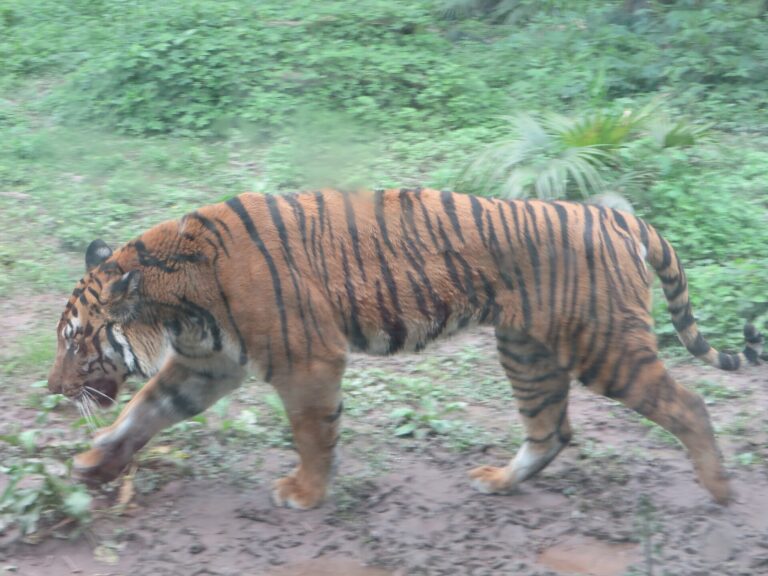
Photo: Ayberk Mirza on Pexels.
Updated 13 September 2026: updated Cambodia’s reintroduction site.
Updated 15 November 2026: refocused as the subspecies page with a dated range-collapse table; corrected the Thai and Myanmar figures, the Vietnam date (1999, not 1998) and the home range data, and removed unsourced totals.



Thank you for writing about Thailand. Many people even in Bangkok don’t know we still have tigers.
Backpacked through Laos in 2014 and a couple of places were still advertising tiger treks, ‘see wild tigers’ and so on. Reading this I guess there were basically none left even then? Feel abit conned.