
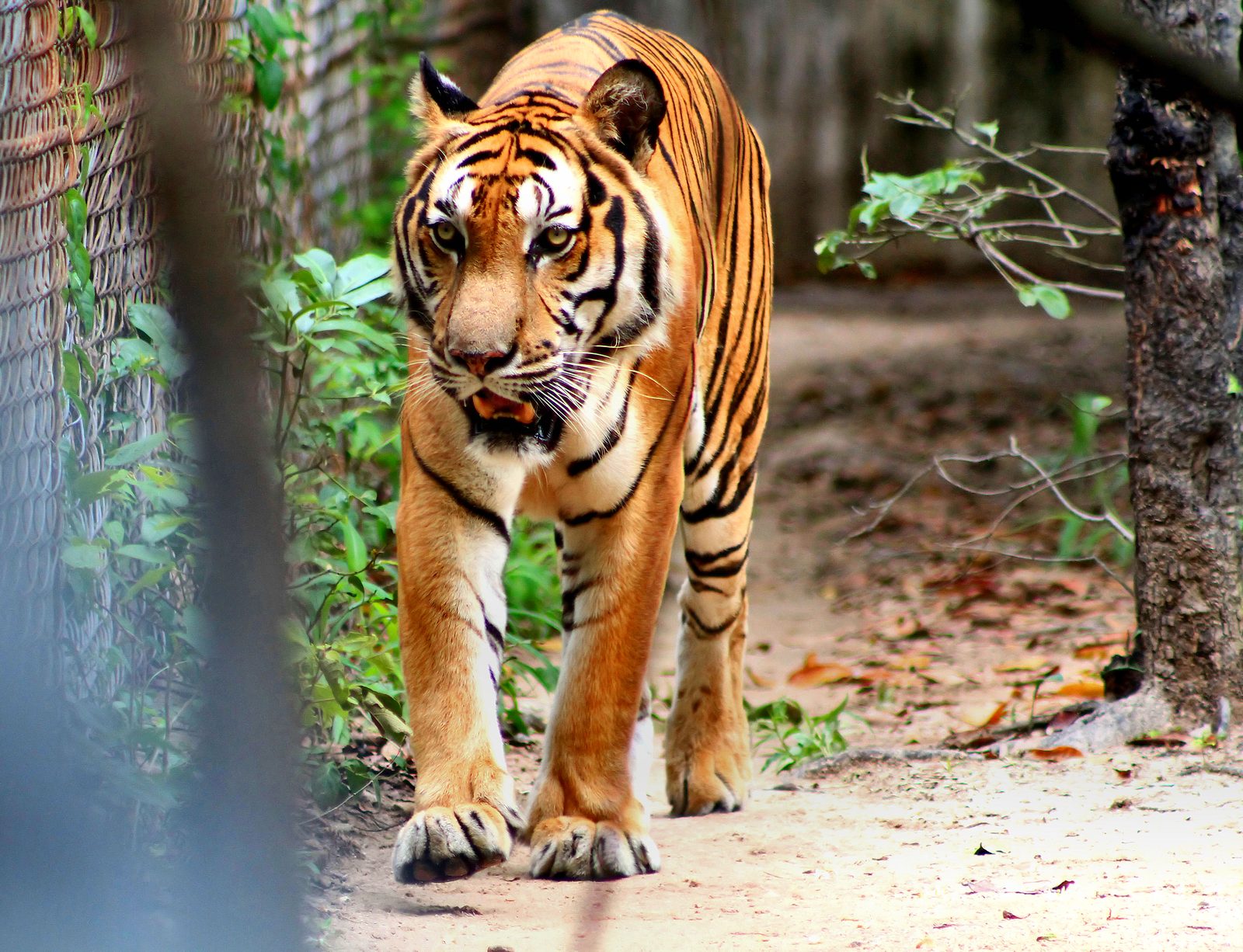
Cambodia’s last confirmed wild tiger was a female photographed by a camera trap in November 2007, in what is now Srepok Wildlife Sanctuary in Mondulkiri. Wildlife Alliance also lists a record from the Cardamom Mountains in December 2007, without saying what kind of evidence it was. Nothing has been confirmed since. In 2016 the government approved a national tiger action plan and WWF declared the species functionally extinct in the country. Cambodia is now trying to become the first Southeast Asian country to put tigers back, and in September 2026 the first transfer from India was postponed again, to 2028.
| Status | Former range state, no current wild tigers |
|---|---|
| Subspecies | Historically Indochinese tiger (Panthera tigris corbetti). No confirmed wild tiger since 2007. Any reintroduced founders would be Bengal tigers from India. |
| Current wild population | None. The last verified camera trap record was a female in Srepok Wildlife Sanctuary, Mondulkiri, in November 2007. |
Current status
Cambodia has had no confirmed wild tiger since 2007. The Cambodia Tiger Action Plan was approved on 23 March 2016, and on 6 April WWF announced both the plan and its judgement that tigers were functionally extinct in the country. A memorandum of understanding signed with India on 12 November 2022 opened the way for founder animals to come from there (see tigers in India).
Since then the date has kept moving. In February 2024 officials said one male and three females could arrive by the end of that year, into a 90 hectare enclosure in Tatai Wildlife Sanctuary in Koh Kong. They did not. Concerns about the habitat, and the suspension of a carbon credit project that was expected to help pay for the work, held it up; the certifier Verra suspended the Southern Cardamom project in June 2023 and reinstated it in September 2024. In May 2026 the Environment Ministry approved a new roadmap with arrivals in 2027. In September 2026 India and Cambodia moved the target to 2028, after a review found prey in the release area still too scarce. No tiger had been moved when this page was checked in November 2026.
| Date | What happened | Source |
|---|---|---|
| November 2007 | Last confirmed wild tiger, a female, photographed in Srepok Wildlife Sanctuary | Gray and colleagues 2012, cited in the IUCN Red List 2022 |
| 23 March and 6 April 2016 | Tiger Action Plan approved; tigers declared functionally extinct | Anadolu Agency, 6 April 2016 |
| 12 November 2022 | Memorandum of understanding signed with India | Cambodianess, 15 November 2022 |
| February 2024 | Officials say four tigers could arrive by the end of 2024; 410 camera traps to be set in the Cardamoms | AFP, 18 February 2024; Associated Press, 16 February 2024 |
| May 2026 | New roadmap proposes arrivals in 2027 | AFP, 8 July 2026 |
| September 2026 | Transfer postponed to 2028 because prey is still too scarce | Mongabay India, 24 September 2026 |
A short history of tigers in Cambodia
The Eastern Plains Landscape, taking in Phnom Prich and Srepok wildlife sanctuaries in Mondulkiri, was the last Cambodian stronghold. War and instability into the 1990s left the forest open to logging and to commercial snaring, and the snares took both the tigers and the animals tigers eat. The IUCN’s 2010 assessment still credited Cambodia with about 20 tigers, three years after the last one had been photographed. The Cardamom Mountains in the south-west also held tigers, with a last reported record in December 2007.
Conservation programmes
Wildlife Alliance is the Environment Ministry’s main partner in the Cardamoms. In February 2024 it said 410 camera traps would be set at one kilometre intervals for three months, to measure what a tiger would find to eat. So far the answer is too little. Mongabay’s reporting in 2026 cites a 2020 feasibility study that warned of a high risk that prey was too thin to support a viable tiger population. Tom Gray of WWF is quoted recommending that prey be built up first, by moving sambar and wild pig into the area. A consultant to the ministry is quoted saying the cameras show enough prey for the first arrivals. Why prey sets the limit is covered in what tigers eat.
Notable former tiger habitat
Srepok and Phnom Prich wildlife sanctuaries in Mondulkiri form the Eastern Plains Landscape, where WWF proposed in 2016 to release tigers. The plan has since moved west. The holding enclosure is in Tatai Wildlife Sanctuary in Koh Kong province, and reports in 2026 name the release area as the 926,123 hectare Kravanh National Park in the Cardamom Mountains. Virachey National Park in Ratanakiri also held tigers historically.
What this means for tiger conservation
Nobody in Southeast Asia has yet put tigers back into a country that lost them. Laos has drawn its own conclusion already: its recovery plan for 2026 to 2035 calls reintroduction from distant populations “expensive and risky” and waits for tigers to walk in from Thailand. The nearest working comparison is a long way off, in Kazakhstan, which released its first tiger in July 2026.
A delay on these grounds is defensible. Tigers released into forest that cannot feed them, or that still holds snares, are likely to starve, leave or be killed. The founders would also be Bengal tigers, the same subspecies as the Indochinese tiger under the 2017 classification and a different one under the older scheme, so the project would return a predator to the Cardamoms without returning the animal that was lost. Money is the other open question. Mongabay reported in June 2026 that funding from Wildlife Alliance, the main backer, had shrunk.
Related reading
- Indochinese tiger profile
- Tiger conservation: where things stand
- External authority: WWF Cambodia tiger reintroduction
Frequently asked questions
Are there still wild tigers in Cambodia?
No. The last confirmed record was in 2007 and tigers were declared functionally extinct in 2016. Any tiger seen in Cambodia today is a captive animal.
When did tigers go extinct in Cambodia?
The last confirmed wild tiger was a female photographed in Srepok Wildlife Sanctuary in Mondulkiri in November 2007. Wildlife Alliance also lists a record from the Cardamom Mountains in December 2007. WWF declared tigers functionally extinct in Cambodia in April 2016.
Is Cambodia planning to reintroduce tigers?
Yes. A memorandum of understanding with India was signed in November 2022 and four tigers were expected by the end of 2024. They did not arrive. A roadmap approved in May 2026 proposed 2027, and in September 2026 the two countries moved the target to 2028 because prey in the release area is still too scarce.
Why did Cambodia lose its tigers?
Forest clearance after the wars, and commercial snaring that took the prey as well as the tigers.
Where would reintroduced tigers go?
The plan has moved. The Eastern Plains in Mondulkiri was the original site. The current proposal puts the founders first in a fenced enclosure in Tatai Wildlife Sanctuary in Koh Kong province, in the Cardamom Mountains.
More tiger countries
Cambodia lost its wild tigers, and Vietnam, Laos, Thailand and Malaysia tell the neighbouring parts of the same retreat.
- Tigers in Vietnam (wild tigers lost)
- Tigers in Laos (wild tigers lost)
- Tigers in Thailand (wild tigers today)
- Tigers in Malaysia (wild tigers today)
All 25, grouped by whether tigers still live there: tigers by country.
Hero image: photo by Karolina on Pexels.
Updated 15 November 2026: updated the reintroduction timetable (postponed to 2028 in September 2026), corrected the last confirmed record and the location of the Tatai enclosure, and added a dated timeline.