
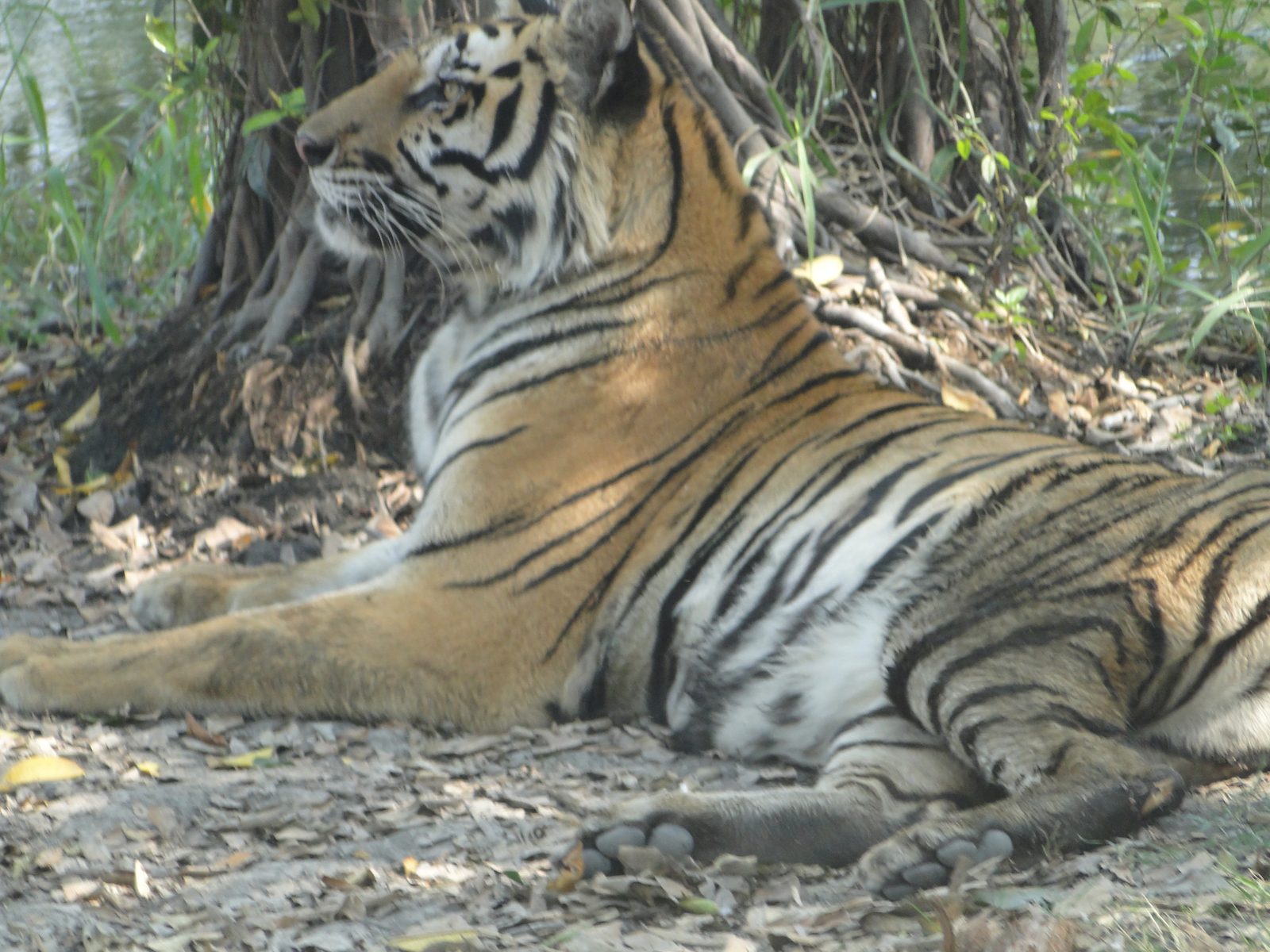
Thailand holds most of the world’s remaining Indochinese tigers (Panthera tigris corbetti). Its Department of National Parks identified at least 210 wild tigers in its 2025 to 2026 survey, 182 of them in the Western Forest Complex, about 18,000 square kilometres of connected protected forest along the Myanmar border. It is also the only country in mainland Southeast Asia where two dated national estimates show the number rising.
| Status | Wild tiger range state |
|---|---|
| Subspecies | Indochinese tiger (Panthera tigris corbetti) |
| Current wild population | At least 210 identified in the 2025 to 2026 survey, with adults estimated at 210 to 257 (Department of National Parks, 29 July 2026). Earlier estimates: 148 to 189 in 2022 and 179 to 223 in 2024. |
Current status
The department announced the result on 29 July 2026: at least 210 tigers identified from camera trap photographs, and an adult population estimated at 210 to 257. The survey covered 30 protected areas and found tigers in 26 of them. Its earlier national estimates were 148 to 189 in 2022 and 179 to 223 in 2024. The breakdown by forest complex, as reported by Thai PBS World, adds up to 211.
| Forest complex | Tigers identified, 2025 to 2026 |
|---|---|
| Western Forest Complex | 182 |
| Dong Phayayen-Khao Yai | 12 |
| Hala-Bala and Bang Lang, on the Malaysian border | 11 |
| Kaeng Krachan and Kui Buri | 3 |
| Chumphon | 3 |
The best evidence for the trend is older and narrower. A camera trap study ran from 2007 to 2023 in Huai Kha Khaeng Wildlife Sanctuary and the two Thung Yai Naresuan sanctuaries, led by the department with the Wildlife Conservation Society, Kasetsart University and India’s Centre for Wildlife Studies (Duangchantrasiri and colleagues, 2024). Its estimate for Huai Kha Khaeng went from 40 tigers in 2007 to 79 in 2023, for Thung Yai East from 3 in 2008 to 20, and for Thung Yai West from 13 in 2007 to 44. That is about 143 tigers older than one year across the three sanctuaries in 2023. Density in Huai Kha Khaeng roughly doubled, from 1.45 to 2.86 tigers per 100 square kilometres. The figures of 75 for 2022 and 94 for 2023 that circulate, and that this page used to give, are the numbers of individual tigers photographed in those years. Our page on how camera traps count wild tigers explains the difference.
Outside the western forests the numbers are small. The 12 tigers identified in the Dong Phayayen-Khao Yai complex in the east were in Thap Lan and Pang Sida national parks. A study of 2018 to 2021 data found that population stable, with survival above 90 percent, at about one tiger per 100 square kilometres (Pakpien and colleagues, 2025). Khao Yai National Park itself, which gives the complex half its name, has no known tigers; the last evidence there was a footprint in 2005. In the Kaeng Krachan forests on the Myanmar border a tigress was photographed with three cubs in July 2024. The 11 on the Malaysian border are Malayan tigers, according to WWF-Thailand.
A short history of tigers in Thailand
Tigers once lived in forest across most of Thailand. Deforestation through the 1980s and 1990s, poaching for the parts trade and the loss of prey removed them from most of it, and the IUCN’s 2010 assessment put the country at about 200. Huai Kha Khaeng, gazetted as a wildlife sanctuary in 1972 and part of a World Heritage Site since 1991, kept a breeding population through that period.
Conservation programmes
The Smart Patrol System was introduced at Huai Kha Khaeng in 2006, with training supported by WCS, and covered the whole Western Forest Complex by 2014. Rangers walk planned routes and record what they find (snares, camps, tiger sign), first in software called MIST and later in SMART, and the records decide where the next patrols go. The 2024 study reports about 500 active rangers working from 52 patrol stations in Huai Kha Khaeng and Thung Yai. It also reports what they found: 9.67 poacher camps per 1,000 kilometres patrolled in Huai Kha Khaeng in 2008, a peak of 12.10 in 2010, and between 1.2 and 2.1 in each year from 2018 to 2023.
Prey recovered over the same years. A survey in 2021 went back to sites in Huai Kha Khaeng first surveyed in 2007 to 2008 and found that sambar density had doubled, from 2.03 to 3.99 animals per square kilometre, and banteng had gone from 0.91 to 1.71 (Saisamorn and colleagues, 2024). Some news reports of that study, and an earlier version of this page, gave the figures per 100 square kilometres; the paper gives them per square kilometre. Sambar, banteng and gaur together made up 95.1 percent of prey biomass at 150 tiger kills studied in the sanctuary, which is covered on our page on what tigers eat.
Notable tiger reserves
Huai Kha Khaeng and the two Thung Yai Naresuan sanctuaries are the core of the Western Forest Complex, a block of 17 protected areas (11 national parks and 6 wildlife sanctuaries). Tigers are recorded well beyond the core: the 2026 survey found 14 in Umphang Wildlife Sanctuary, and in December 2025 the 350 square kilometre Si Sawat corridor in the south of the complex was made a non-hunting area. In the Dong Phayayen-Khao Yai complex, a World Heritage Site since 2005, the tigers are in Thap Lan and Pang Sida. Khao Yai, Thailand’s first national park (1962), has none. In July 2026 the department named the Phu Khieo-Nam Nao forests as its priority recovery area, and plans to move wild tigers there from the west and from Dong Phayayen-Khao Yai once prey has recovered. Huai Kha Khaeng also appears in our tour of the world’s best-known tiger reserves.
What this means for tiger conservation
Thailand holds nearly all the Indochinese tigers that anyone has counted. Vietnam, Cambodia, Laos and southern China have lost theirs, and Myanmar’s last published count was at least 22, from surveys that ended in 2018. Within Thailand the concentration is just as sharp: 182 of the tigers identified in 2026 were in one forest complex. If that complex declined, the Indochinese tiger would be close to the position of the South China tiger, which has no confirmed wild animals left.
The methods behind the Thai increase are ordinary: ranger patrols that record what they find, repeated camera trap counts, and protection of deer and wild cattle. All three have to be paid for every year.
Related reading
- Indochinese tiger profile
- Tiger conservation: where things stand
- External authority: WWF Thailand tiger conservation
Frequently asked questions
How many tigers are in Thailand?
At least 210 were identified in the Department of National Parks survey of 2025 to 2026, announced on 29 July 2026, with adults estimated at 210 to 257. Earlier estimates were 148 to 189 in 2022 and 179 to 223 in 2024.
Where is the best place to see a tiger in Thailand?
Wild sightings are very rare and visitors should not expect one. Most camera trap footage comes from Huai Kha Khaeng. Khao Yai, the country’s first national park, has had no confirmed tiger evidence since a footprint in 2005.
Are Thai tigers a separate subspecies?
They are Indochinese tigers (Panthera tigris corbetti), the same subspecies as in Myanmar and historically Laos, Cambodia and Vietnam. The exception is the far south: the tigers of Hala-Bala and Bang Lang on the Malaysian border are Malayan tigers.
Did Thai tiger temples really keep tigers?
Yes. The Tiger Temple in Kanchanaburi was raided in 2016 after a wildlife trafficking investigation, and 147 tigers were taken into government care. Officials said in September 2019 that 86 of them had died.
Is the Indochinese tiger Endangered?
Yes. The IUCN lists the tiger as Endangered at species level (2022). The Indochinese tiger was last assessed separately in 2010, also as Endangered.
More tiger countries
Tiger populations cross these borders, and national counts often include the same animals twice, so Myanmar, Malaysia, Cambodia and Laos are worth reading next to Thailand.
- Tigers in Myanmar (wild tigers today)
- Tigers in Malaysia (wild tigers today)
- Tigers in Cambodia (wild tigers lost)
- Tigers in Laos (wild tigers lost)
All 25, grouped by whether tigers still live there: tigers by country.
Hero image: photo by Balazs Simon on Pexels.
Updated 13 September 2026: updated to the 2026 count (at least 210 tigers).
Updated 15 November 2026: corrected the Huai Kha Khaeng study figures (the estimate was 40 in 2007 and 79 in 2023; 75 and 94 were tigers photographed), the prey density units, and Khao Yai National Park, which has no known tigers; added the 2026 count by forest complex.