
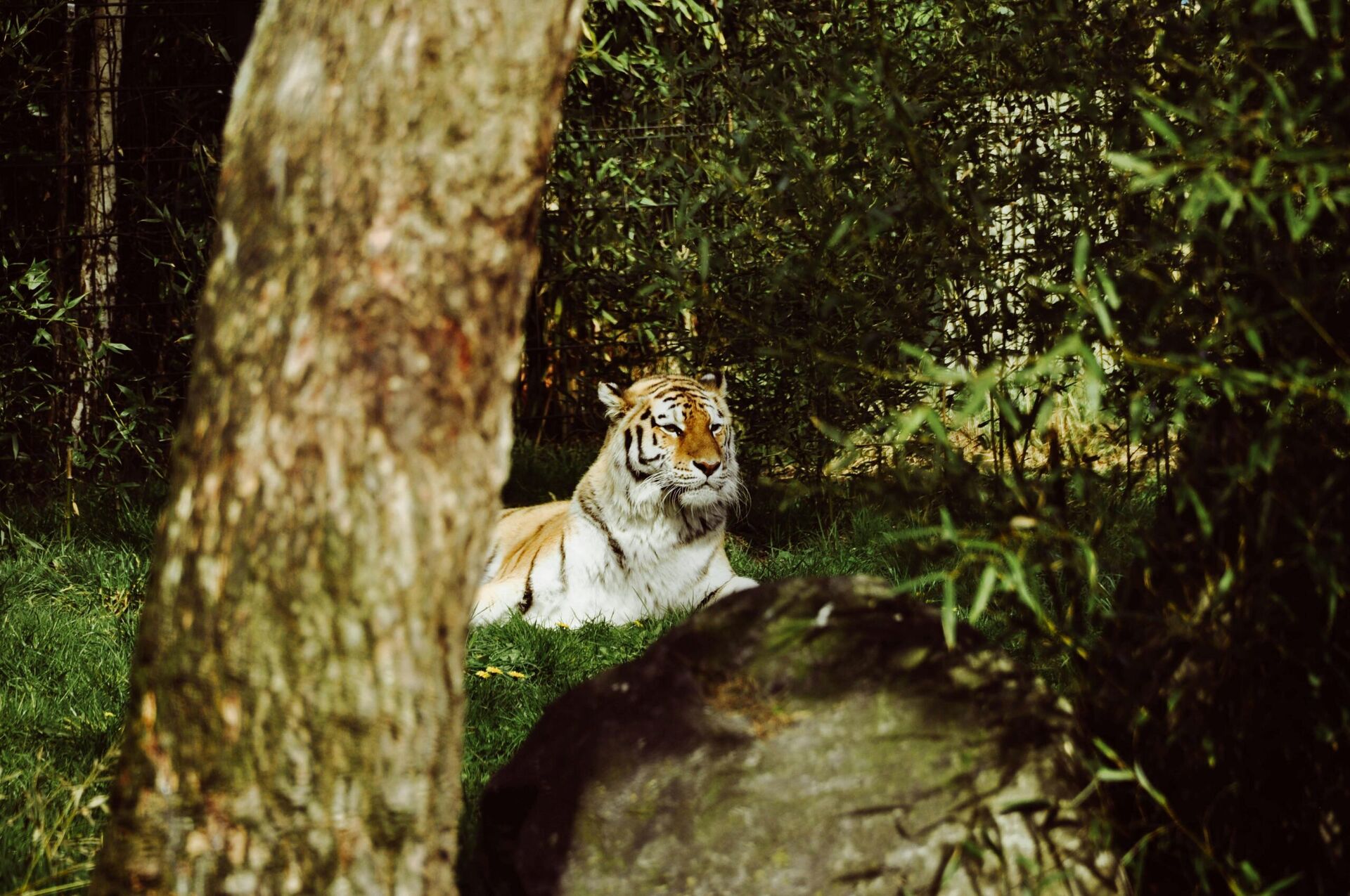
How much ground a tiger uses depends mostly on how much there is to eat on it. Radio and GPS collars have put numbers on that: about 12 sq km for a female in the Bangladesh Sundarbans, and 1,385 sq km for the average male in Russia’s Sikhote-Alin. This page lists the measured home ranges study by study, then covers how tigers mark and hold a range and how young tigers find one.
How big is a tiger’s territory
Territory size varies more than almost anything else about the animal. The largest measured ranges are about a hundred times the size of the smallest.
Prey is the main reason. Karanth and colleagues showed in 2004 that tiger density follows prey density across 11 Indian sites: from 3.2 to 16.8 tigers per 100 sq km, where prey ran from about 5 to 64 animals per sq km. A tiger kills about 50 large animals a year on average, and GPS-collared Amur tigers made a kill roughly every six and a half days (Miller and colleagues, 2013). Where deer and pigs are dense that need is met on a small area. Where they are scarce the tiger has to cover more ground. Our page on what tigers eat has the prey studies.
Sex is the second. In every study that tracked both, males used more ground than females, because a male’s range takes in those of several females. The gap runs from under one and a half times at Pench, where one animal of each sex was tracked, to nearly four times at Huai Kha Khaeng and Panna.
Measured home ranges, study by study
The figures below come from published radio and GPS tracking. Sample sizes are small and the methods differ, so the last column says how each range was calculated. Compare rows with care.
| Site | Study | Females (sq km) | Males (sq km) | Animals and method |
|---|---|---|---|---|
| Sundarbans, Bangladesh | Barlow and colleagues, 2011 (Oryx) | 12.3 | None tracked | 2 females, GPS collars, 95% minimum convex polygon (14.2 by kernel) |
| Chitwan, Nepal | Smith, McDougal and Sunquist, 1987 | 23 (13 to 51) | 68 (24 to 151) | Radio collars; figures as given in the Handbook of the Mammals of the World, 2009 |
| Pench, India | Majumder and colleagues, 2012 (Wildlife Biology in Practice) | 43 | 55 | 1 female and 1 male, radio collars, 95% minimum convex polygon |
| Panna, India | Chundawat and colleagues, 2016 (Biological Conservation) | 46.6 | 179.3 | 4 females and 2 males, radio collars 1996 to 2005, 95% kernel |
| Sundarbans, India | Naha and colleagues, 2016 (PLoS ONE) | 56.4 | 110 | 2 females and 2 males, GPS and radio collars, 95% kernel |
| Huai Kha Khaeng, Thailand | Simcharoen and colleagues, 2014 (Oryx) | 70 | 267 | 7 females and 4 males, GPS collars, 95% minimum convex polygon |
| Sariska, India (reintroduced) | Sankar and colleagues, 2010 (Tropical Conservation Science) | 181.4 | 168.6 | 1 tigress and 1 male in their first year after release into a reserve with no other tigers |
| Sumatra (translocated) | Priatna and colleagues, 2012 (Asian Journal of Conservation Biology) | Not reported | 67 to 400 | 4 translocated males, GPS collars, 100% minimum convex polygon |
| Ussuriisky Reserve and Land of the Leopard, Russia | Hernandez-Blanco and colleagues, 2015 (Integrative Zoology) | 401 | 778 | 6 females and 8 males, GPS collars 2008 to 2011, 95% kernel |
| Sikhote-Alin, Russia | Goodrich and colleagues, 2010 (Journal of Mammalogy) | 390 | 1,385 | 14 females and 5 males, radio collars 1992 to 2006, 95% kernel |
The Chitwan figures are the ones most often quoted as the smallest tiger territories. We could not open the original chapter, so the table gives them as the 2009 Handbook reports them. For Nagarahole in southern India, Ullas Karanth has given about 18 sq km for females and 50 for males (Scientific American, 2016).
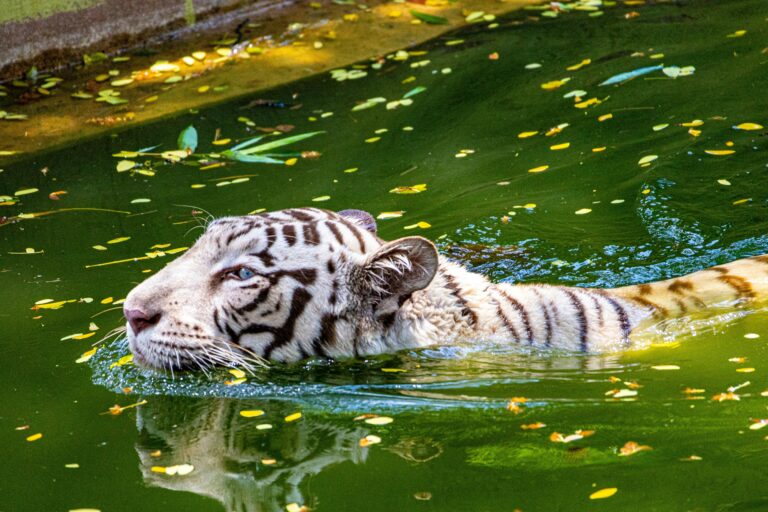
Some rows need a comment. Males in the southern Russian Far East, tracked by GPS, averaged 778 sq km, a little over half the Sikhote-Alin figure, though females at the two sites were almost the same at about 400. The reintroduced Sariska pair ranged over more ground than residents at Panna or Pench, as animals with no neighbours in an unfamiliar forest might. And the two Sundarbans females in Bangladesh, at 12 sq km, hold the smallest ranges measured for any tiger. The Sundarbans is tidal mangrove, and the Indian study there is the one our page on whether tigers can swim draws on.
For several populations there is nothing to put in the table. No home range from collared tigers has been published for Peninsular Malaysia, Myanmar or north-east China. Bhutan collared its first tigress in February 2018 and has published no range for her; a 2023 camera-trap study there estimated 151 sq km for a male and 90 for a female. Tables that give a confident figure for every subspecies are not drawn from tracking data.
How tigers mark territory
A tiger cannot patrol the edge of a range that size, so it leaves signs: scent marks, scrapes, scratches and calls that say who holds the ground and how recently they passed.
Scent is the main one. Tigers spray a mix of urine and anal gland secretion onto tree trunks and other upright surfaces along their regular routes. Field observations in Chitwan suggest a mark lasts up to three weeks (Smith, McDougal and Miquelle, 1989).
Scrapes are made by raking the hind feet through leaf litter or sand, often with urine left on the cleared patch. Claw marks on tree trunks are a third sign.
Roaring matters less than scent for spacing. A roar is usually said to carry about three kilometres, which is an estimate; nobody has published a test. Our page on tiger communication covers the calls.
Overlap, conflict, and turnover
Ranges are not exclusive. A male’s range overlaps those of several females. Overlap between two males, or between two breeding females, is much smaller. Neighbouring males fight, sometimes to the death. Females tolerate a shared strip more readily, mothers and daughters especially.
Nobody holds a range for life. In Chitwan, resident males bred for 2.8 years on average, with a spread from seven months to 6.3 years. Females bred for 6.1 years on average, and two lasted 10.5 and 12.5 years. Those figures are from the long-term Chitwan study, as given in the 2009 Handbook. In Panna one male was dominant for five and a half years, and his range shrank from over 250 sq km to 91 by the end of his tenure. A male who takes over a range often kills the cubs he finds there.
When a range falls vacant, the neighbours shift and young tigers without ranges move in.
Why territory size matters for conservation
Range size sets how many tigers a reserve can hold. A widely used benchmark for a secure breeding site is more than 25 breeding females (Walston and colleagues, 2010). At the range sizes measured in Chitwan that takes roughly 600 sq km of good habitat. At Sikhote-Alin’s it takes close to 10,000. India’s 58 tiger reserves cover 84,488 sq km between them (National Tiger Conservation Authority), under 1,500 sq km each on average, which is why the forest between reserves matters. Our page on habitat loss and tiger survival covers what is happening to it.
Space alone is not enough. In north-eastern Cambodia the forest is still there, but the last camera-trap record of a tiger dates from 2007, and WWF declared tigers functionally extinct in the country in 2016.
Dispersal: how young tigers find their first territory
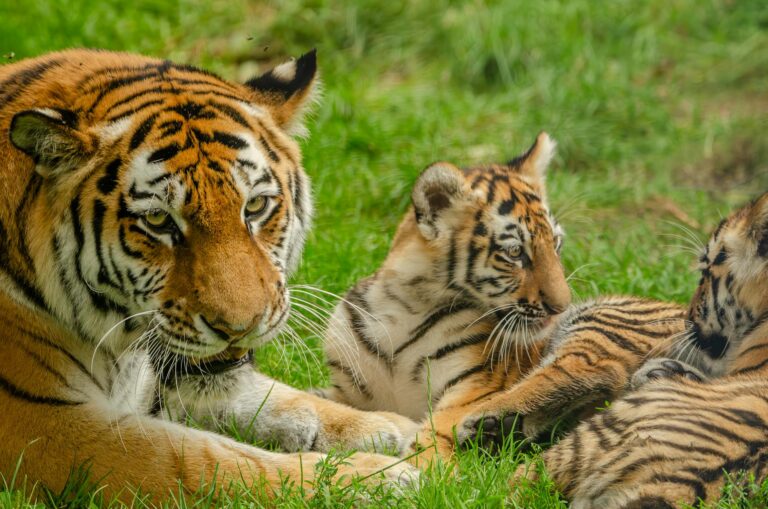
Young tigers leave their mother’s range at about a year and a half to two years old: between 19 and 28 months in Chitwan (Smith, 1993), and at 18.8 months on average for five Amur litters (Kerley and colleagues, 2003). Males go further. In Chitwan they settled 33 km from where they were born, on average, and females less than 10 km. It is the most dangerous stretch of a tiger’s life, with fights against residents, roads, snares and hunger all in play.
The longest tracked journeys are far longer. A young male collared in Maharashtra in 2019 and known as Walker left Tipeshwar Wildlife Sanctuary at 30 months old and settled in Dnyanganga, 315 km away in a straight line. His GPS collar logged about 3,000 km of walking in the 13 months it was tracked (Hussain and colleagues, 2022). In Thailand, three collared dispersers made forays of 29 to 301 km (Simcharoen and colleagues, 2022). In China, a male was recorded at Huangnihe Nature Reserve, about 270 km from the Russian border (Dou and colleagues, 2016).
Daughters usually settle next to their mother’s range or inside part of it, which is why reserves that have been watched for decades have lines of related tigresses on neighbouring ground. Dispersal also needs forest to move through. India’s reserves are linked by corridors such as Kanha to Pench, and the Bandipur, Mudumalai, Nagarahole and Wayanad block in the south.
On the Russian border the movement is international. China’s National Forestry and Grassland Administration counted 72 tigers in Northeast China Tiger and Leopard National Park in July 2026, up from 27 in 2017, and 21 tigers have been recorded moving back and forth across the border.
Related reading
- How tigers hunt
- A tour of the best-known tiger reserves
- Amur tiger profile
- External authority: IUCN Red List entry for Panthera tigris
Frequently asked questions
How big is an average tiger’s territory?
There is no useful average. Tracked females range from about 12 sq km in the Bangladesh Sundarbans to about 400 in the Russian Far East, and males from about 55 sq km at Pench to 1,385 in Sikhote-Alin. Prey density explains most of the difference.
How do tigers mark territory?
With scent sprayed on trees and other upright surfaces, scrapes raked in the ground with the hind feet, claw marks on trunks, and roars.
Do male and female tigers share territory?
Yes. A male’s range overlaps those of several females. Two males, or two breeding females, overlap far less, and neighbouring males sometimes fight.
Which tigers have the biggest territories?
Amur tigers in the Russian Far East. Males tracked in Sikhote-Alin averaged 1,385 sq km and females 390 (Goodrich and colleagues, 2010).
Which tigers have the smallest territories?
Among tracked tigers, two females in the Bangladesh Sundarbans, at 12.3 sq km (Barlow and colleagues, 2011). Females in Chitwan, Nepal, averaged about 23 sq km.
Do tigers defend their territories to the death?
Sometimes. Fights between males over a range can be fatal. Disputes between females more often end with one of them moving off.
How long does a tiger hold its territory?
In Chitwan, males bred for 2.8 years on average (seven months to 6.3 years) and females for 6.1 years, with two lasting more than a decade.
Photo: Lexi Lauwers on Pexels.
Updated 13 September 2026: aligned territory and scent marking figures with our other guides.
Updated 15 November 2026: replaced general statements with a table of measured home ranges, corrected the dispersal ages and removed a claim about the store.



Up to 400 sq km for one tiger?! Thats the whole Isle of Wight.
So the young males mostly just die? Wish I hadn’t asked.