
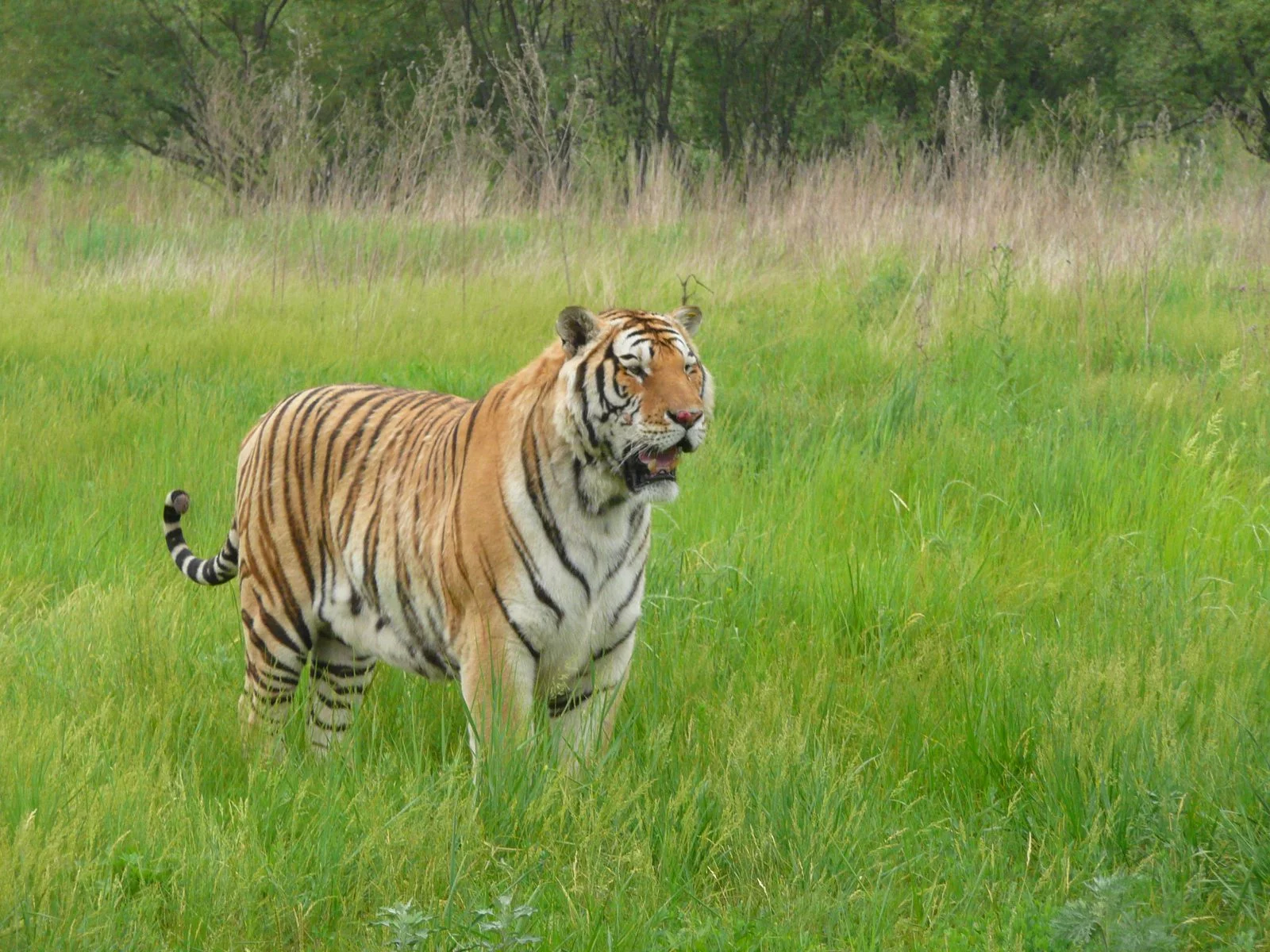
China has one wild tiger population that is growing and one subspecies it has lost. In the northeast, along the Russian border, the official count of Amur tigers reached 72 in July 2026, up from 27 in 2017. In the south, the South China tiger has not been seen in the wild since the 1970s and survives only in zoos. China also holds more captive tigers than any other country, around 6,000 on the Environmental Investigation Agency’s figures.
| Status | Wild tiger range state |
|---|---|
| Subspecies | Amur tiger (Panthera tigris altaica) in the northeast. Historically also the South China tiger (P. t. amoyensis), the Indochinese tiger in Yunnan, the Bengal tiger in southeast Tibet and the Caspian tiger in Xinjiang. |
| Current wild population | 72 wild Amur tigers in Northeast China Tiger and Leopard National Park (official count, July 2026). No South China tiger seen in the wild since the 1970s. |
Current status
Northeast China Tiger and Leopard National Park covers 14,100 square kilometres of Jilin and Heilongjiang. It ran as a pilot from 2017 and was formally established in October 2021, one of China’s first national parks alongside Giant Panda National Park. The official counts are 27 tigers and 42 Amur leopards in 2017, 50 tigers in 2021, and 72 tigers and 115 leopards in July 2026. The tigers came from Russia and still cross the border. The park adjoins Russia’s Land of the Leopard National Park, and in May 2024 the two countries agreed to join them in one cross-border reserve. Our Amur tiger profile covers the animal.
A short history of tigers in China
Five kinds of tiger once lived in China: the Amur in the northeast, the South China tiger across the centre and south, the Indochinese tiger in Yunnan, the Bengal tiger in southeast Tibet and the Caspian tiger along the rivers of Xinjiang. The country may also be where the tiger line began. The oldest known skull from that line, Panthera zdanskyi, was found at Longdan in Gansu and is between 2.16 and 2.55 million years old.
The South China tiger was the only one found nowhere else. More than 4,000 were thought to be alive in the early 1950s. It was declared a pest during the Great Leap Forward and hunted, and by 1982 the estimate was 150 to 200. The IUCN says it has not been directly observed in the wild since the 1970s. In captivity there were 247 at the end of October 2024, all descended from six founders.
The others went with less notice. The Caspian tiger is extinct. The last Indochinese tiger recorded in Yunnan was killed in a reserve in Xishuangbanna in 2009. Bengal tigers still turn up in Medog County in southeast Tibet, where camera traps photographed at least one adult male in 2019 and 2022. Researchers do not know whether any live there permanently.
Conservation programmes
The national park is the centre of China’s wild tiger work. During the pilot it closed 155 mining concessions and took out more than 4,600 km of grazing fence, according to the Chinese business daily Yicai. The Wildlife Conservation Society has worked in the area since 1998 and helped set up Hunchun Nature Reserve in 2001, and WWF China supports the park and nearby communities.
For the South China tiger the work is captive breeding. A project in South Africa has kept captive-born tigers in large enclosures since 2003 to teach them to hunt, and in June 2025 a 100-hectare rewilding base opened at Meihuashan in Fujian. No tiger has been released in China.
Notable tiger habitat
Northeast China Tiger and Leopard National Park holds the only breeding wild tigers in China. Hunchun, on the Russian border in Jilin, is where tigers cross. The South China tiger’s former range in Hunan, Hubei, Guangdong, Fujian, Jiangxi and Zhejiang has none, and a 2001 survey of eight reserves there found no sign of them.
What this means for tiger conservation
Almost all of China’s wild tigers are in one block of forest, and they got there by walking from Russia. Whether the number keeps rising depends on what the park does about prey, snares and grazing, and on the border staying open to animals. So far the trend is clear: 27 in 2017, 72 in 2026.
The captive industry pulls the other way. The Environmental Investigation Agency puts the number of captive tigers in China at around 6,000, more than the 5,574 counted in the wild worldwide in 2023. China banned domestic trade in tiger bone in 1993. In October 2018 the State Council issued a notice that would have allowed farmed tiger bone in medicine, then said two weeks later that the change was postponed; the agency says the notice has never been withdrawn. It argues, as does TRAFFIC, that farmed tigers keep demand alive, and that demand drives the poaching and illegal trade in wild tigers.
Related reading
- Tiger subspecies compared
- External authority: WCS China tiger and leopard programme
Frequently asked questions
Are there still wild tigers in China?
Yes. China’s official count for Northeast China Tiger and Leopard National Park was 72 wild Amur tigers in July 2026, up from 27 in 2017. Bengal tigers have also been photographed in southeast Tibet.
Is the South China tiger extinct?
In the wild, almost certainly. It has not been directly observed since the 1970s, and the IUCN lists it as possibly extinct in the wild. In captivity there were 247 at the end of October 2024.
How many tiger subspecies were historically in China?
Five: Amur in the northeast, South China across the centre and south, Indochinese in Yunnan, Bengal in southeastern Tibet, and Caspian in the far west.
Will tigers be reintroduced to China?
Not yet. A rewilding base for captive South China tigers opened in Fujian in June 2025, but no tiger has been released. In the northeast, tigers are returning on their own from Russia.
Is China still part of the tiger trade?
Domestic trade in tiger bone has been banned since 1993. China still has around 6,000 captive tigers on the Environmental Investigation Agency’s figures, and the agency argues that they keep demand for tiger products alive.
More tiger countries
China is usually looked at on its own, which hides the picture. Russia, North Korea, Mongolia, Myanmar and Kazakhstan are the countries whose tiger numbers connect to it.
- Tigers in Russia (wild tigers today)
- Tigers in North Korea (wild tigers lost)
- Tigers in Mongolia (wild tigers lost)
- Tigers in Myanmar (wild tigers today)
- Tigers in Kazakhstan (wild tigers returning)
All 25, grouped by whether tigers still live there: tigers by country.
Hero image: photo by Bruna Santos on Pexels.
Updated 13 September 2026: updated the national park count to 72 (2026), added Bengal tigers in Tibet and corrected captive figures.
Updated 15 November 2026: corrected the South China tiger’s last wild record and captive count, added the park’s 2021 count, the Tibet and Yunnan records and the 2018 trade notice, and fixed the image alt text.