
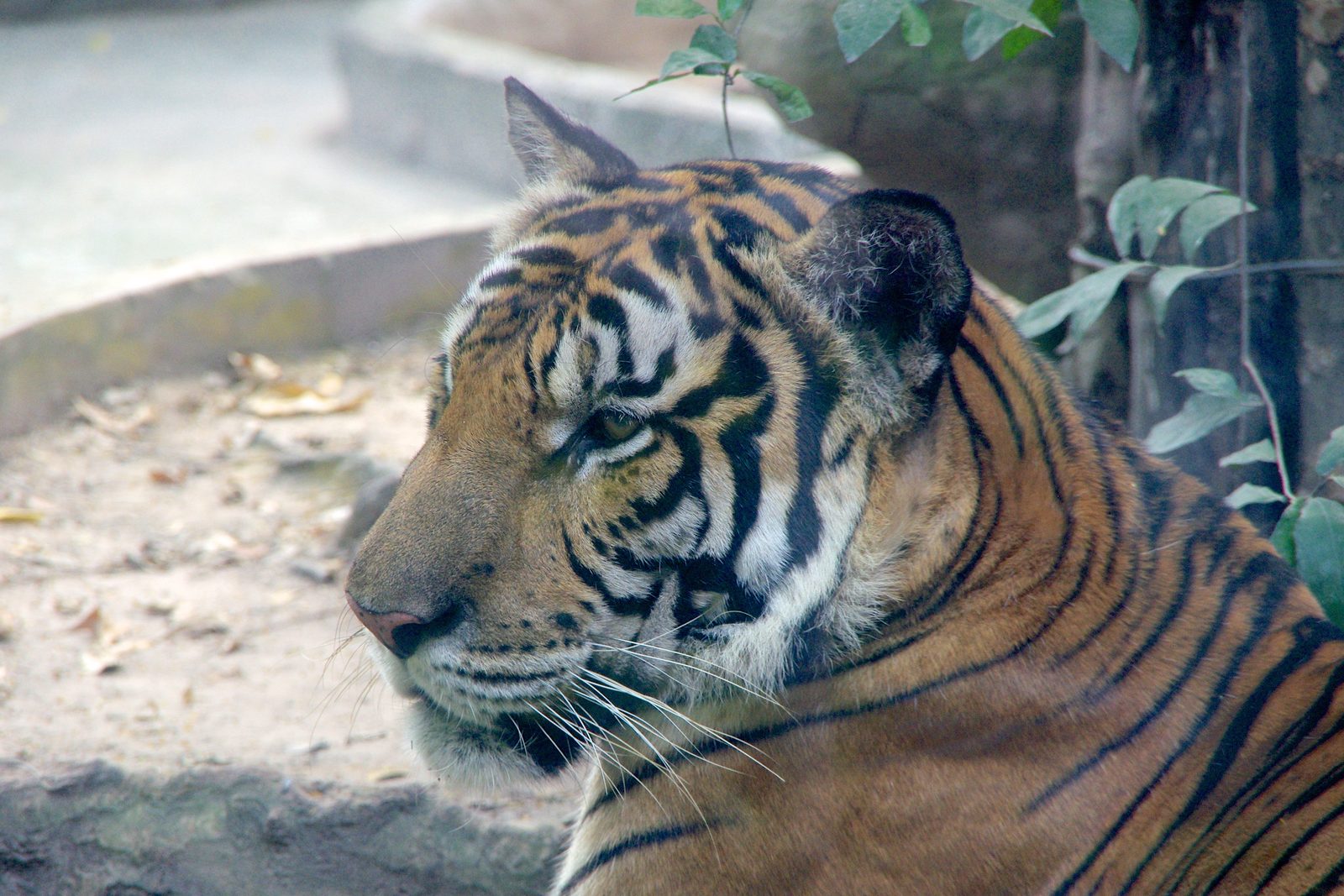
Indochinese tigers once lived the length of Vietnam. War era defoliation, post war forest clearance and poaching for the tiger bone trade removed them within a couple of generations. There is one photograph of a wild tiger in the country, taken by a camera trap at 1:30 in the morning on 21 December 1999. Nothing has been photographed since, and the IUCN’s 2022 assessment lists the tiger as extinct in Vietnam. The tigers there now are in zoos and private farms: 359 of them in January 2026.
| Status | Former range state, no current wild tigers |
|---|---|
| Subspecies | Historically Indochinese tiger (Panthera tigris corbetti). No wild tiger photographed since 1999. |
| Current wild population | Functionally extinct in the wild. The only photograph of a wild Vietnamese tiger was taken by a camera trap in Pu Mat National Park, Nghe An, on 21 December 1999. |
Current status
The Pu Mat image remains the only photograph of a wild tiger in Vietnam. The park’s director, Tran Xuan Cuong, gave the date and time to Vietnamnet in 2022 and estimated the animal at 150 to 170 kg. Other dates are in circulation: Vietnam’s 2024 Red Data Book is reported as giving 1998, and 1997 also appears. The director’s account and the IUCN both say 1999. The last sign the IUCN accepts is later, a measured footprint in Song Thanh National Park in February 2002.
The searching since has been thorough. Pu Mat rangers set camera traps 617 times between 2018 and 2020, using 200 cameras, and photographed no tiger. A larger survey under the USAID Biodiversity Conservation activity, carried out by WWF from 2019 to 2023, ran 1,176 camera trap stations in 21 protected areas across eight provinces and recorded none either. Its report noted the absence of large carnivores and large herbivores generally. Our page on how camera traps count wild tigers explains what a result like that can and cannot rule out.
A short history of tigers in Vietnam
The herbicide campaigns of 1962 to 1971, Operation Ranch Hand and the related Agent Orange spraying, stripped forest cover across large parts of the country. Economic reform from 1986 onwards sped up clearance for farming, the pattern described on our page on habitat loss and tiger survival. Demand for tiger bone glue and other tiger products paid for poaching through the 1990s. Official figures trailed the animals: the IUCN’s 2010 assessment still credited Vietnam with about 20 tigers, and the Global Tiger Recovery Program records the country’s own estimate as 10 in 2010 and 0 in 2022.
Conservation programmes
Vietnam adopted the Global Tiger Recovery Program at the St Petersburg summit in 2010, with a goal of 50 tigers that the programme said “may require translocation”. Its own National Programme on Tiger Conservation ran from 2014 to 2022. We found no successor to it and no government commitment to reintroduce tigers. A general programme for endangered species to 2030 was approved in January 2025, and the IUCN and the forestry administration are drafting a national rewilding plan due in December 2026; the announcement of that plan does not mention tigers.
Snares are the first obstacle. Between 2011 and 2017, rangers and WWF forest guards removed more than 100,000 wire snares from the two Saola Nature Reserves in the central Annamites, in what are now Hue and Da Nang. The captive tigers are a separate matter. Education for Nature Vietnam counted 385 in captivity at the end of 2023, 310 of them across 16 privately owned farms and zoos. Its January 2026 count was 359, with 286 in 17 private facilities. We found no plan to release any of them.
Notable former tiger habitat
Pu Mat National Park in Nghe An, Vu Quang in Ha Tinh, Yok Don in Dak Lak and Cat Tien in Dong Nai all held tigers within living memory. Pu Mat, on the Lao border, is where the only photograph was taken. Song Thanh, further south, produced the last accepted footprint in 2002.
What this means for tiger conservation
Tiger bone glue is made and sold in Vietnam, so part of the demand that paid for the poaching was domestic. That gives the country something it can act on without waiting for its neighbours. The trade itself is covered on our page on poaching and the illegal tiger trade.
Reintroduction is not close. The surveys above found little for a tiger to eat, and the snare counts show what would happen to one. Cambodia, which is further along, postponed its first transfer of tigers from India to 2028 in September 2026 because prey in the release area was still too scarce.
Related reading
- Indochinese tiger profile
- Tiger conservation: where things stand
- External authority: WWF Vietnam wildlife programme
Frequently asked questions
Are there any wild tigers in Vietnam?
None has been photographed since December 1999, and two decades of camera trapping have produced no confirmed record. The IUCN’s 2022 assessment lists the tiger as extinct in Vietnam.
When did tigers go extinct in Vietnam?
The last photograph is the Pu Mat National Park camera trap image of 21 December 1999, and the last accepted sign is a footprint in Song Thanh National Park in February 2002. Surveys since, including 1,176 camera trap stations across 21 protected areas from 2019 to 2023, have recorded no tiger.
Why did Vietnam lose its tigers?
War era defoliation, post war forest clearance for agriculture, and sustained poaching to feed the trade in tiger bone glue through the 1990s.
Are tigers kept in captivity in Vietnam?
Yes. Education for Nature Vietnam counted 385 captive tigers at the end of 2023 and 359 in January 2026, 286 of them in privately owned farms and zoos. That is more tigers than Thailand has in the wild.
Could tigers be reintroduced to Vietnam?
Not soon. We found no government plan to do it, and recent camera surveys show too little prey and too many snares.
More tiger countries
The decline that emptied Vietnam did not stop at the border. Laos, Cambodia, China and Thailand show how unevenly it fell.
- Tigers in Laos (wild tigers lost)
- Tigers in Cambodia (wild tigers lost)
- Tigers in China (wild tigers today)
- Tigers in Thailand (wild tigers today)
All 25, grouped by whether tigers still live there: tigers by country.
Hero image: photo by Lucas Tran on Pexels.
Updated 13 September 2026: corrected the tiger product and province names.
Updated 15 November 2026: corrected the camera trap survey figures (617 deployments with 200 cameras; 1,176 stations in 21 protected areas), what Vietnam has committed to, and the tiger bone product named in the FAQ.