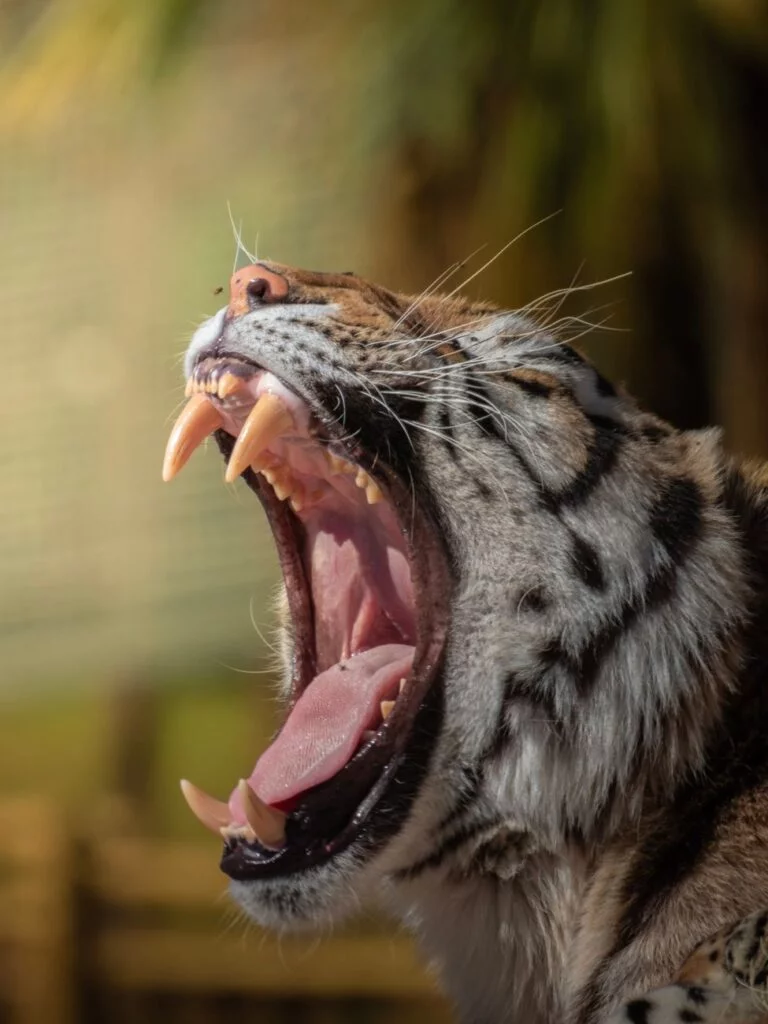
A tiger hunting at dusk relies on eyes built for low light, ears that turn towards a sound and whiskers that work at touching distance. Smell, which many people assume does most of the work, matters least for hunting.
George Schaller reached that conclusion in Kanha in the 1960s: tigers search for prey using vision and hearing. This page takes each sense in turn. Much of the detailed physiology was measured in domestic cats, and the text says where that is the case. Hearing is the exception, because tigers themselves have been tested.
Eyes built for dusk
A tiger’s eyes face forward, so their fields of view overlap. That gives binocular vision and with it the depth judgement a stalking cat needs, as SeaWorld’s species notes put it. Unlike a house cat’s slit pupils, a tiger’s pupils are round, a shape the San Diego Zoo Wildlife Alliance fact sheet describes as better suited to working in daylight.
Behind the retina sits a reflective layer called the tapetum lucidum. Panthera describes it as a layer that gives wild cats the ability to see in low light, acting “like a retroreflector” that bounces light back through the retina. Light that missed the light-sensing cells the first time gets a second chance. This is also why a tiger’s eyes glow when a torch hits them at night.
SeaWorld says a tiger’s eyes hold more rods than cones, and rods are the cells linked to night vision. Cats in general need only about one sixth of the light a human needs to see, a figure given on both the SeaWorld page and in the overview of cat senses. That figure is for cats as a group. We found no measurement of it in tigers, so treat it as a rule of thumb.
Panthera adds a limit: the tapetum “still requires some ambient light to function effectively”. A tiger cannot see in total darkness, and the same article notes that tigers approach prey at dusk.
The price of seeing in the dark
Good low-light vision costs something. In dim light a tiger’s pupils open wide, and SeaWorld notes that dilated pupils help night vision but make it hard to focus on objects close up. Colour suffers too: research on cats in general suggests they see green, blue and possibly red, less vividly than people do. The deer a tiger hunts see fewer colours still, which is part of why tigers have orange coats and stripes.
Ears like radar dishes
SeaWorld calls hearing the most acute of the tiger’s senses, used mainly for hunting, and likens the ears to radar dishes that rotate to find where a sound came from. The upper limits usually quoted, 60 kHz on the SeaWorld page and 64 kHz in the cat senses article against about 20 kHz for people, are for domestic cats. Tigers have been tested directly. Edward Walsh and colleagues measured hearing in zoo tigers under anaesthetic and found them most sensitive at 300 to 500 hertz and able to hear below the 20 hertz floor of human hearing. The frequency most represented in close-range roars is 300 hertz. A 2012 study from the same group reported that the tiger’s upper limit is lower than a house cat’s. That points to an ear tuned for the low calls of other tigers as much as for the rustle of prey.
Direction matters as much as pitch. The ears rotate towards a sound, which lets a tiger place a rustle in the undergrowth before it can see what made it. For how the whole hunt unfolds, see How Tigers Hunt: Stalk, Ambush, Kill, and for the animals on the receiving end, what tigers eat.
Whiskers: the sense you do not see
SeaWorld lists five types of whiskers on a tiger, on the muzzle, above the eyes, on the cheeks, on the back of the front legs and scattered over the body. The big ones on the muzzle are the mystacial whiskers, and the facial whiskers run about 15 centimetres (six inches) long.
According to SeaWorld the muzzle whiskers are used when attacking prey and moving in the dark, and the tiger “uses these whiskers to sense where they should inflict a bite”. The cat senses article adds that nerve endings in the whiskers give cats detailed information about nearby air movement, so a cat can know it is near an obstacle without seeing it.
Whiskers, then, work at touching distance. Eyes and ears find the prey, and the whiskers help place the bite once it is too close to focus on. Tiger teeth, claws and paws covers what the bite does.
Smell is for messages, not hunting
Many people expect a tiger to track prey by scent the way a dog would. SeaWorld says the tiger’s sense of smell is less acute than its other senses and is generally not used for hunting. The San Diego Zoo Wildlife Alliance gives the anatomy behind that: cats have fewer scent-detecting cells than dogs and a smaller olfactory bulb in the brain. Tigers use smell mainly to read each other.
That fits what tigers do with scent. They have a Jacobson organ in the roof of the mouth, and the behaviour that goes with it is flehmen. Both males and females show a flehmen response, a curled-lip grimace, when smelling urine markings. If you want the full picture of marks, roars and calls, read Tiger Communication: Roars, Marks, and Calls.
What this adds up to
| Sense | What it does | Measured in tigers? |
|---|---|---|
| Sight | Low-light vision and depth judgement during the stalk | No. The one-sixth light figure is for cats in general |
| Hearing | Finds and places prey, and picks up other tigers | Yes. Most sensitive at 300 to 500 hertz (Walsh and colleagues) |
| Touch (whiskers) | Helps place the bite at close range | Length only: about 15 cm on the face |
| Smell | Reads scent marks left by other tigers | No measurement found |
Three of the four rows rest on cats in general. We found tiger-specific measurements only for hearing, so treat the other figures as guides.
If you have watched tigers in a reserve or a good zoo and noticed how they use their ears or whiskers, tell us in the comments.
Sources
- Panthera: The Spooky Science of Glowing Eyes in Cats
- SeaWorld: Tiger senses
- Wikipedia: Cat senses
- Wikipedia: Tiger
- San Diego Zoo Wildlife Alliance: Tiger fact sheet, physical characteristics (summarises Walsh and colleagues, 2008; we could not find that paper itself)
- Walsh and colleagues (2003), Acoustic communication in Panthera tigris, Acoustical Society of America, lay language paper
- Bergevin, Walsh, McGee and Shera (2012), Probing cochlear tuning and tonotopy in the tiger using otoacoustic emissions, Journal of Comparative Physiology A
Photo: JL Dixon, Pexels Licence, via www.pexels.com.
Updated 15 November 2026: added hearing measurements made on tigers themselves, corrected the source of the 64 kHz figure for cats, and noted that tigers have round pupils.
Updated 18 November 2026: added the 2003 primary hearing report and noted that the 2008 figures come from a zoo summary.