
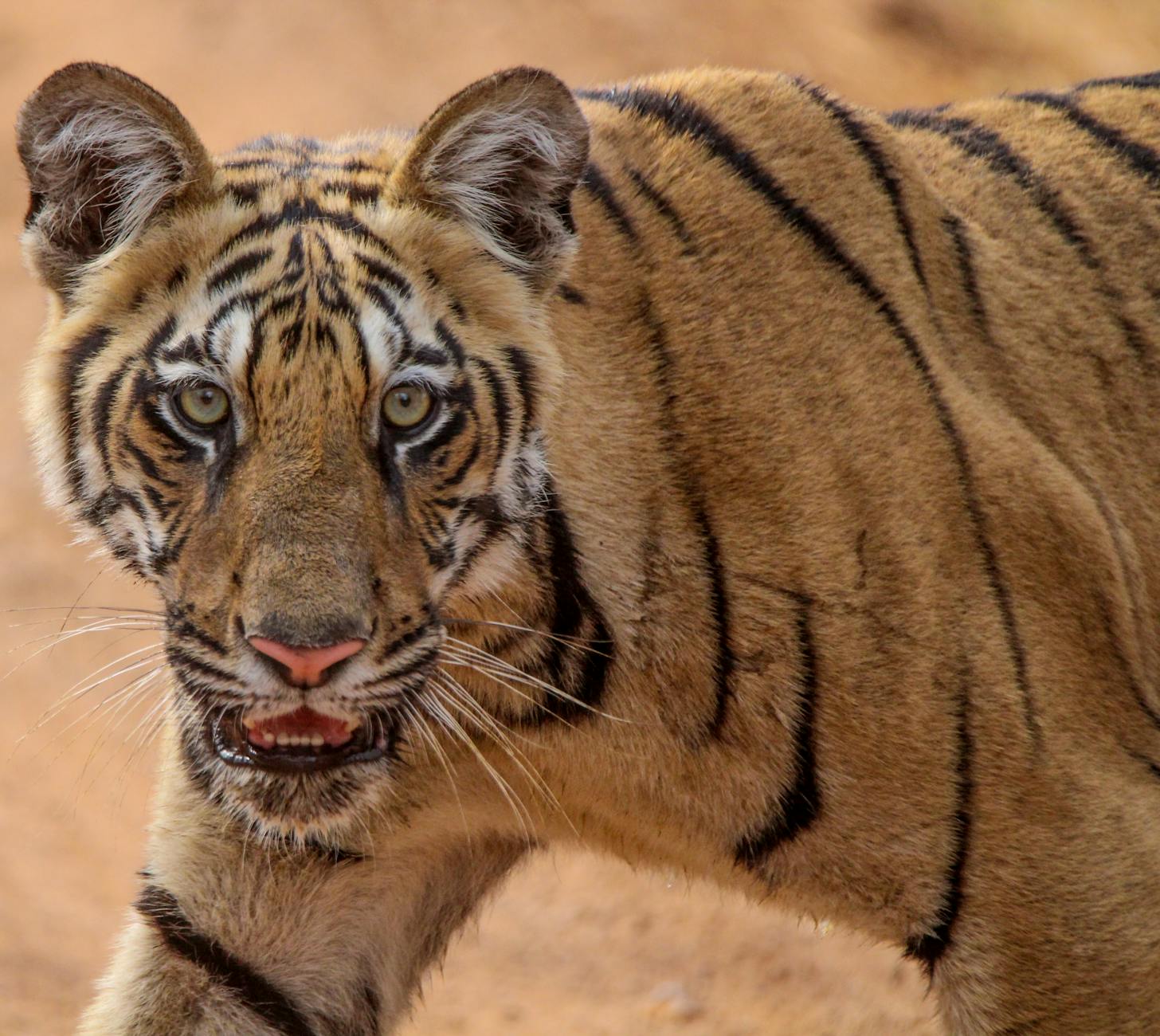
Tigers and leopards share a lot of ground in Asia. They are both big cats and both ambush hunters, and camera traps in Indian reserves photograph them on the same trails. Tigers are also known to kill leopards.
They differ in size, in what they hunt and in where they can live. This is a side-by-side look at how they compare.
Key facts
- Tigers: typically 90 to 260 kg, body length up to 3 m including tail
- Leopards: typically 30 to 70 kg, head and body up to 1.8 m, plus a tail of up to 1 m
- Tigers have stripes; leopards have rosettes
- Both are solitary, territorial, and ambush hunters
- Leopards are far more widespread and adaptable than tigers
- Where ranges overlap, leopards usually defer to tigers
Size and build
The most useful single difference is size. A grown tiger is three to five times heavier than a leopard. Male Bengal tigers weigh 200 to 260 kg and stretch close to 3 m from nose to tail tip. Male leopards weigh 31 to 72 kg and are much shorter. Females are smaller in both species.
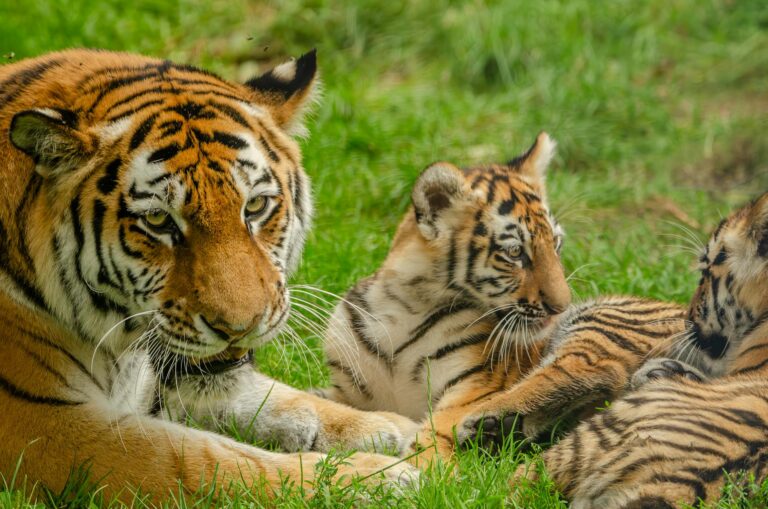
The build follows the size. Tigers have heavier shoulders, deeper chests and thicker forearms. Leopards are leaner and built for hauling prey upwards: one was seen dragging a young giraffe of nearly 125 kg more than 5 m up a tree. A full-grown tiger is too heavy to climb well, though cubs under 16 months do it routinely.
Coat and markings
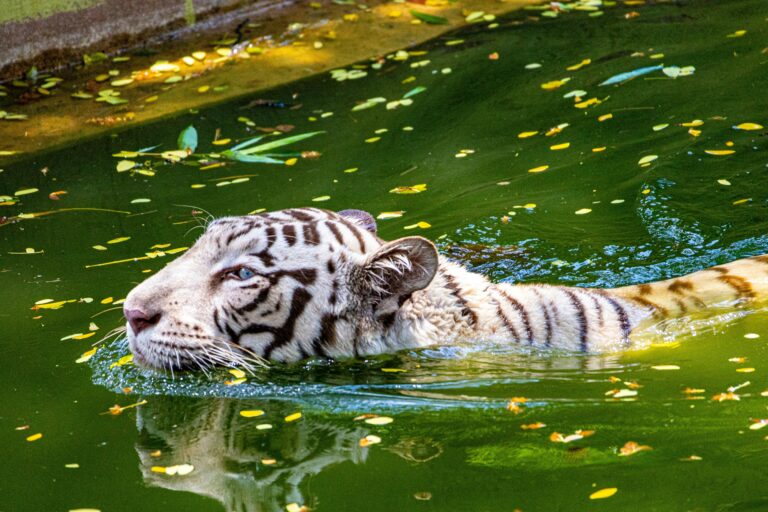
Tigers have vertical black stripes on a tawny base. The pattern differs from one tiger to the next and from one flank to the other, and the skin underneath carries it too. Field researchers use the patterns to identify wild tigers from camera-trap photos, and our page on why tigers have stripes explains what they are for.
Leopards have spots, but those spots are rosettes: small clusters of dark spots forming a ring around a slightly darker centre. The shape varies by region. Rosettes are circular in East African leopards, squarer in southern Africa and larger in Asian populations. Cubs look darker because their spots are packed closely in woolly fur. Melanistic leopards, the so-called black panthers, look uniformly dark but still carry rosettes under good light.
If a photograph is too dark or distant to make out fur patterns, body proportions usually settle it. The tiger looks heavier through the shoulder. The leopard looks longer through the back and lower to the ground.
Where they overlap
Tigers and leopards share habitat across much of South and Southeast Asia. India is the obvious example. Major reserves including Ranthambore, Bandhavgarh, Kanha, Tadoba, and Nagarhole all hold both species. Leopards are more widespread overall: Panthera pardus ranges across Africa and much of Asia, while Panthera tigris is restricted to fragments of Asian forest.
Where they overlap, they divide the landscape. Leopards survive close to villages, near roads and in patches of forest too small for tigers, while tigers hold the dense, prey-rich core. The pattern has been measured. In Rajaji National Park in northern India, leopard densities fell as tigers recovered during the 2000s (Harihar, Pandav and Goyal, 2011). Where prey is plentiful the two can live side by side: in Nagarhole they were separated mainly by the size of the animals they killed.
Hunting style and diet
Both species are solitary ambush predators that rely on cover and a short rush, and our page on how tigers hunt covers the tiger’s version. The differences are in scale and in what happens to the kill.
- Tiger prey: typically large ungulates (chital, sambar, gaur, nilgai, wild boar). A tiger can take down a young gaur or a buffalo, animals well over its own weight.
- Leopard prey: smaller ungulates, monkeys and langurs, ground birds, and small to medium livestock. In Nagarhole the average leopard kill weighed 37.6 kg and the average tiger kill 91.5 kg, a gap explored in what tigers eat.
- Caching: leopards drag kills up trees to hide them from lions, hyenas, tigers, and dholes. Tigers cache on the ground, often near water, and may stay with a kill for several days.
- Kill technique: both apply a throat or nape bite. A tiger has the mass to bring down and hold prey much larger than itself. A leopard relies more on precision and on the speed of suffocation.
Diets overlap where ranges do. In Kui Buri National Park in Thailand, as the preferred hoofed prey declined, tigers, leopards and dholes all shifted towards smaller animals (Steinmetz and colleagues, 2021). Leopards are the more flexible of the two. More than 100 prey species have been recorded for them, and the largest kill on record is reported to be a male eland of 900 kg.
Behaviour and tolerance of people
Both cats avoid people most of the time. The difference is that leopards are good at living in landscapes people have changed. There are well-studied leopard populations in and around Sanjay Gandhi National Park in suburban Mumbai and in farmland elsewhere in India, and in towns domestic dogs are an important part of their diet.
Tigers do not do this. A tiger that ends up near a town is usually a sub-adult dispersing through unfamiliar ground, or an injured or sick individual. Tigers are not city animals, which is one reason tiger conservation rests so heavily on large, connected protected areas, while leopard conservation has more to do with managing human-wildlife conflict.
What about strength and “who wins”
People love this question. A healthy adult tiger against a leopard is not a contest. The tiger is three to five times heavier, and a 2023 review of how tigers, leopards and dholes interact across Asia found that tigers typically dominate both, through chasing, stealing kills and outright killing. Leopards survive by avoidance.
This is why “tiger vs leopard” as a question is mostly answered by the leopard moving out of the way. In landscapes with both species, leopards are the ones doing the adjusting. For more on how tigers compare with the other big cat they are most often set against, see our piece on tiger vs lion: what actually differs.
We also have a short guide to the most persistent tiger myths and a deeper look at famous wild tigers.
FAQs
What is the main difference between a tiger and a leopard?
Size and pattern. Tigers are three to five times heavier than leopards and have vertical stripes. Leopards are smaller, more wiry, and have rosette-shaped spots.
Do tigers and leopards live in the same places?
Yes, across much of South and Southeast Asia. Many Indian tiger reserves hold both species. Leopards are more widespread overall, with populations across Africa and most of Asia.
How do tigers and leopards avoid each other?
Mostly by dividing the landscape. In forests with many tigers, leopards tend to take the edges and hunt smaller prey. In Rajaji National Park, leopard densities fell as tigers recovered.
Can a leopard beat a tiger?
In a direct fight, no. The tiger is much larger and stronger, and tigers are known to kill leopards. Leopards survive by keeping out of the way.
Why do leopards drag kills up trees?
To keep kills safe from larger competitors. In Asia those competitors include tigers and dholes; in Africa they include lions and spotted hyenas. Caching in trees buys the leopard a quiet meal.
Are leopards more dangerous to people than tigers?
It depends on the region, and we found no reliable combined figures. Leopards live closer to people, so encounters with them are more frequent. Most tiger incidents happen around particular reserves.
Is a black panther a tiger or a leopard?
Usually a leopard with melanism, a genetic variant that produces an almost black coat with the rosettes still faintly visible. Tigers have no true melanistic form, but pseudo-melanistic tigers with unusually broad, merged stripes do occur, almost all of them in and around Similipal Tiger Reserve in Odisha, India.
Sources
- Harihar, Pandav and Goyal (2011), Journal of Applied Ecology: Responses of leopard Panthera pardus to the recovery of a tiger Panthera tigris population
- Karanth and Sunquist (1995), Journal of Animal Ecology: Prey selection by tiger, leopard and dhole in tropical forests
- Srivathsa and colleagues (2023), Biological Reviews: Topcats and underdogs: intraguild interactions among three apex carnivores across Asia’s forestscapes
- Steinmetz and colleagues (2021), Integrative Zoology: The effects of prey depletion on dietary niches of sympatric apex predators in Southeast Asia
- Athreya and colleagues (2014), Oryx: A cat among the dogs: leopard Panthera pardus diet in a human-dominated landscape in western Maharashtra, India
- Sagar and colleagues (2021), PNAS: High frequency of an otherwise rare phenotype in a small and isolated tiger population
- Wikipedia: Leopard
- Wikipedia: Tiger
Updated 13 September 2026: corrected leopard size figures and two wording errors.
Updated 15 November 2026: corrected how leopard rosettes vary by region, replaced an unsupported claim that leopards turn nocturnal around tigers with measured examples from Rajaji, Jigme Dorji and Nagarhole, and sourced the weights.
Updated 28 November 2026: added a sources list, corrected the Kui Buri prey finding, and removed a Jigme Dorji example the study does not support, and corrected the leopard body length.




You’d think nobody could mix the two up, but we had a ‘tiger’ reported on our village Facebook group last year (Hampshire!) which turned out to be somebody’s Bengal cat. So I suppose a guide does no harm.
I always thought leopards took kills up trees because of hyenas (Africa brain). In India it’s tigers. Huh.
Meanwhile there are leopards living inside Mumbai. A tiger could never.