

“Tiger vs lion” is one of the most-asked questions about big cats, and most of the answers online are guesses. The two species are close relatives of similar size, and they differ most in where they live and in how they live with each other.
This page sets out the differences in habitat, social life, hunting and anatomy, with sources for the figures, and says where nothing has been measured.
Key facts
- Tigers live in forest, grassland, and mangrove across Asia. Lions live in savanna and open woodland across sub-Saharan Africa, plus one remnant population in and around Gir Forest, Gujarat, India, which numbered 891 at the May 2025 census.
- Tigers are solitary. Lions live in prides and hunt cooperatively.
- Male lions average about 175 kg in East Africa and 187 to 225 kg in southern Africa. Male Bengal tigers weigh 200 to 260 kg, and wild Amur males average about 176 kg.
- There is no wild range overlap today. The Gir lions and the nearest wild tiger populations do not share landscapes.
- On the IUCN Red List the tiger is Endangered and the lion is Vulnerable.
Habitat: where they actually live
The simplest difference is geographic. Tigers are cover-dependent animals. Their range across Asia covers tropical rainforest (Sumatra), mangrove (the Sundarbans), dry deciduous forest (much of India), montane mixed forest (Bhutan, southwest China), boreal taiga (the Russian Far East), and grassland mosaic (the Terai, Indochina). The unifying feature is cover. Tigers need terrain that lets them close the distance on prey before the final rush.
Lions are open-country animals. African lions occupy savanna, open woodland, scrub and the edges of arid country. The lions of Gujarat live in dry forest and scrub, and at the May 2025 census more than half of the 891 counted were living outside the protected forest areas.
The separation today is complete. Tigers do not occur naturally anywhere in Africa. Lions are absent from Asia except for the Gir population, which is a surviving remnant of the historical Asiatic lion range rather than an introduction. There is no current wild range overlap between the two species.
Social structure: solitary versus pride
The biggest behavioural difference is social, and most of the other differences follow from it.
Tigers are solitary outside of mating, cub rearing and occasional shared kills. A male’s range takes in those of several females: in Sikhote-Alin in the Russian Far East, resident males overlapped up to five. Cubs leave their mother at around 18 months to 2 years, and from then on young males are treated by adult males as competitors, while mothers often tolerate daughters settling next door. Our page on tiger territory and range has the detail.
Lions live in prides. An average pride has around 15 lions: a stable core of related females, their cubs, and up to four adult males, often brothers or allies in what is called a coalition. The females stay for life and the males are eventually displaced by a rival coalition. Prides defend territory and hunt together.
This difference is why most “tiger vs lion fight” scenarios are nonsense. One tiger against one lion is a contest that does not happen, because in the wild the two never meet.
Hunting style
A tiger hunts alone by ambush. It stalks close, makes a short rush, and either kills or gives up and tries again later. Most attempts fail: Animal Diversity Web gives one success in 10 to 20 attacks, and published estimates run from 5 to 50 percent. Tigers regularly take prey their own size or larger, such as sambar, gaur and wild boar.
Lions usually hunt in groups, and it pays. In George Schaller’s Serengeti study, lions hunting alone killed in 37 of 249 hunts (15 percent) and groups in 82 of 273 (30 percent). Groups also bring down very large prey such as Cape buffalo.
A single tiger can kill very large prey. What a pride gives a lion is a better success rate.
Body size and physical comparison
The size comparison is closer than the internet usually suggests, and it depends on which populations are compared.
| Measure | Tiger | Lion |
|---|---|---|
| Adult male weight | Bengal: 200 to 260 kg. Wild Amur: average about 176 kg | Southern Africa: 187 to 225 kg. East Africa: average about 175 kg. India: 160 to 190 kg |
| Adult female weight | Bengal: 100 to 160 kg. Wild Amur: average about 118 kg | Southern Africa: 118 to 144 kg. East Africa: about 120 kg. India: 110 to 120 kg |
| Bite force at the canines | 1,234 newtons, estimated from skulls (Christiansen, 2007) | 1,594 newtons, measured from a living lioness (Van der Meijden and colleagues, 2023) |
| Social life | Solitary | Prides averaging about 15 lions |
| Wild population | 5,574 (Global Tiger Forum, 2023) | About 23,000 adults and subadults in Africa (IUCN, 2023), and 891 in India (2025 census) |
| IUCN Red List | Endangered | Vulnerable |
| Share of historical range still occupied | 7 percent or less | About 6 percent |
Wikipedia’s reading of the weights is that the tiger’s average size may be less than the lion’s, while the largest tigers are bigger than the largest lions. The record usually quoted for the second half needs a caveat. A male Bengal tiger shot in the Himalayan foothills in 1967 weighed 388.7 kg, but it had just eaten a buffalo calf, so the figure overstates its normal weight. For Amur tigers, no verified weight from the wild exceeds 300 kg.
Skulls and jaws are very similar. The San Diego Zoo Wildlife Alliance notes that the tiger’s lower jaw is nearly straight where the lion’s curves slightly upward, and that tigers have longer lower canines. The popular claim that one cat has a clearly stronger bite is not supported. The two figures in the table were obtained in different ways, one calculated from skulls and one measured from a living animal, so they cannot be compared. Our page on tiger teeth, claws and paws explains where the numbers come from.
For the population biology of both species, the IUCN Red List tiger assessment and the equivalent lion assessment are the reference documents.
What follows from the social difference
Territorial signalling: tigers use scent marking and calls to keep solitary individuals spaced apart, and avoid direct encounters where they can. Lions use chorus roaring to defend pride territory against rival coalitions, and conflict between coalitions is a major cause of adult male death.
Cub care: tiger cubs are raised by their mother alone. Lion cubs are raised collectively, with related lionesses pooling cubs and males contributing to defence. Infanticide by an incoming male happens in both species, but in lions it arrives as a coalition takeover and hits a whole cohort of cubs at once.
Water: tigers swim readily and lie up in water in hot weather. Collared Sundarbans tigers crossed about five tidal channels a day. Lions swim when they have to and mostly avoid it. Our page on how well tigers swim has the tracking data.
They can interbreed, but only in captivity
Tigers and lions produce hybrid offspring in captivity: ligers (male lion with female tiger) and tigons (male tiger with female lion). Ligers can grow very large. Hercules, a liger at a South Carolina facility, is listed by Guinness World Records as the largest living cat at 418.2 kilograms. The usual explanation for liger size involves imprinted growth genes inherited differently from each parent species, which is a plausible mechanism rather than a settled one.
Hybrids have no conservation value. They occur only in captivity because the wild ranges do not overlap. Male ligers are sterile, while females are often fertile, and credible sanctuaries refuse to breed them on welfare grounds. Hybrids turn up mainly in private collections and unaccredited zoos.
Which one is “better”?
If you mean which is the better individual fighter, there is no dataset that answers it. The two species are comparable in size, they do not meet in the wild, and the handful of captive encounters people cite are anecdotes from unrepresentative circumstances. Anyone offering you a confident ranking is guessing.
If you mean which species is doing better, the answer is clearer. The Global Tiger Forum put the wild tiger population at 5,574 in 2023, and the IUCN lists the tiger as Endangered. The IUCN’s 2023 lion assessment used an estimate of about 23,000 adult and subadult lions in Africa, and Gujarat counted 891 in May 2025, up from 674 in 2020. The lion is listed as Vulnerable. Both have lost most of their historical range: tigers occupy 7 percent or less of theirs, and lions about 6 percent.
If you mean which is more interesting, that is a matter of taste. We run a tiger blog, so we are biased.
For more on tiger biology, see our tiger facts guide. For the global population picture, see how many wild tigers are left.
For tiger-themed merchandise, visit our paired store at store.welovetigers.org.
Frequently asked questions
Are tigers bigger than lions?
On average they are close. Male Bengal tigers weigh 200 to 260 kg and male lions in southern Africa 187 to 225 kg, while wild Amur tigers and East African lions both average about 175 kg. The heaviest wild tiger on record, at 388.7 kg, had just eaten.
Do tigers and lions ever meet in the wild?
No. Their historical ranges overlapped across parts of western and northern India and the Middle East, but lions were wiped out there long ago. The surviving Asiatic lions in Gujarat share no landscape with any wild tiger population.
Are tigers solitary or social?
Solitary. Adult tigers hold individual territories and avoid each other except during mating and cub rearing. This is the largest behavioural difference from lions, which live and hunt in prides.
Which is the better hunter, tiger or lion?
They hunt differently. Tigers ambush alone and most attempts fail. In Schaller’s Serengeti study, lions in groups succeeded about twice as often as lions hunting alone, 30 percent against 15 percent.
Can tigers and lions interbreed?
Yes, but only in captivity, since the wild ranges no longer overlap. The hybrids are called ligers and tigons. Male ligers are sterile, females are often fertile, and credible sanctuaries refuse to breed them.
Do lions have a stronger bite than tigers?
Nobody knows. The published tiger figure was estimated from skulls and the best lion figure was measured from a living lioness, so the two cannot be compared. The confident claims either way are not supported.
Why do tigers swim but lions avoid water?
The usual explanation is habitat. Tigers live among rivers and swamps and use water to cool down, while lions live mostly on open savanna. It is a reasonable account that nobody has tested.
Which species is more endangered?
The tiger. It is listed as Endangered by the IUCN, with 5,574 wild individuals reported by the Global Tiger Forum in 2023. Lions are listed as Vulnerable, with about 23,000 adults and subadults in Africa (IUCN, 2023) and 891 in India (2025 census).
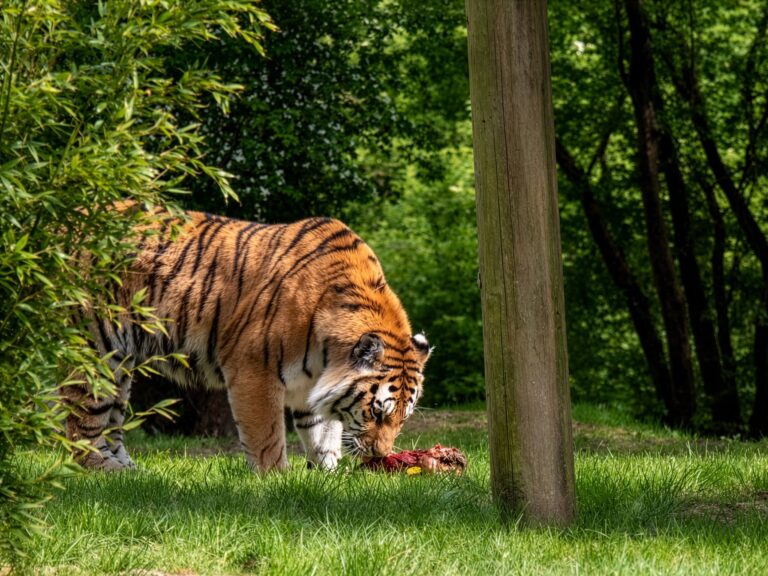
Photo: Hugo Sykes on Pexels.
Updated 13 September 2026: corrected the weight comparison and how young tigers disperse.
Updated 15 November 2026: replaced the shared 180 to 220 kg weight band with sourced figures by population, noted that the record 388.7 kg tiger had just eaten, updated lion numbers (IUCN 2023 and the 2025 Gujarat census) and range figures, and corrected the bite force and hybrid fertility statements.



ok I came here fully ready to argue in the comments about who wins and you didnt even pick one. fair enough I guess. (its the tiger though)
Small addition, India has lions too, in Gir. They just never meet the tigers, too far apart.
a lion has the pride, a tiger has nobody. kind of sad actually
Thank you for not making a fuss about ligers. My grandson is obssessed with them because of some YouTube channel and I never know what to tell him.