
A lot of what people repeat about tigers is wrong. Most of it is harmless. One myth, that tiger bone is medicine, gets tigers killed. Here are eight that come up often, with the evidence for each.
Key facts
- White tigers are not albinos and not a separate subspecies
- Most wild tigers actively avoid people
- Tigers are not “the same all over”: subspecies differ in size, range and habitat
- Tigers cannot purr in the smooth, continuous way a domestic cat does
- Tiger bone medicines have no demonstrated medical value
Myth 1: White tigers are a separate species (or albinos)
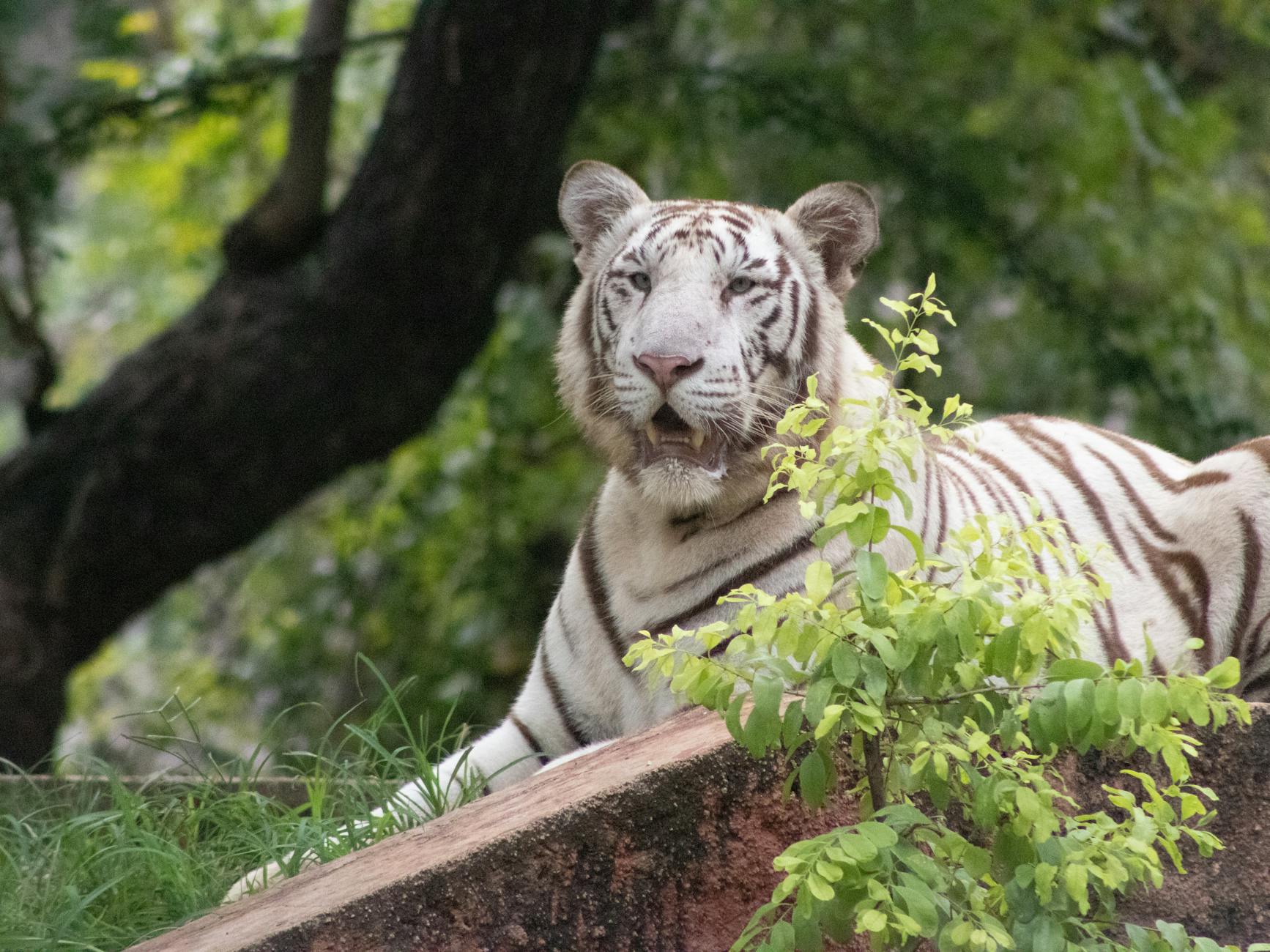
White tigers are Bengal tigers carrying a recessive gene that reduces pigment in the fur. They still have stripes, just on a pale base, and their eyes are typically blue, not the pink eyes of a true albino. They are not a subspecies and not a different kind of tiger.
Almost every white tiger alive today traces back to one male, Mohan, captured in the forests of Rewa in what is now Madhya Pradesh in 1951. To make more white tigers, breeders had to mate close relatives, and the captive population has paid for it in crossed eyes, other inherited defects and high cub mortality. For the full picture see our piece on why white tigers exist and why they should not be bred.
Myth 2: Tigers eat people regularly
They do not. Wild tigers across most of their range avoid people, and most encounters end without contact. India holds the largest wild population, 3,682 in the 2022 All India Tiger Estimation, in a country of more than a billion people. Figures the environment ministry gave Parliament show 82 human deaths from tiger attacks in 2023 and 73 in 2024. Each one is a disaster for a family. Set against the number of people who live and work beside tigers, the total is small.
Individual tigers do become man-eaters, usually when injured, very old, or pushed into degraded habitat with little prey. The Champawat tigress is the most famous case. Jim Corbett credited her with 436 deaths across Nepal and the Kumaon hills before he shot her in 1907. He found two of her canine teeth broken by an old gunshot wound, which is why she could no longer take natural prey. We tell that story in our profile of the Champawat tigress.
Myth 3: All tigers are the same
Tigers are one species, Panthera tigris, but they vary a lot across their range. Amur and Bengal tigers are the largest. Wild Amur males weighed by the Siberian Tiger Project average about 176 kg, and the heaviest radio-collared male weighed 212 kg. Older sources gave the Amur tiger a clear size lead over the Bengal, and modern field weights do not support it. The Sumatran tiger is the smallest, with males around 100 to 140 kg, adapted to dense rainforest. Indochinese and Malayan tigers fall in between.
Three subspecies have gone extinct in modern times: the Caspian, Javan and Bali tigers. The IUCN Cat Specialist Group’s 2017 revision groups the survivors into just two subspecies, mainland and Sunda, while most field and conservation literature still works with the traditional six, as our guide to tiger subspecies explains.
Myth 4: Tigers cannot swim
The opposite is true. Tigers are strong swimmers and use water on purpose. They cool off in pools, cross rivers to reach hunting grounds, and in the Sundarbans they swim between mangrove islands. Lions swim when they have to, but it is not part of their daily routine the way it is for tigers.
The mangrove tigers of the Sundarbans, split between India and Bangladesh, cross tidal channels as a matter of course, and the people who fish and collect honey there work with that in mind. More detail in can tigers swim.
Myth 5: Tigers purr like house cats
The four roaring cats (tigers, lions, leopards and jaguars) are built differently in the throat from the cats that purr. Their hyoid, the bone that supports the larynx, is only partly bony and more flexible. A 2002 anatomical study by G. E. Weissengruber and colleagues also found pads of tissue on their vocal folds that would make purring difficult or impossible. Tigers have been reported making purr-like sounds, but these may not be true purrs, meaning the continuous rumble a domestic cat keeps up while breathing in and out. Cheetahs and pumas do purr.
What tigers do have is the chuff, also called prusten: a soft, breathy puffing exchanged between friendly animals, particularly mothers and cubs, and between captive tigers and keepers they know. Our piece on tiger communication covers the rest of the repertoire.
Myth 6: There are still plenty of tigers in the wild
The Global Tiger Forum put the wild population at 5,574 in its 2023 estimate and 5,711 in 2025. That is up from a low of around 3,200 in 2010, and the recovery is real, but it is a fraction of the estimated 100,000 at the start of the 20th century. We work through the current count in how many wild tigers are left.
This is often paired with the claim that the United States alone holds more captive tigers than exist in the wild. Treat it with care. Estimates of the American captive population start around 5,000, but there is no official count, a 2005 census found 4,692 and a 2011 census 2,884, and the higher figures have been challenged as inflated. The comparison was built when the wild total stood near 3,200, and it does not hold against 5,574. Captive tigers do nothing for wild populations all the same: their ancestry is usually mixed across subspecies, they are used to people, and they have never hunted. Our page on tigers in the United States has the detail.
Myth 7: Tiger parts have medicinal value
Traditional Chinese medicine has used tiger bone and other parts for centuries. No controlled trial has shown a medical effect for any of them beyond placebo. China banned the trade in tiger bone in 1993 and removed it from the official list of medicinal ingredients. In October 2018 the government announced it would allow bone from farmed tigers to be used in hospitals, then postponed the change two weeks later after an outcry and said the ban stayed in force.
Demand is what keeps tiger poaching profitable, so groups including Panthera and TRAFFIC work on reducing demand and on monitoring trade routes.
Myth 8: Tigers and lions used to fight in the wild all the time
Tigers and lions do not overlap today. Lions live in sub-Saharan Africa, plus the Asiatic lion population centred on Gir in Gujarat, where there are no tigers. Their ranges did once meet across parts of India and southwest Asia, but there is no good evidence that the two met often.
The fights people have in mind are Roman arena shows and staged contests in the 19th century, both with captive animals. For the actual comparison, see tiger vs lion: what actually differs.
FAQs
Are white tigers albino?
No. White tigers carry a recessive pigment-reducing gene and have blue eyes, not pink. True albinism is a different condition and has not been reliably documented in wild tigers.
Do tigers normally hunt humans?
No. Most wild tigers avoid people. India’s environment ministry reported 82 human deaths from tiger attacks in 2023 and 73 in 2024, against a wild population of 3,682 on the 2022 estimate. Man-eating cases usually trace to an injured or old animal.
Are all tigers the same?
No. Amur and Bengal tigers are the heaviest, with wild Amur males averaging about 176 kg, while Sumatran males run 100 to 140 kg. Three subspecies, the Caspian, Javan and Bali, are already extinct.
Can tigers swim?
Yes, very well. Tigers swim across rivers, cool off in pools, and in the Sundarbans they routinely swim between mangrove islands.
Do tigers purr?
Not in the way domestic cats do. Tigers chuff, a soft puffing greeting, and can growl, moan and roar. A continuous purr has not been shown in tigers, and the structure of their vocal folds makes one unlikely.
Does tiger bone medicine work?
No controlled trial has shown a medical effect for any tiger-derived product beyond placebo, and medicinal tiger bone has been prohibited in China since 1993. Demand for these products is what keeps tiger poaching commercially worthwhile.
Are there really more tigers in captivity in the US than in the wild?
The claim is shakier than it sounds. American captive estimates start around 5,000, but a 2005 census found 4,692 and a 2011 census 2,884, and the wild global figure has since risen to 5,574 on the Global Tiger Forum’s 2023 estimate. The comparison is no longer safe to make.
Photo by Bansi Maddali on Pexels.
Updated 13 September 2026: corrected tiger weights.
Updated 15 November 2026: corrected the source of India’s tiger attack figures, the explanation of purring and the Champawat injury, and removed an unsourced Bengal tiger weight and a store donation claim.
Updated 18 November 2026: added the 2011 US captive tiger census.





Hang on, tigers can’t purr? I’m 41 and nobody told me.
The problem with all the good news from India is my relatives now think tigers are ‘saved’ and don’t want to hear anything else. 3000 something is still nothing for a country this size.
Sent to my brother. He is telling everyone since years that white tigers are their own species from Siberia. No answer so far 🙂