

Most lists of tiger facts repeat the same dozen: the roar, the swim, the stripes. Those are on our tiger facts reference page, with their sources. The twelve below are less familiar, and each comes from a published study, a survey report or a dated news record. The last one covers famous tiger numbers that turn out to have no measurement behind them.
Key facts
- To deer, which see in two colours, a tiger’s orange coat reads as green.
- India’s 2022 tiger estimate rests on 97,399 camera-trap photographs of tigers, from which 3,080 individuals were identified by their stripes.
- In Similipal Tiger Reserve in Odisha, 13 of the 27 adult tigers in the state’s 2023 to 2024 count were black-coated.
- Tigers have been camera-trapped at 4,400 metres in Bhutan.
- The first tiger set free in Kazakhstan in 70 years, a female named Umit, was released on 31 July 2026.
1. To a deer, a tiger is green
Deer, like most mammals, are dichromats: they have two kinds of colour receptor where most people have three, and cannot tell orange from green. A 2019 study in the Journal of the Royal Society Interface modelled how a tiger looks to such an eye and concluded that, to its prey, the orange coat appears green and blends into the foliage (Fennell and colleagues). The work simulated two-colour vision on images and tested it on people. Nobody has put the question to a deer. It would explain how an animal that looks so bright to us gets so close to its prey. Our page on why tigers have stripes covers the pattern itself.
2. Shave a tiger and the stripes are still there
Vets who clip a tiger for surgery find the pattern underneath. Andrew Cushing, a zoo veterinarian at the University of Tennessee, has written that the skin “almost looks like it’s been tattooed”. The geneticist Greg Barsh told National Geographic in 2017 that what shows is probably the coloured hair follicles sitting in the skin, much as stubble shows on a shaved chin. We found no published study of the skin itself, so the mechanism is an informed opinion and not an established result.
3. India’s tiger count rests on 97,399 photographs
For the 2022 All India Tiger Estimation, camera traps were set at more than 32,000 locations and took 47 million photographs. Tigers appeared in 97,399 of them. Matching the stripe patterns sorted those pictures into 3,080 individual tigers more than a year old, up from 2,461 in 2018. The published figure of 3,682 (range 3,167 to 3,925) is a statistical estimate that adds the tigers the cameras missed. How camera traps count tigers explains the method.
4. For decades India counted tigers that were not there
Until the 2000s India counted tigers from tracings and plaster casts of pawprints, on the assumption that every tiger’s print could be told apart. In 2004 that method credited Sariska Tiger Reserve in Rajasthan with 16 to 18 tigers. By early 2005 there were none, and the federal investigation that followed blamed poachers. Panna Tiger Reserve was found to have none in 2009. The replacement method, built on camera traps and designed with the Wildlife Institute of India, produced a national figure of 1,411 for 2006 (range 1,165 to 1,657), published in 2008. Counts from 2006 on can be compared with each other. Earlier ones cannot.
5. In one Indian reserve, nearly half the tigers are black
Similipal Tiger Reserve in Odisha is the only place where wild black tigers are known. They are pseudomelanistic: the stripes are so broad and merged that little orange shows between them. A 2021 study in PNAS traced the pattern to a single change in the Taqpep gene, found it at high frequency in Similipal, and found it in none of 395 tigers sampled from other populations (Sagar and colleagues). About 37 percent of Similipal’s tigers were black at the time. Odisha’s 2023 to 2024 count found 27 adults in the reserve, 13 of them black. The authors put the frequency down to a small founding group and to isolation from other tigers.
6. Golden tigers have turned up in the wild
The golden tabby, a pale tiger with faded stripes, was long known only from captive breeding. In July 2020 a photograph of a wild golden tigress in Kaziranga National Park, Assam, went round the world. The park catalogues her as Kazi 106-F and had first caught her on a camera trap in 2014, and it has reported four golden tigers in all. A park research officer put the colour down to inbreeding in a population cut off from its neighbours. We found no published genetic study of the Kaziranga animals. Our page on the golden tabby tiger has the gene behind the coat.
7. A tiger’s scent mark smells of basmati rice
In 1990 three Indian scientists reported in Nature that tiger marking fluid, the spray tigers leave on trees, has the aroma of fragrant cooked rice. Their letter was titled “The aroma of rice … and tiger” (Brahmachary, Poddar-Sarkar and Dutta). The rice smell comes from a compound called 2-acetyl-1-pyrroline, which is also what gives popcorn its smell. Whether the same compound is in the tiger’s spray is less settled than the story suggests. The 1990 letter did not confirm it, a 2008 analysis failed to detect it, and a 2016 study reported finding it in Amur tiger marking fluid.
8. The extinct Caspian tiger was almost an Amur tiger
The Caspian tiger of Central Asia died out in the twentieth century and is usually listed as a lost subspecies. In 2009 a team led by Carlos Driscoll took mitochondrial DNA from 20 museum specimens and found that Caspian tigers differed from living Amur tigers by a single nucleotide. That result is why Kazakhstan’s reintroduction programme uses Amur tigers. Four wild-caught tigers arrived from Russia’s Khabarovsk region in May 2026. The first, a female named Umit, was released on 31 July 2026, and a second, a male, on 31 October 2026. Our page on tigers in Kazakhstan follows the programme.
9. Tigers live above 4,000 metres
Tigers are usually thought of as lowland animals. In Bhutan they have been camera-trapped at 4,400 metres in Wangchuck Centennial National Park, with pawprints recorded at 4,600 (IUCN, 2017). Nepal’s record is 3,165 metres, from camera traps in Ilam district in November 2020. In India a tiger was photographed at 3,630 metres in the Dibang Valley of Arunachal Pradesh in 2017, and Sikkim reported one at 3,640 metres in 2023. A single news report from January 2024 puts a Sikkim tiger at 3,966 metres.
10. One young tiger walked about 3,000 km
In June 2019 a male of two and a half, fitted with a GPS collar a few months earlier and known as Walker, left Tipeshwar Wildlife Sanctuary in Maharashtra. He settled in Dnyanganga Wildlife Sanctuary, 315 km away in a straight line. His collar recorded about 3,000 km of movement in the 13 months it was tracked, roughly 2,000 of them during the dispersal itself (Hussain and colleagues, 2022). The usual distance is far shorter: young males in Chitwan settled about 33 km from where they were born. Tiger territory and range has the tracking studies.
11. The heaviest tiger on record had just eaten a buffalo
Guinness World Records lists the largest wild cat as a male tiger shot in northern Uttar Pradesh in November 1967, at about 389 kg. By Guinness’s own account he had killed a buffalo the night before, so an unknown part of that weight was his last meal. Tigers that researchers have weighed are lighter. Seven adult males caught in Chitwan averaged 235 kg, and the heaviest was 261 kg (Smith and colleagues, 1983). In the Siberian Tiger Project, wild Amur males averaged about 176 kg and the heaviest collared male weighed 212 kg. Historical records of wild Amur males average about 215 kg (Slaght and colleagues, 2005).
12. Several famous tiger numbers were never measured
- A roar of 114 decibels that carries three kilometres. The decibel figure comes from a 2011 study of lion and tiger vocal folds, which quotes it from older literature on animal calls. The distance is an estimate cited to a 1981 book. We found no published sound measurement of a wild tiger roaring.
- Night vision six times better than ours. That is a figure for the domestic cat. We found no measurement for tigers, and no source at all for the “eight times” version. Our page on tiger senses sets out what is known.
- A bite of 1,050 psi. Nobody has measured the bite of a live tiger. The published figures are forces calculated from skulls. Tiger teeth, claws and paws covers the anatomy.
- A top speed of 65 km/h. The source in the scientific literature is a 1983 compilation that lists 56 km/h for the tiger and marks it as a subjective estimate taken from George Schaller’s 1967 book.
What has been measured is sometimes stranger. Recordings of 24 captive tigers, presented to the Acoustical Society of America in 2000 by Elizabeth von Muggenthaler, found sound in their roars at about 18 hertz, below the range of human hearing. Whether tigers can hear at that pitch has not been tested.
The current population figures are in how many wild tigers are left. Tiger-themed merchandise is at our partner store, store.welovetigers.org.
Frequently asked questions
What colour does a tiger look to its prey?
Green, or close to it. Deer see in two colours and cannot separate orange from green, according to a 2019 modelling study in the Journal of the Royal Society Interface.
Is a tiger’s skin striped?
A shaved tiger still shows its stripes, as zoo vets have reported. The likely reason is the coloured hair follicles in the skin. We found no published study of the skin itself.
Are there black tigers?
Yes, in one place. In Similipal Tiger Reserve in Odisha, 13 of the 27 adult tigers counted in 2023 to 2024 were pseudomelanistic, with stripes so broad that they merge. A 2021 study traced the pattern to one change in the Taqpep gene.
How high up do tigers live?
The highest camera-trap record is 4,400 metres, in Bhutan’s Wangchuck Centennial National Park. Nepal’s record is 3,165 metres (2020), and a tiger was photographed at 3,630 metres in Arunachal Pradesh in 2017.
What is the heaviest tiger ever recorded?
A male shot in Uttar Pradesh in November 1967, at about 389 kg according to Guinness World Records, after he had killed a buffalo. The heaviest of seven males weighed by researchers in Chitwan was 261 kg.
How loud is a tiger’s roar?
The usual answer, 114 decibels, is not a measurement of a tiger. It is a literature value quoted in a 2011 study of lion and tiger vocal folds. Part of a roar is at about 18 hertz, too low for people to hear.
How far can a tiger travel?
A collared male known as Walker covered about 3,000 km in 13 months in Maharashtra in 2019 and 2020, and settled 315 km from his starting point. Young males in Chitwan settled about 33 km from where they were born.
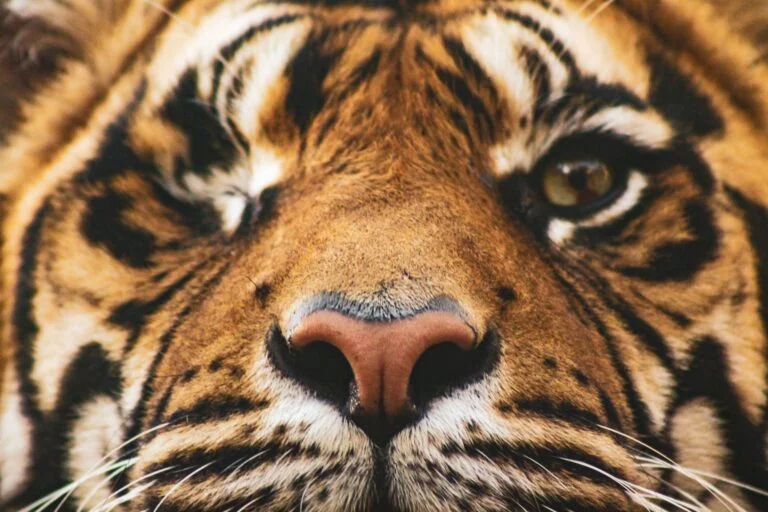
Photo: ClickerHappy on Pexels.
Updated 13 September 2026: corrected the kill rate, the swimming claim, weights and the golden tabby count.
Updated 15 November 2026: replaced the list with twelve sourced facts and dropped figures that have no measurement behind them.




wait so 3,682 isnt an actual headcount?? ive been saying that for years lol
THANK YOU for the eight times one. Tried to find the source for my daughter’s class talk and every site just links to another site. Gave up.
the striped skin one sounds fake ngl. has anyone actually seen a shaved tiger or is this just one of those internet facts
It’s real! Zoo vets have photos from shaving patches for surgery and the stripes carry on underneath. Not nice pictures, so I left them out.
My husband brings up the 388 kg tiger every single time lions vs tigers comes up, which in our house is more often than you’d think. Looking forward to telling him it had just eaten a buffalo calf.
About pugmarks. My mama was in the forest dept in MP for 30 plus years, retired late 90s, and he will still tell you he could know each tiger from its pugmark. Male or female, which leg was injured, everything. When they changed to camera traps in 2006 and the number came out so low he took it very personally. He says the cameras miss tigers. We don’t argue with him anymore.
Wait so deer see the tiger as green?? That explains a lot.