

Tigers live alone but need to know who is nearby, who holds which ground and who is ready to breed. Most of that information passes between animals that never meet, through calls, scent and marks left on the ground and on trees.
The roar: the long-distance signal
A roar can be heard about 3 km away, according to the standard species accounts. The often quoted 114 decibels comes from the voice scientist Ingo Titze, who gave it in 2011 as the level a few feet from a roaring lion or tiger. His team’s study of dissected larynxes, published in PLoS ONE that year, found that the pitch of a roar follows from the mechanical properties of the vocal folds, which stand up to hard stretching and shearing, and that big cats turn lung pressure into sound very efficiently. The tiger roars they cite had fundamental frequencies of 83 to 246 hertz. Lions, jaguars and leopards roar too. Snow leopards share the flexible hyoid of the other big cats but have shorter vocal folds and cannot.
Roars differ between individuals. An Ji and colleagues recorded long-distance roars from six tigers at Omaha’s Henry Doorly Zoo between November 2009 and March 2010 and could tell the animals apart with up to 90 percent accuracy, mostly from the timing pattern of the call. Whether wild tigers use that information is untested. We found no playback experiment on free-ranging tigers that checks whether a resident reacts differently to a neighbour and to a stranger.
Tigers roar to announce where they are, to call cubs and during courtship. In Chitwan, Mel Sunquist counted one tigress in oestrus roaring 69 times in 15 minutes.
Chuffling: the close-range hello
The chuffle, or prusten, is a soft, breathy snort made by blowing air through the nostrils with the mouth closed. Mothers chuffle at cubs, mates chuffle during courtship, and captive tigers chuffle at keepers they know.
It is a friendly, close-range call, the tiger’s counterpart to purring in small cats. Growls and hisses signal threat or tension. A chuffle signals neither, and keepers read it as a sign that a tiger is at ease.
Tigers are not alone in it. Snow leopards, jaguars and clouded leopards all produce a version. Lions do not.
Scent: the message that waits
Scent carries most of the traffic. A roar is gone in seconds, while a scent mark stays on a tree trunk long after the animal has left. Tigers spray urine mixed with a musky secretion onto trees, rocks and bushes along the routes they use, and other tigers can read age, sex and breeding condition from it.
The best field description comes from four years of work on radio-collared tigers in Chitwan by Smith, McDougal and Miquelle, published in Animal Behaviour in 1989. They recorded five kinds of marking: urine spraying; scraping the ground and leaving urine, faeces or anal gland secretion on the scrape; clawing; cheek rubbing; and flattening vegetation. Spraying and scraping were the commonest. Tigers marked more heavily at territory boundaries than in the interior, and along the boundaries the marks were clumped where main travel routes met the edge. That reflected more frequent marking, since the tigers spent no more time in those spots than elsewhere. Marking was most intense while a tiger was establishing a territory, and females marked heavily just before coming into oestrus.
A tiger that finds a mark often responds with flehmen: head raised, upper lip curled, nose wrinkled, which draws scent over the vomeronasal organ in the roof of the mouth. Both sexes do it, and males use it to check marks left by females in oestrus. Of all the tiger senses, smell is the one that works mainly for communication.
The chemistry is partly mapped, and the studies do not fully agree. The compound long credited with the characteristic smell of tiger marking fluid is 2-acetyl-1-pyrroline, the molecule that also gives basmati rice its aroma. A 2008 analysis of male Bengal tigers by Burger and colleagues identified 98 volatile compounds and did not detect it. A 2016 study of Amur tiger marking fluid by Soso and Koziel identified 32 compounds and did. Whether the mixture differs enough between animals for one tiger to recognise another from it has not been shown.
Scrapes, scratches, and posture
A scrape is a visual mark with scent added. The tiger rakes its hind feet backwards through leaf litter or sand and often urinates or defecates on the patch. In the Chitwan study, scrapes clustered in the same boundary zones as the spraying.
Claw marks last longer. The tiger stands on its hind legs and rakes the bark with its retractile claws, leaving parallel grooves and scent from glands between the toes.
Face to face, tigers signal with ears, face and tail. A threat display has the face wrinkled, the teeth bared, the ears pulled back and the pupils wide. A tail held up and swaying slowly is friendly, and a lowered or lashing tail means the animal is uneasy. Tigers also turn their ears to show the white spot on the back of each one, particularly in aggressive encounters and between mothers and cubs.
Infrasound: below human hearing
Some tiger sounds are too low for people to hear. Elizabeth von Muggenthaler recorded 24 tigers at the Carnivore Preservation Trust in North Carolina and Riverbanks Zoo in South Carolina and reported the results to the Acoustical Society of America in December 2000. Tigers produced sound at around 18 hertz, just below the limit of human hearing, and lower still when roaring. Most of the energy in their growls, grunts and chuffles sat below 100 hertz. Low frequencies carry further through forest than high ones, which is the suggested advantage. Later hearing tests by Edward Walsh’s group found that tigers can hear below 20 hertz and are most sensitive at 300 to 500 hertz, according to the San Diego Zoo Wildlife Alliance’s summary of their 2008 work, which we could not find in print. Their 2003 report found the ears most sensitive at 500 hertz, the lowest frequency then tested, and said infrasonic hearing had not yet been measured.
The popular claim built on this is that a roar’s infrasound briefly paralyses prey. Von Muggenthaler said in 2000 that a tiger’s roar can rattle and paralyse a listener, suspected the low frequencies and the loudness, and described that explanation as untested. We have found no later study that tested it.
Aggression and courtship
Aggressive encounters bring growling, snarling and hissing, and an explosive coughing roar given with the mouth open and the teeth showing. George Schaller recorded the coughing roar from tigers when another animal approached their kill.
Warnings usually come first. Schaller described tigers growling at an intruder and, if that was ignored, moving on to short rushes and roars. Even meetings with other species often end without a fight. In a 2024 analysis of 43 filmed encounters between tigers and sloth bears, 86 percent ended without contact.
Courtship is noisy. A tigress scent-marks heavily just before oestrus and roars during it, which draws in the resident male and sometimes younger rivals. Mating takes no more than about 20 seconds and is repeated many times over as long as four days, with moans, grunts, growls and hisses throughout.
What cubs learn
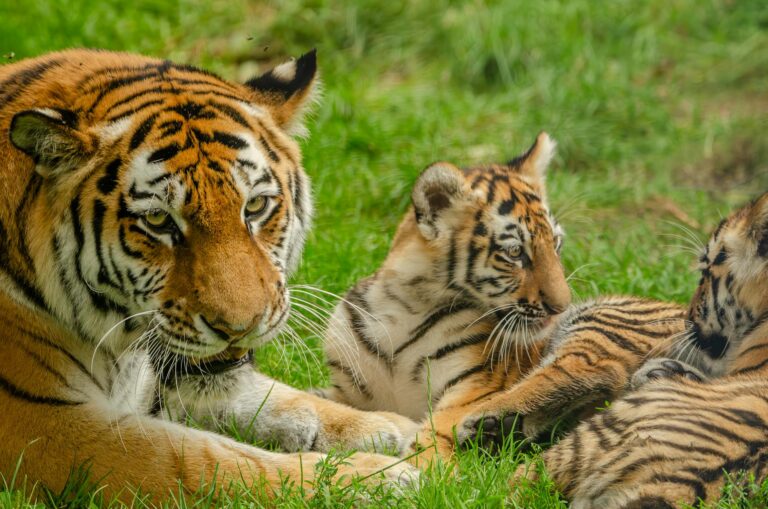
Mother and cubs keep contact by voice. Schaller described tigresses grunting to their cubs and the cubs answering with miaows, and a mother also roars to call cubs to her. Cubs learn their mother’s scent as well. How the rest of the repertoire develops in the wild is poorly documented. Our page on tiger cubs and family life covers the two years they spend with her.
Recognition of kin seems to outlast the family. In Smith’s dispersal study in Chitwan, published in 1993, three of four young females settled next to their mothers, and in two cases the mother shifted her own territory and left the daughter a large part of the old one. Males dispersed further and settled in poorer habitat. A tigress that gives ground to her daughter and not to a stranger is treating neighbours differently, which requires some way of telling them apart.
These signals have to work across very different distances. Female ranges in Chitwan measure 13 to 51 square kilometres. In Sikhote-Alin in the Russian Far East, John Goodrich and colleagues tracked 14 females with ranges of 248 to 520 square kilometres and five resident males with ranges of 847 to 1,923. Our piece on tiger territory and range covers how that space is held.
Related reading
Our partner store is at store.welovetigers.org.
Frequently asked questions
How far can a tiger’s roar travel?
About 3 km, according to the standard species accounts. The 114 decibel figure often quoted is an estimate, given by a voice scientist in 2011, of the level a few feet from the animal.
What is the chuffling sound tigers make?
A soft snort made by blowing air out through the nostrils with the mouth closed, also called prusten. It is a friendly close-range call, used between mothers and cubs, between mates, and toward familiar keepers.
How do tigers mark their territory?
Five ways, according to four years of tracking in Chitwan: urine spraying, scraping the ground and depositing on it, clawing bark, cheek rubbing, and flattening vegetation. Spraying and scraping dominate, and marking is concentrated at territory boundaries.
Can tigers recognise each other by call?
Their roars are individually distinctive, which zoo recordings have shown. Whether wild tigers actually use that to tell a neighbour from a stranger has not been tested with playback experiments in the field.
Do tigers use infrasound?
Tigers can produce sound at around 18 hertz, just below human hearing, as reported to the Acoustical Society of America in 2000. The claim that this paralyses prey was described by the researcher herself as untested, and we have found no test of it since.
What does tiger scent marking smell like?
Like cooked basmati rice, by most accounts. The compound credited is 2-acetyl-1-pyrroline, which also gives basmati its aroma, although one of the two main chemical studies of tiger marking fluid did not detect it.
What does it mean if a tiger curls its lip?
That is flehmen. The tiger is drawing scent over the vomeronasal organ in the roof of its mouth, usually after sniffing another tiger’s urine mark.
Photo: Señoreyto Antonio on Pexels.
Updated 13 September 2026: corrected Sikhote-Alin territory sizes and the description of the chuffle.
Updated 15 November 2026: sourced the roar loudness and distance figures, corrected the infrasound and scent chemistry sections (one study did not find the basmati compound), updated territory sizes and removed behaviour claims that had no source.
Updated 18 November 2026: noted that the tiger hearing figures come from a zoo summary and added the 2003 primary report.



When I was about 8 we went to a safari park and it was feeding time, and one of the tigers roared maybe 10 metres from us. I remember feeling it in my chest more than hearing it. My mum says I cried, I say I didn’t. That was 30 years ago and I still think about it, so maybe there’s something in the infrasound idea even if nobody has proved it.
chuffle 😂 best word I learned this week
Do we know if tigers can tell each other apart by voice? I know there’s been work on identifying individuals from recordings, but that’s us recognising them, not them recognising each other. Any actual studies?
Good distinction. Not properly, as far as I could find. The playback work points that way but nobody has done a big controlled study in the wild. That’s true of a lot of tiger sound research, it’s hard to do.