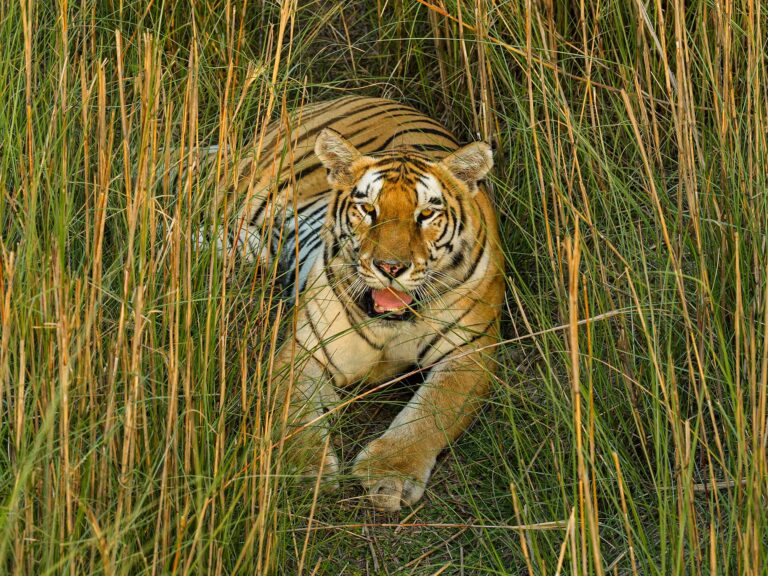
A tiger kills with its front end: forepaws that grab and hold, and jaws that finish the job. It gets few chances. Animal Diversity Web puts hunting success at between 1 in 10 and 1 in 20 attacks, and Wikipedia gives the spread of published estimates as 5% to 50%, so the equipment has to work when a chance comes.
This page goes through it piece by piece: the claws, the paws and forelimbs, the teeth, the tongue and the skull that anchors the jaw muscles. It also sets out where the published numbers disagree, which is more often than the confident figures online suggest. For the hunt itself, start with How Tigers Hunt: Stalk, Ambush, Kill.
Retractile claws: sharp because they are protected
A tiger has five digits on each front foot, counting the dewclaw, and four on each back foot. All of them carry retractile claws that are compact and curved and can reach 10 cm (3.9 in) long, a figure Wikipedia’s tiger entry takes from Vratislav Mazák’s 1981 species account, which gives 8 to 10 cm. Retractile means the claw folds back into the toe when it is not needed. The practical result is a claw that is not worn down by walking and stays sharp for the moments it is used.
Claws do more than kill. They are also a signpost. Tigers mark their home ranges partly by clawing or scent rubbing trees, and Animal Diversity Web lists claw marks left on trees among a tiger’s visual signals. Claws also help the cat climb: the same source calls tigers excellent climbers that use their retractile claws and powerful legs. Wikipedia is more cautious and says a tiger’s size makes it a poorer climber than many other cats, although cubs under 16 months climb routinely. Leopards are the tree specialists, as our tiger vs leopard field guide explains. If you want the territory side of this, see Tiger Territory and Range and Tiger Communication: Roars, Marks, and Calls.
Paws and forelimbs: the grip comes first
Before any bite, a tiger has to get hold of its prey. Animal Diversity Web describes tigers as having short, thick necks, broad shoulders and massive forelimbs, which are ideal for grappling with prey while holding on with long retractile claws and broad forepaws. The same page notes that one tiger is known to have dragged a gaur bull weighing 700 kg. The San Diego Zoo Wildlife Alliance’s fact sheet gives 770 kg for a gaur bull moved by a tiger in Myanmar, which may be the same record. Either way it is a single case, but it shows what the shoulders and forelimbs can do.
The paws are sometimes credited with more. Wikipedia says swipes from the large paws are capable of stunning or breaking the skull of a water buffalo, a line it takes from Valmik Thapar’s 2004 book on tigers. We found no measurement of the force of a tiger’s swipe, so this is best read as an experienced observer’s judgement. Kills end with a bite.
Teeth: 30 of them, and four long ones
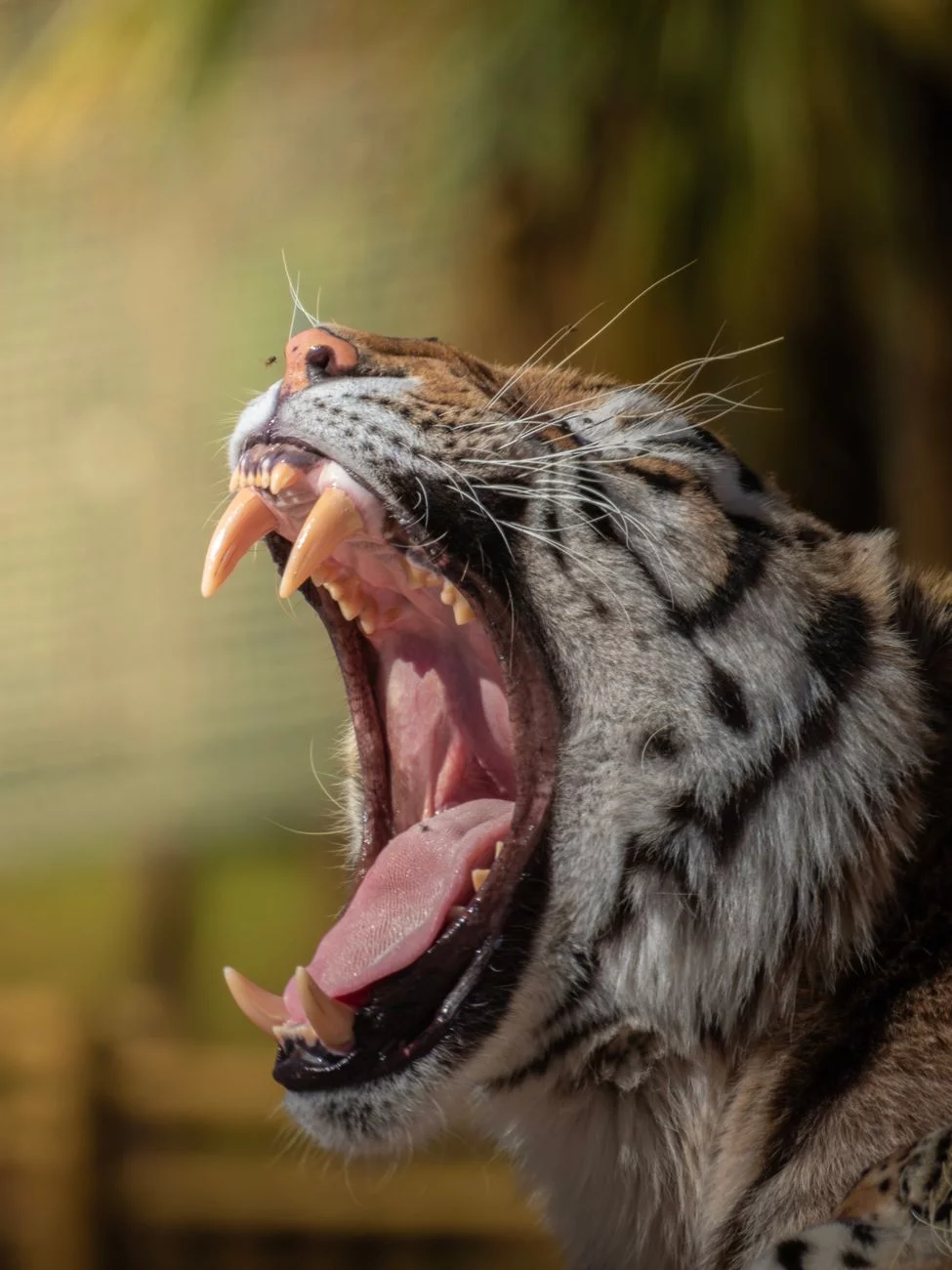
A tiger has 30 teeth. Animal Diversity Web gives the dental formula as 3/3 incisors, 1/1 canines, 3/2 premolars and 1/1 molars, counted per side of the upper and lower jaw. The four canines get the attention. How long they are depends on the source, so here are three figures.
- Wikipedia: the somewhat curved canines are the longest in the cat family, at 6.4 to 7.6 cm (2.5 to 3.0 in).
- Animal Diversity Web: Bengal tigers have the longest canines of any living large cat, from 7.5 to 10 cm.
- San Diego Zoo Wildlife Alliance, citing a 2007 study of big cat canines by Per Christiansen: an average length of 50.8 mm, or about 5 cm.
The three barely overlap, and they are probably not measuring the same thing. One may give the visible crown and another the whole tooth, one a museum sample and another the largest animals, one a subspecies and another the species. None of the pages says which. A tiger canine is somewhere between 5 and 10 cm long depending on what is measured, and a single figure quoted without that detail should be treated with care.
The back teeth have a job too. After a kill is dragged to cover, tigers feed first on the buttocks, using the carnassials to rip open the carcass (Animal Diversity Web). Carnassials are the shearing teeth at the side of the jaw. The same source puts a meal at 18 to 40 kg of meat, and our page on what tigers eat covers which animals supply it. At the Smithsonian’s National Zoo, keepers give tigers knucklebones or cow femurs twice a week “to exercise their jaws and keep their teeth healthy” (Smithsonian’s National Zoo).
Where the bite goes
A tiger does not bite at random. Animal Diversity Web describes two methods. Small animals, weighing less than half the tiger’s own weight, are killed by a bite to the back of the neck, where the canines are inserted between the neck vertebrae and force them apart, breaking the spinal cord. For larger animals the bite goes to the throat to crush the windpipe and suffocate the animal. The same page calls the throat bite the safer tactic, because it limits the damage the prey can do in return.
Wikipedia adds the same logic from another angle: holding onto the throat puts the cat out of reach of horns, antlers, tusks and hooves. It notes that tigers can vary the method, for example by cutting the tendon at the back of the hock to disable large prey (Wikipedia). The Smithsonian’s National Zoo describes the finish simply as breaking or biting the neck (Smithsonian’s National Zoo).
Bite force: an estimate from skulls
Bite force is where the internet is most confident and the evidence is thinnest. The figure Wikipedia gives, an average of 1,234.3 newtons at the canine tips, comes from Per Christiansen’s 2007 paper in the Biological Journal of the Linnean Society. It is an estimate worked out from skulls, with no living tiger involved. The round numbers in pounds per square inch that circulate online come with no study attached that we could find.
Direct measurement on big cats is recent. A 2023 paper in the Journal of Experimental Biology described a bite plate that rewards an animal with food for biting harder, and noted that few large mammals had ever been measured that way. Wikipedia’s lion entry cites that paper for a lioness biting with 1,593.8 newtons at the canines. The tiger figure and the lion figure were obtained in different ways, so they cannot be used to rank the two cats, a point our tiger vs lion comparison also makes.
The tongue and the skull
Two less obvious parts finish the kit. A tiger’s tongue is covered with hard papillae, which scrape flesh off the bones of prey (Animal Diversity Web). And the skull carries a well-developed sagittal crest and coronoid processes, which the same source says provide muscle attachment for the strong bite. In plain terms, the bone is shaped to hold big muscles, and the muscles drive the bite.
For how this fits with the rest of a tiger’s equipment, the night vision and hearing covered in Tiger Senses find the prey and the anatomy above deals with it.
What the sources do not tell us
Most of the numbers above come from general reference pages, and they carry limits. Canine length differs by a factor of two between sources. The bite force figure is an estimate from skulls. The claim that a swipe can break a buffalo’s skull is an observer’s judgement. We found no measured study of the force of a tiger’s paw or of how fast its claws grow.
The figures and where they come from
| Part | Figure | Source |
|---|---|---|
| Claws | 8 to 10 cm, retractile, on all 18 toes | Mazák (1981) |
| Canine length | About 5 cm on average; 6.4 to 7.6 cm; 7.5 to 10 cm | Christiansen (2007); Wikipedia; Animal Diversity Web |
| Teeth | 30 | Dental formula 3/3, 1/1, 3/2, 1/1 (Animal Diversity Web) |
| Bite force at the canines | 1,234.3 newtons, estimated from skulls | Christiansen (2007) |
| Killing bite | Back of the neck for prey under half the tiger’s weight, throat for larger prey | Animal Diversity Web |
| Heaviest carcass moved | A gaur bull of 700 kg, or 770 kg | Animal Diversity Web; San Diego Zoo Wildlife Alliance |
| Meat at one sitting | 18 to 40 kg | Animal Diversity Web |
Do you know more about how tiger teeth and claws work, or have you seen a tiger’s paws up close? Add what you know in the comments.
Sources
- Wikipedia, Tiger
- Animal Diversity Web, University of Michigan Museum of Zoology, Panthera tigris
- Smithsonian’s National Zoo and Conservation Biology Institute, Tiger
- Christiansen (2007), Canine morphology in the larger Felidae: implications for feeding ecology, Biological Journal of the Linnean Society
- San Diego Zoo Wildlife Alliance, Tiger fact sheet: physical characteristics
- Van der Meijden and colleagues (2023), Measurement of voluntary bite forces in large carnivores using a semi-automated reward-driven system, Journal of Experimental Biology
Photo: Jesús Esteban San José on Pexels.
Updated 15 November 2026: added a measured canine length study and the source of the bite force figure, noted that the buffalo skull claim is an observer’s judgement, and replaced the summary list with a table of sourced figures.