
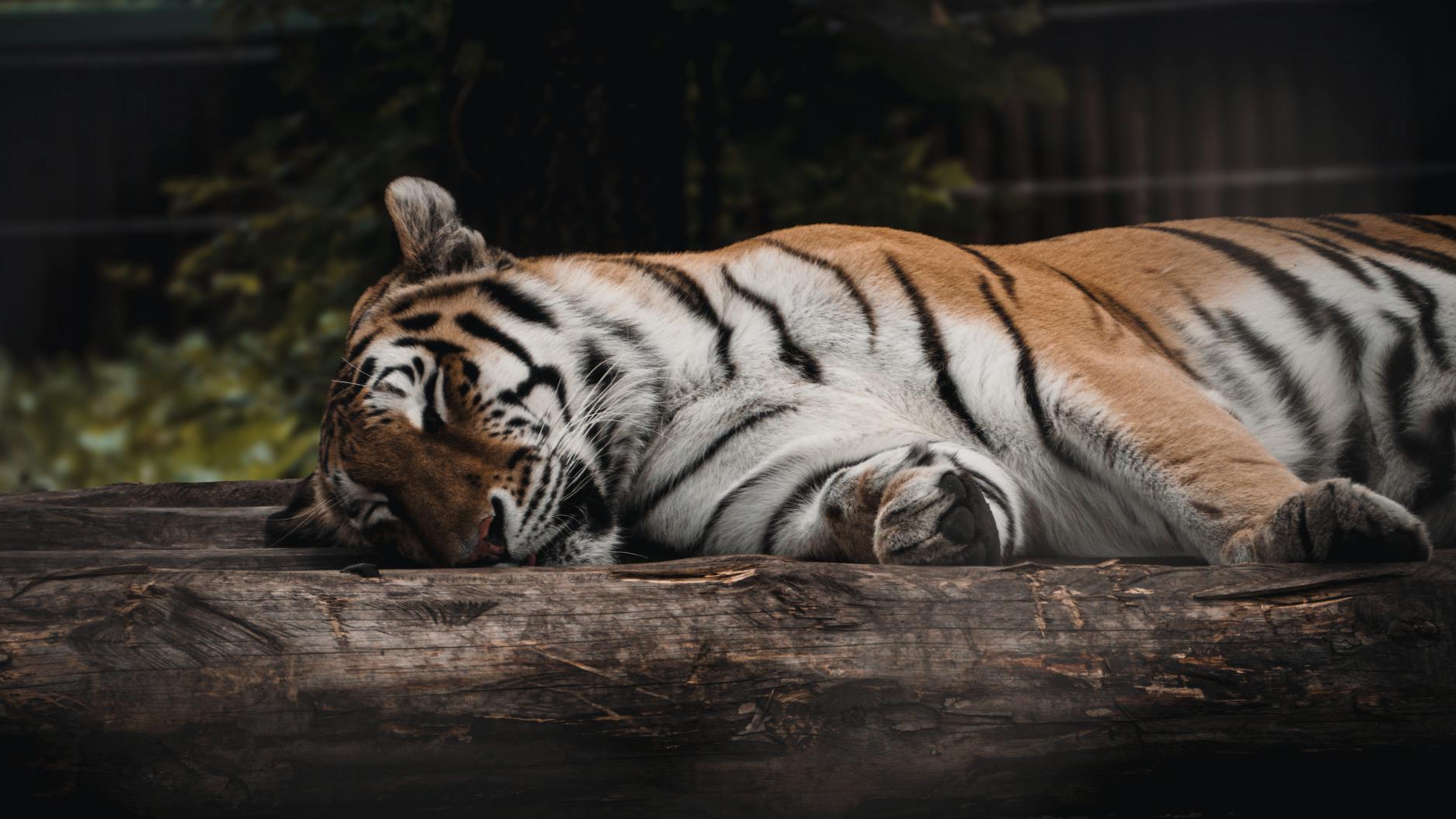
Wild tigers usually live 10 to 15 years, according to the Smithsonian’s National Zoo, and a tiger in a zoo can reach about 20. The oldest on record died at 26. Other references put the wild figure lower, at 8 to 10 years.
None of these figures is an average from birth. Up to half of wild cubs die before they are two, so a range such as 10 to 15 years describes tigers that survived cubhood. This page sets out what each source says, which records are documented, and what kills wild tigers before old age does.
Key facts
- Wild lifespan: usually 10 to 15 years (Smithsonian’s National Zoo) or 8 to 10 years (Animal Diversity Web)
- Oldest well-documented wild tiger: Machli of Ranthambore, who died on 18 August 2016 aged about 19
- Zoo lifespan: median life expectancy of 14 to 18 years in accredited North American zoos (AZA, 2023), with records of 25 and 26
- Cub mortality: up to half die before age 2
- Adult females outnumber males by 2 to 1 or more in studied wild populations, which points to higher male mortality
Wild tigers: what the sources say
The reference sources do not agree, and the zoo figures are lower than many people expect.
| Source | Wild | In zoos |
|---|---|---|
| Smithsonian’s National Zoo | Usually 10 to 15 years | Up to 20 years |
| Animal Diversity Web (University of Michigan, 2007) | Usually 8 to 10 years | Typically 16 to 18 years, up to 26 |
| Association of Zoos and Aquariums (2023) | Not covered | Median life expectancy: Amur males 16 years, Amur females 14.3, Malayan 16.1, Sumatran 18.4 |
The wild figures are rounder than the zoo ones for a reason. A zoo knows every birth and death date, while a wild tiger’s age is usually estimated from when it was first seen. A few wild tigers are known to have lived far longer than the ranges suggest. Machli of Ranthambore, born around 1997, died on 18 August 2016 at about 19. Collarwali of Pench died on 15 January 2022 at 16 or 17, after giving birth to 29 cubs.
Adult tigers have no predators except other tigers and people. George Schaller, in his 1967 study of Kanha, ranked people as the main cause of adult deaths, followed by injuries from hunting and infections. Wounds from porcupine quills can be enough to kill.
Disease is on the list as well. Canine distemper virus was confirmed in wild Amur tigers that died in 2001, 2004 and 2010, and the 2013 study that reported it estimated that the virus killed about 1 percent of Amur tigers in 2010.
Captive tigers: longer, but not always better
Zoo tigers do not fight for territory or hunt, and vets treat what would kill them in the wild. Even so, the typical zoo lifespan is shorter than the popular figure of 20 years. The Association of Zoos and Aquariums’ 2023 figures give a median life expectancy of 16 years for male Amur tigers, 14.3 for females, 16.1 for Malayan tigers and 18.4 for Sumatran tigers. Twenty is an old tiger, and the records go further.
| Tiger | Where | Age | Record |
|---|---|---|---|
| Guddu | Kanpur Zoo, India | 26 | Died January 2014 |
| Raja | South Khairbari rescue centre, West Bengal, India | 25 years 10 months | Died 11 July 2022 |
| Bengali | Tiger Creek Animal Sanctuary, Texas | 25 years 319 days | Certified by Guinness World Records in July 2021 as the oldest living tiger in captivity |
| Machli | Ranthambore, India (wild) | About 19 | Died 18 August 2016 |
| Collarwali | Pench, India (wild) | 16 or 17 | Died 15 January 2022 |
Extra years are not always good years. Guddu stopped eating about a week before he died, and by then he had lost his teeth and was being fed boneless meat and vitamins. A wild tiger in that condition could not kill.
The zoo figures also describe accredited zoos. They say nothing about tigers in private hands or on tiger farms, where records are poor. A 2005 census of captive tigers in the United States counted 4,692, and a 2011 census 2,884, and private ownership of big cats was banned there in 2022.
What shortens a wild tiger’s life
People are the largest factor, through poaching and the illegal tiger trade, snares set for other animals, and killings after livestock losses. The effect on lifespan is hard to measure, because a poached tiger simply stops appearing in the records and its age at death is never known.
Among natural causes, field studies point to these.
- Fights over territory. In Chitwan, only four of eight young males that set up temporary territories after leaving their mothers survived.
- Prey. A tigress needs to kill about 3,000 kg of prey a year, and about half as much again when she has cubs.
- Hunting injuries. Gaur, buffalo and wild boar sometimes injure or kill the tigers that attack them.
- Sex. Adult females outnumber males by between 2 and 5 to 1 in studied populations, although cubs are born in roughly equal numbers. Young males disperse further and fight more.
The life stages of a wild tiger
Risk changes with age. The first two years are the most dangerous, and our piece on tiger cubs and family life covers them. In Chitwan, 34 percent of cubs died in their first year. In Ranthambore, studied more recently, about 85 percent survived each year.
Between about 19 and 28 months young tigers leave their mother’s range. Females often settle next door. Males travel further and live as transients in other males’ ranges until they can hold ground of their own, and many do not live to do it.
Settled adults have the best odds. Females first breed at three to four years and males at four to five, and a tiger generation is estimated at seven to ten years. Competition for space does not stop: when a resident dies, its range can be taken over within days or weeks.
How we know all this
Wild figures come from following known individuals: radio-collared tigers in Chitwan and Sikhote-Alin, and tigers identified year after year by camera traps that recognise each animal by its stripes. Zoo figures come from studbooks, which record every birth and death. The international tiger studbook goes back to 1938.
There are limits. A wild tiger’s birth date is usually an estimate, and one that disappears may have died or may only have moved. Machli holds the record partly because she lived her whole life in front of cameras and tourists. Older wild tigers may have lived and died unrecorded.
Our piece on famous wild tigers and their stories profiles several long-lived individuals.
FAQs
How long do tigers live in the wild?
Usually 10 to 15 years, according to the Smithsonian’s National Zoo. Animal Diversity Web gives 8 to 10. Reaching the late teens is exceptional.
How long do tigers live in captivity?
Median life expectancy in accredited North American zoos is 14 to 18 years, depending on subspecies and sex (AZA, 2023). Some tigers reach 20, and the records are 25 and 26.
What is the oldest tiger on record?
Guddu, a male at Kanpur Zoo in India, died in January 2014 at 26. Bengali, a tigress at a Texas sanctuary, was recognised by Guinness World Records in July 2021 as the oldest living captive tiger at 25 years and 319 days. In the wild, Machli of Ranthambore reached about 19.
Why do wild tigers die so young?
People first, through poaching, snares and retaliation. Then come injuries from hunting and fighting, disease and shortage of prey. Few wild tigers live long enough to die of old age.
Do male or female tigers live longer?
Probably females. Adult females outnumber males by 2 to 1 or more in studied wild populations although cubs are born in roughly equal numbers, and young males disperse further and fight more.
Do tigers die of old age?
Some captive tigers do. Wild tigers rarely reach a point we would recognise as old age. Injury, territorial loss, disease or human conflict usually comes first.
How do scientists measure tiger lifespan?
Long-term monitoring of identified individuals at reserves, camera-trap re-identification from stripe patterns, and radio-collar studies. Captive figures come from international zoo studbooks that track each animal across its life.
Photo: Lisá Yakurím on Pexels.
Updated 15 November 2026: replaced unsourced lifespan ranges with figures from the Smithsonian’s National Zoo, Animal Diversity Web and the Association of Zoos and Aquariums (2023), added dated age records, and removed an unsupported claim that tigers under pressure live to about 8.
Updated 18 November 2026: added the 2011 US captive tiger census.



Our local zoo had a tigress who made 19 or 20 I think, and she was very stiff by the end, poor old girl. Longer isn’t always kinder.
didnt realise so many die right after they leave mum