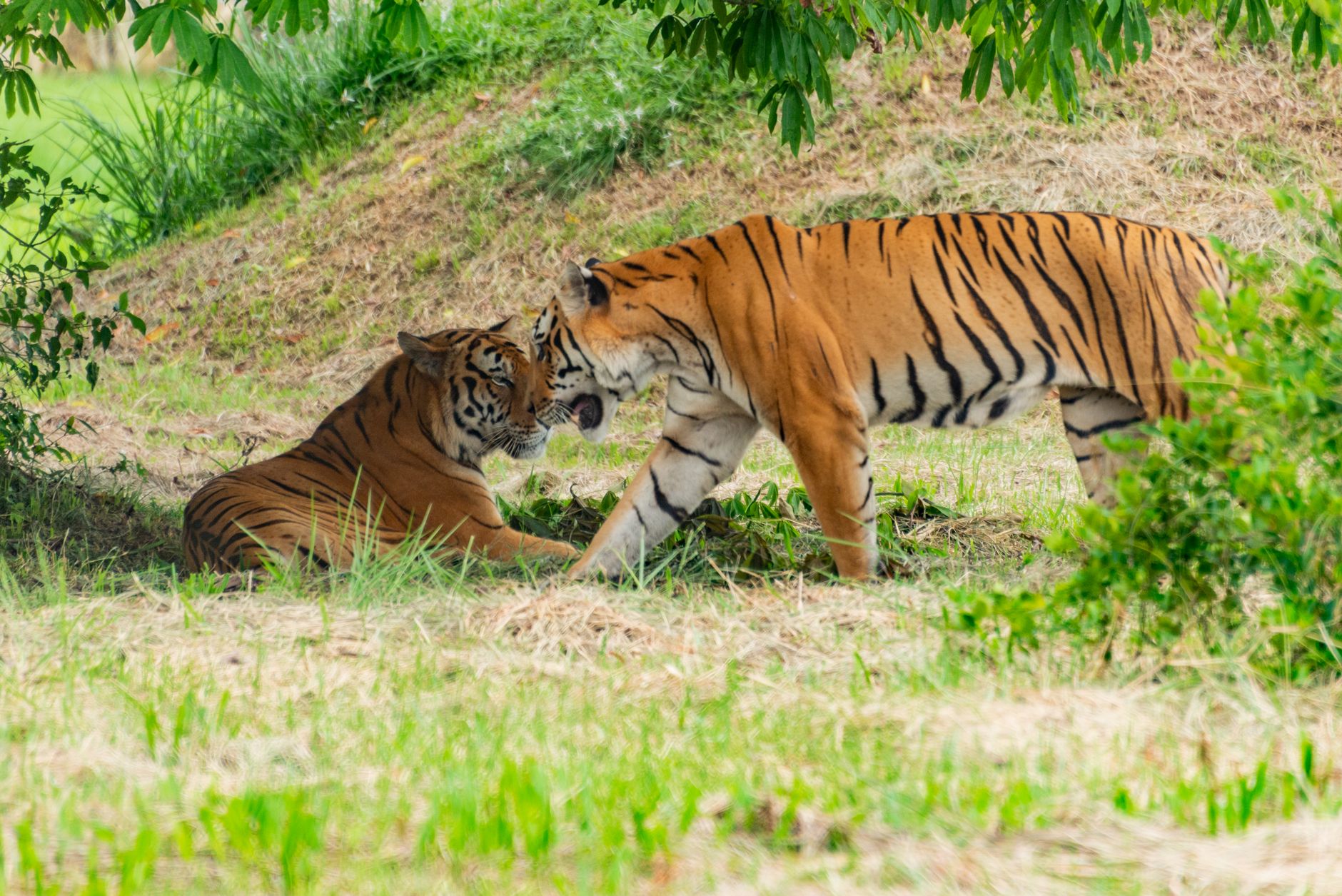
A tigress is ready to mate for only a few days at a time, and a male has to find her through scent and sound. Tigers live alone, so the whole business of breeding happens in short, loud, risky meetings. This page covers what happens before a litter exists: the signals, the courtship, the odd biology of ovulation and the timing that follows.
How a tigress says she is ready
Female tigers come into oestrus every 3 to 9 weeks and stay receptive for 3 to 6 days, according to the University of Michigan’s Animal Diversity Web. Animal Diversity Web adds that tigers are solitary and do not associate with mates except for mating.
She advertises. The San Diego Zoo Wildlife Alliance says a female leaves “messages” on trees and other places to tell males her reproductive status, and that loud moaning calls help a male and female find each other. Wikipedia’s tiger entry adds that receptive females signal by roaring and marking. Our guide to tiger roars, scent marks and calls explains how those signals work the rest of the year.
Who gets to mate
The usual pattern is that a resident male mates with the females whose ranges lie inside his own. Younger, wandering males are drawn to the same females. Wikipedia’s tiger entry describes a fight in which the resident male drives the intruder off. Animal Diversity Web puts it more plainly, noting that local males may compete for access to females in oestrus, and it classes the tiger mating system as polygynandrous, meaning both sexes can have several partners.
Our page on tiger territory and range gives the measured home range sizes, from about 12 sq km for a Sundarbans female to 1,385 sq km for the average Sikhote-Alin male.
Courtship and the short act itself
Courtship is cautious. Wikipedia’s tiger entry says the male is wary of the female until she shows she is ready, which she does by positioning herself in a posture called lordosis with her tail to the side. Copulation typically lasts no more than 20 seconds, with the male biting the scruff of her neck. Afterwards he pulls away quickly, because the female may turn and slap him.
The pair do not part straight away. The same source says tiger pairs may stay together for up to four days and mate multiple times in that period. The San Diego Zoo Wildlife Alliance agrees that a male and female may stay together for a few days before going their separate ways. Then the male leaves, and the female raises the litter on her own.
Induced ovulation: why repetition matters
The Smithsonian’s National Zoo lists tigers as induced ovulators. That means a female does not release eggs until mating has taken place. That fits with pairs mating multiple times during their few days together.
One caution on this point. Our sources state the fact but not the detailed mechanism, and we would not guess at the hormones involved.
When in the year, and at what age
Tigers can breed in any month. The Smithsonian’s National Zoo and Animal Diversity Web agree that mating happens most often between November and April, the cooler months. Females become sexually mature at 3 to 4 years old and males at 4 to 5 years.
From mating to birth
Gestation averages about 103 days, with a range of 96 to 111 days, per Animal Diversity Web. The Smithsonian gives approximately 100 days, and the San Diego Zoo about 103. That is a little over three months from mating to birth.
Litters run from 1 to 7 cubs. Animal Diversity Web puts the usual size at 2 to 3 and reports an average of 2.65 for Siberian tigers in a sample of 123. Cubs are born blind and weigh 780 to 1,600 grams. Raising them takes up most of the next two years, which we cover in tiger cubs and family life.
How often can a tigress breed?
Here the sources differ, and the difference is worth stating:
- Animal Diversity Web says females give birth every 3 to 4 years, depending on how long the previous cubs depend on her.
- The Smithsonian says females are ready to breed again once cubs become independent, at about age 2.
- The San Diego Zoo says a female can have a litter of up to seven cubs every two years.
Animal Diversity Web ties the interval to how long the previous cubs depend on their mother, so the quoted gaps are not a real contradiction: a two year gap is the shortest. The Smithsonian adds that if a female’s offspring do not survive, through causes such as infanticide or starvation, she can conceive another litter right away. Our piece on how long tigers live covers the life span side.
What is not known here
We have not found measured data on how often wild pairs mate per oestrus, or on how many mating attempts end in a litter. The figures above come from species summaries that draw on zoo and field records together, so treat them as typical ranges rather than guarantees for any one animal.
Sources
- Animal Diversity Web, University of Michigan Museum of Zoology: Panthera tigris
- Smithsonian’s National Zoo: Tiger
- San Diego Zoo Wildlife Alliance: Tiger
- Wikipedia: Tiger
Have you seen tigers courting, in the wild or in a good zoo? Add what you know in the comments.