
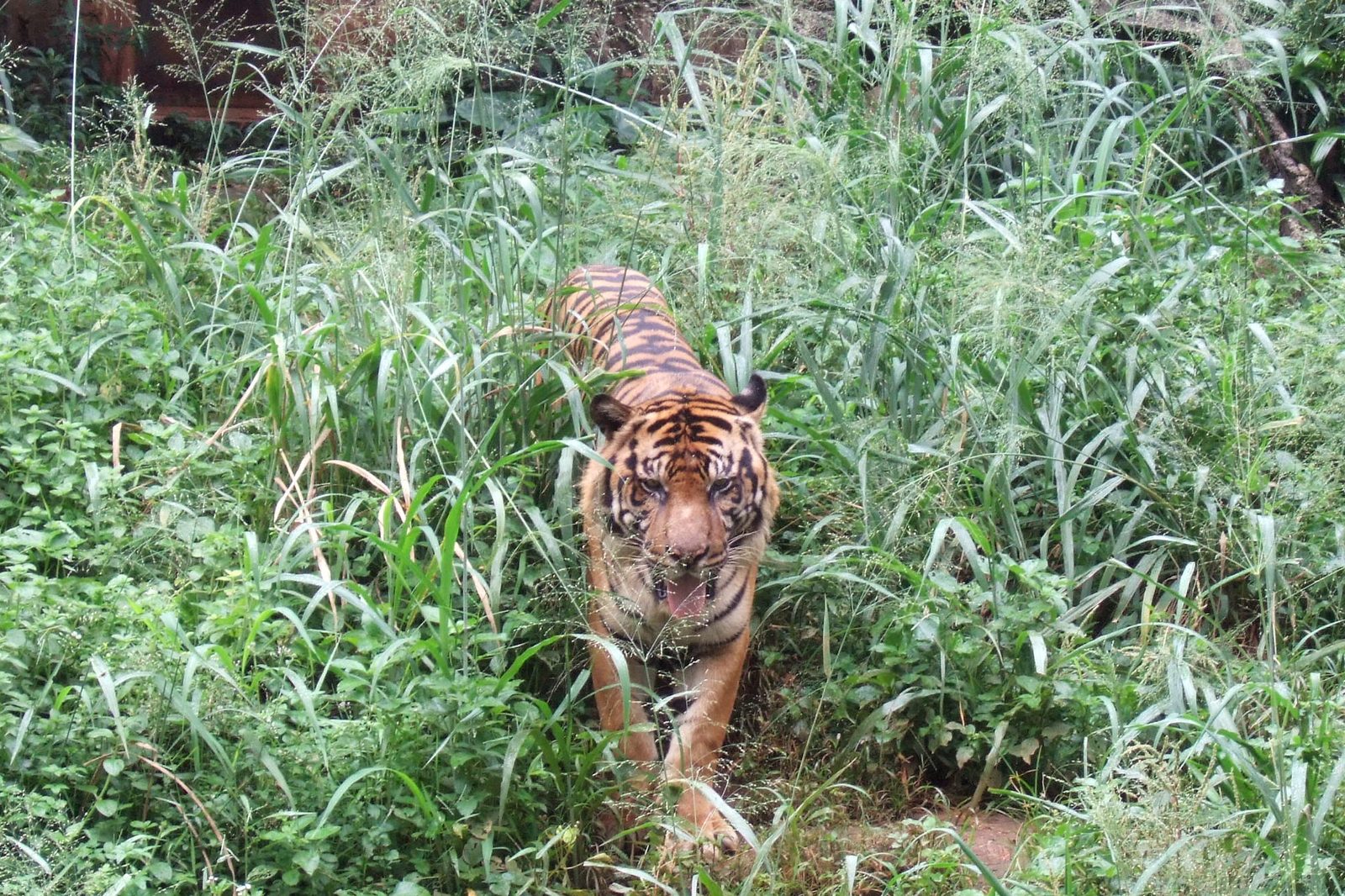
Indonesia once had tigers on three islands. The Bali tiger was last confirmed in 1937 and the Javan tiger in 1976, which leaves Sumatra. Estimates for the Sumatran tiger run from about 400 to about 600 depending on the method. A second island-wide survey had covered 657 of its 721 grid cells by 2023, according to the environment minister, and its island-wide results have not been published.
| Status | Wild tiger range state |
|---|---|
| Subspecies | Sumatran tiger (Panthera tigris sumatrae) |
| Current wild population | No agreed figure. The range most often quoted is 400 to 600. The IUCN’s 2022 assessment modelled 393 (range 173 to 883) on 2017 forest cover; the environment minister cited about 586 adults in March 2024. |
Current status
There is no agreed figure for Sumatran tigers. The range most often quoted is 400 to 600. The IUCN’s 2022 assessment modelled 393 (range 173 to 883) from camera trap densities and 2017 forest cover, about 10 percent below its modelled 439 for 2008. In March 2024 the environment minister gave about 586 adults, from 2013 to 2019 data. None of these is a count, and our page on the Sumatran tiger sets the methods side by side. The IUCN assessed the Sumatran tiger as Critically Endangered in 2008; since 2022 it assesses tigers only as a species, as Endangered.
A short history of Indonesian tigers
The tigers of Bali, Java and Sumatra were long treated as three subspecies. The IUCN Cat Specialist Group’s 2017 revision groups them as one, Panthera tigris sondaica. The table gives the last confirmed record for each island.
| Island | Last confirmed record | Status in 2026 |
|---|---|---|
| Bali | A female shot at Sumbar Kima, West Bali, on 27 September 1937 | Extinct. Bali tiger |
| Java | Tracks in Meru Betiri National Park, 1976 | Listed as Extinct by the IUCN in 2003 and 2008. A 2024 claim from a hair sample has not held up (see below the table). Javan tiger |
| Sumatra | Still present | No agreed count. Estimates run from 393 to about 600 |
The Javan record needs care. The 1976 evidence from Meru Betiri was tracks. In 2024 a paper in the journal Oryx reported that a hair found on a fence near Sukabumi, West Java, after a reported sighting in 2019, matched Javan tiger DNA. A reanalysis in the same journal in December 2024 concluded that it was “inappropriate to use the sequences presented in that study to infer the existence of the Javan tiger”. The original authors replied in January 2025 that the animal seen could have been a tiger but that “the subspecies cannot be confirmed”.
Conservation programmes
Protection is organised park by park. In Kerinci Seblat, Tiger Protection and Conservation Units have been run by the park and Fauna and Flora since 2000. Their patrols recorded no active tiger snares between February 2022 and January 2023, for the first time in the project’s history, and none again in the year to January 2026. WWF-Indonesia supports Tiger Protection Units in Riau. Outside the parks the record is worse. In March 2025 a tiger was snared and butchered in Rokan Hulu, Riau, and at least 11 people were charged in Riau and Aceh in cases reported that month. In May 2026 a snared young tigress was rescued in Pasaman, after which West Sumatra’s conservation agency said people who set snares would face criminal charges.
Notable tiger habitat
Gunung Leuser in the north, Kerinci Seblat in the centre and Bukit Barisan Selatan in the south together form the Tropical Rainforest Heritage of Sumatra, a World Heritage Site since 2004 and on UNESCO’s In Danger list since 2011. A 2017 modelling study found that only Leuser and Kerinci Seblat could each still hold more than 30 breeding females. Kerinci Seblat, at about 13,800 square kilometres, is the largest. A park official put its tigers at 150 to 180 in July 2024; Fauna and Flora’s surveys of 2019 to 2020 gave 128 for the wider landscape. Way Kambas in Lampung holds a smaller lowland population. Tesso Nilo in Riau shows the other outcome: of about 81,800 hectares, 12,561 hectares of forest were left in June 2025, according to the government’s forest task force.
What this means for tiger conservation
The main pressure on Sumatra’s tigers is land. Lowland forest has been converted to oil palm and pulpwood, and the parks that hold breeding tigers are increasingly separated by plantation. Snares set for deer and wild pigs then take tigers as well. Plantation edges are also where tigers and people meet: in July 2026 a tiger killed two people in a concession in Pelalawan, Riau, and the authorities set traps to catch it.
Indonesia lost two island tigers within about forty years, and neither was ever counted. The Sumatran tiger has competing estimates instead. What it lacks is a published island-wide survey since the one walked between 2007 and 2009.
Related reading
- Habitat loss and tiger survival, with a section on Sumatra and palm oil
- A tour of the world’s best-known tiger reserves
- External authority: WWF Indonesia Sumatran tiger programme
Frequently asked questions
How many tigers are in Indonesia?
Somewhere in the region of 400 to 600, all on Sumatra. The IUCN’s 2022 assessment modelled 393 (range 173 to 883) on 2017 forest cover, and the environment minister cited about 586 adults in March 2024. The results of a second island-wide survey have not been published.
Are Javan and Balinese tigers really extinct?
The Bali tiger’s last confirmed animal was shot at Sumbar Kima in West Bali in 1937. The Javan tiger was last confirmed, from tracks, in Meru Betiri in 1976 and is listed as Extinct. A hair reported in 2024 as Javan tiger was challenged by a reanalysis that found the DNA data unreliable, so the listing stands.
What threats do Sumatran tigers face?
Oil palm plantation expansion, pulp and paper plantations, snare poaching, and road infrastructure fragmenting the remaining forest.
Where can I see Sumatran tigers?
Wild sightings are extremely rare. Camera trap footage is regularly released from Kerinci Seblat and Gunung Leuser.
How are Sumatran tigers different from other tigers?
They are the smallest living tigers (males 100 to 140 kg), with darker coats, closer-set stripes and a heavier ruff around the face.
More tiger countries
Indonesia does not hold its tigers in isolation. Malaysia, across the Strait of Malacca, holds the nearest tigers, though the two populations are separate.
- Tigers in Malaysia (wild tigers today)
- Tigers in Thailand (wild tigers today)
- Tigers in Australia (captive only)
- Tigers in Sri Lanka (captive only)
All 25, grouped by whether tigers still live there: tigers by country.
Hero image: photo by Petra Ryan on Pexels.
Updated 13 September 2026: added the latest island-wide estimate and removed an unverified plan.
Updated 15 November 2026: corrected the Javan tiger record (tracks in 1976; the 2024 hair claim was challenged), how the 393 estimate was made, and who runs the protection units; removed a foundation we could not trace.