Sri Lanka, Mongolia and the two Koreas come up again and again in searches about tigers. None of them has a confirmed wild tiger today, but the reasons differ, and so does the quality of the evidence. The table gives the short answer for each, and the country pages have the detail and the sources.
| Place | Wild tigers today | Were tigers ever there? | Last record | Full page |
|---|---|---|---|---|
| Sri Lanka | None | Possibly, in prehistory: two fossils tentatively identified as tiger, one dated to about 16,500 years ago | None in recorded history | Tigers in Sri Lanka |
| Mongolia | None | Only as wanderers: the IUCN lists it as “Extinct and Vagrant” (2022) | No reliable date | Tigers in Mongolia |
| North Korea | None confirmed | Yes, Amur tigers | No sighting since 2000, according to the DPRK’s 2016 Red Data Book | Tigers in North Korea |
| South Korea | None | Yes, Amur tigers | 1921 to 1924, depending on the source | Tigers in South Korea |
Are there tigers in Sri Lanka?
No. The island’s top predator is the Sri Lankan leopard, which the IUCN lists as Vulnerable. Tigers do seem to have reached Sri Lanka when sea levels were lower: a tooth and a toe bone, the bone dated to about 16,500 years ago, were described in 2005 as tentatively tiger. Nothing in recorded history places a tiger there, so a photo labelled as a wild tiger in Sri Lanka shows a zoo animal, a leopard or another country. Our tiger versus leopard field guide shows how to tell the cats apart.
Are there tigers in Mongolia?
No, and it is doubtful that tigers ever lived there as residents. The IUCN’s 2022 assessment files Mongolia as “Extinct and Vagrant”, the category for a country tigers wandered into without settling, and no dated last record exists. Wanderers still reach the Russian side of the border region: tracks were confirmed in Zabaikalsky Krai in November 2026. Mongolia’s own big cat is the snow leopard, estimated at 953 adults in a national survey published in 2021.
Are there tigers in North and South Korea?
Both Koreas had Amur tigers, and both lost them. In the south the last records date from the early 1920s, after a colonial eradication campaign. The north is less certain. Its own Red Data Book reports no sighting since 2000 and the IUCN lists the tiger as extinct there, but the border adjoins occupied tiger range in China and Russia, and no outside survey has ever been run.
What this tells us about the claims you see online
- A tiger photo is not proof of a tiger population. Captive animals, mislabelled pictures and old records circulate widely.
- Words such as “perhaps” and “potentially” in a source are not a survey. Look for a count with a year and a method. Most modern counts come from camera traps that identify tigers by their stripes.
- An absence of records is not proof of absence either, which is why North Korea stays an open question.
Sources
- Manamendra-Arachchi and colleagues (2005), A second extinct big cat from the late Quaternary of Sri Lanka, Raffles Bulletin of Zoology
- IUCN Red List assessment of the tiger (2022)
- WWF-Mongolia on the national snow leopard survey (2021)
- Li and colleagues (2023), Animals, citing the Red Data Book of DPRK
Know of a source this page misses? Email contact@welovetigers.org.
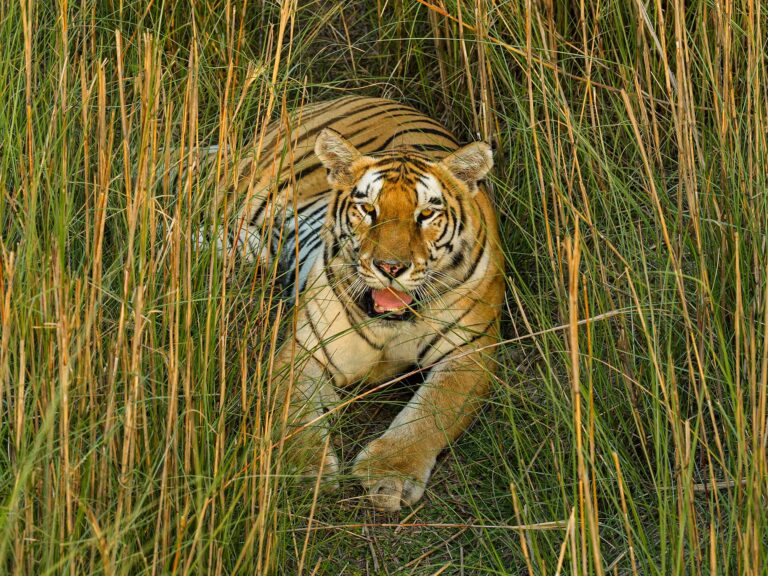
Photo: Senalfernando, CC BY-SA 4.0, via commons.wikimedia.org.
Updated 15 November 2026: rewritten as a short comparison of the four country pages, and corrected the Sri Lanka section, which had said no source explained the absence of tigers (fossils suggest they reached the island in prehistory).