
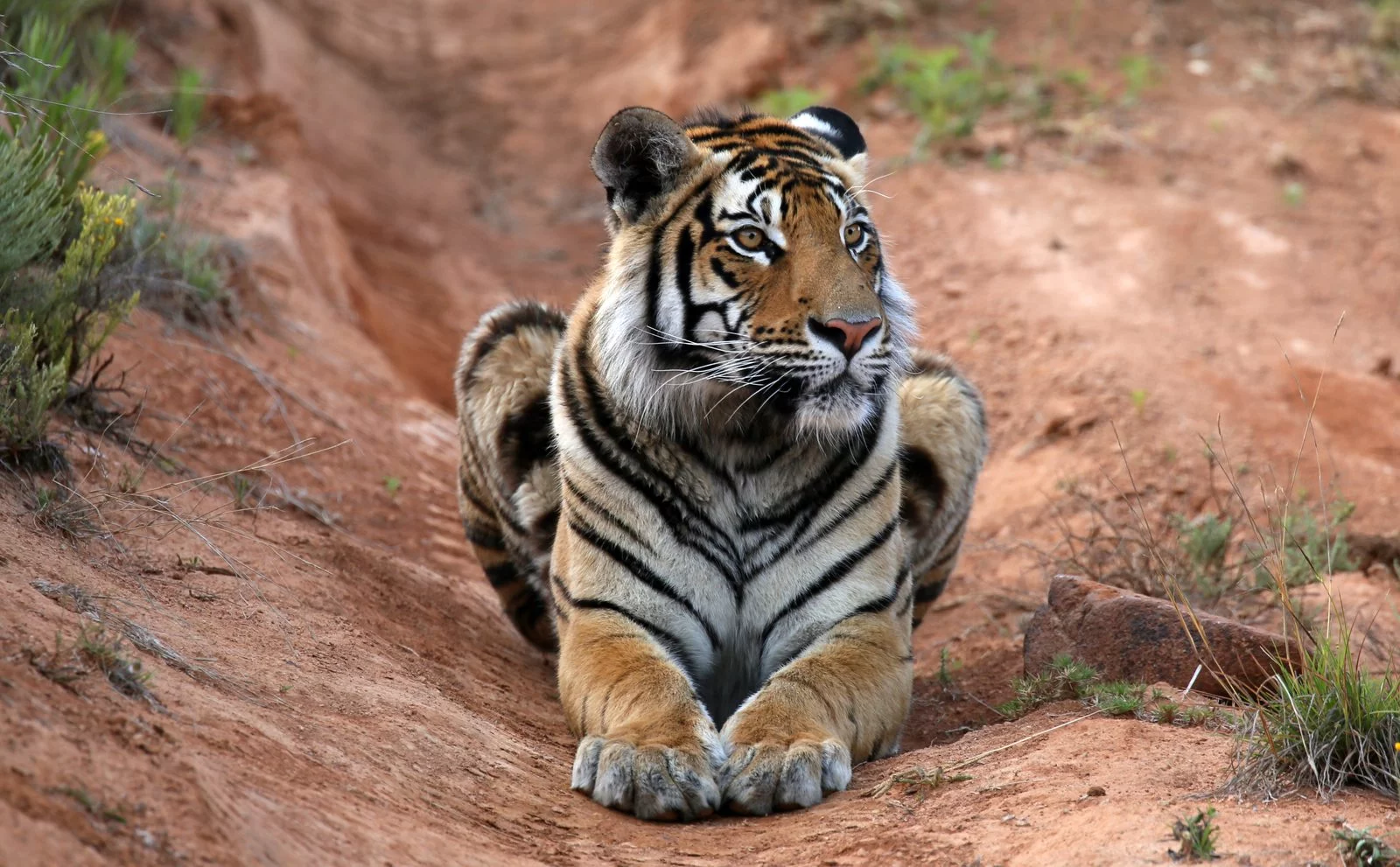
No tiger has ever lived wild in Africa, yet South Africa holds hundreds in captivity, and nobody can say exactly how many. The best official figure is 626, taken from provincial permit records at 30 September 2023, with two provinces supplying no data. Most are held privately, on breeding farms and in predator parks. Tigers fall outside the national law that covers lions, so whether a permit is needed depends on the province, and in Gauteng none is. The one conservation project, the South China tiger group at Laohu Valley, held 18 animals in the 2022 studbook.
| Status | Not native, captive population only |
|---|---|
| Subspecies | Not native. Farm tigers of mostly unrecorded ancestry, plus South China tigers at Laohu Valley. |
| Current wild population | None, ever. In captivity, 626 on provincial permit records at 30 September 2023. No national register exists. |
Current status
Two official numbers exist, and neither is a census. In May 2022 the environment minister, Barbara Creecy, told Parliament that 70 facilities were keeping tigers, on lists the provinces had supplied in 2020. A total of 463 tigers is often attached to that reply. It appears in a 2024 article by Stephanie Klarmann of the campaign group Blood Lions, but the annexure that would confirm it is missing from the published document. The second number is firmer. The Ministerial Task Team on the captive lion industry, whose report was released on 3 April 2024, found 626 tigers on provincial permit records at 30 September 2023.
| Province | Tigers on permit records, 30 September 2023 |
|---|---|
| North West | 275 |
| Free State | 184 |
| Limpopo | 107 |
| Western Cape | 24 |
| Gauteng | 20 |
| Eastern Cape | 16 |
| KwaZulu-Natal and Mpumalanga | No data obtained |
| Total | 626 |
Gauteng’s 20 is a floor. The province requires no permit to keep a tiger, so a count of permits there will miss animals. If you can point us at a more recent or more complete count, email contact@welovetigers.org and we will update the page.
Why nobody has to count them
Tigers are not native, so the national rules for threatened or protected species that govern lions do not apply to them. The environment department told Parliament in late 2024 that tigers “are not managed in terms of the national legislation”: imports and exports need CITES permits, and everything else is left to the provinces “where applicable”. The Task Team found Free State, KwaZulu-Natal, Northern Cape and Western Cape regulating exotic carnivores much as they do native ones, and “very little regulation in place” in Eastern Cape, Gauteng and Limpopo.
Gauteng shows what that means. In January 2023 a tigress called Sheba escaped from a smallholding at Walkerville, south of Johannesburg. She mauled a man and killed two dogs and a pig before she was shot four days later.
The policy position, 2021 to 2026
| Date | What happened |
|---|---|
| 2 May 2021 | The High Level Panel report is released. Its majority recommends ending the captive breeding and keeping of lions. We found no recommendation in it on tigers. |
| 13 May 2022 | The minister tells Parliament that 70 facilities keep tigers. |
| 3 April 2024 | The Ministerial Task Team report is released. It recommends that the phase-out “should not only include lions, but all other captive indigenous or non-indigenous carnivores”, and asks for stronger rules on tigers. It notes that the CITES Secretariat had visited four tiger facilities of concern. |
| 24 April 2024 | The Policy Position on elephant, lion, leopard and rhinoceros is gazetted. Tigers are outside its scope. |
| Late 2024 | The department tells Parliament it “intends to include” exotic species in national legislation and that a task team on them is being set up. |
| 24 March 2026 | The National Council of Provinces approves a notice barring new captive lion facilities. It closes no existing ones. |
| November 2026 | Daily Maverick and Blood Lions report the notice still unsigned. No regulation on tigers has followed. |
In November 2026 the position is a recommendation without a law. A report the government commissioned says captive tiger breeding should be phased out along with lion breeding. The only measure close to adoption applies to new lion facilities. (For how the two cats differ as animals, see our page on tiger and lion differences.)
The trade
South Africa exports live tigers and tiger parts legally under CITES permits. Four Paws, working from CITES trade data, counted 359 live tigers exported between 2011 and 2020, with Vietnam (75), China (45) and Thailand (42) the largest importers, and 93 tiger parts, 54 of them trophies. Most of the live animals were declared as going to zoos. That is why a country with no wild tigers appears in discussions of the illegal tiger trade: its largest customers are also the main consumer markets for tiger parts. CITES Decision 14.69 says tigers should not be bred for trade in their parts. South Africa’s position, stated by its minister in 2024, is that the decision does not apply to it because it is not a tiger range state.
Laohu Valley and the South China tiger
The exception to all of this is Laohu Valley Reserve, near Philippolis in the Free State. Save China’s Tigers acquired the use of 17 sheep farms there in 2002, about 33,000 hectares by its own figure, and the first two South China tiger cubs arrived in September 2003. The idea was to breed zoo-born tigers in large camps, let them learn to hunt blesbok and other antelope (see how tigers hunt), and send their descendants back to China. (For the wild cats that remain there, see tigers in China.)
The group reached 20 animals in November 2015. The international studbook listed 236 purebred South China tigers alive in 2023, in 16 Chinese zoos and one South African reserve (Zhang and colleagues, 2024), and Laohu Valley held 18 in the 2022 edition. No tiger has gone back. In 2011 the charity described preparing reintroduction sites in China as “the next stage”, and we have found no report since of a site secured or an animal returned.
A second Philippolis project is easier to visit and harder to classify. Tiger Canyon, started by the film-maker John Varty in 2000, keeps tigers that hunt for themselves inside a fenced reserve and sells lodge stays to see them. Its tigers are not from a managed subspecies programme, and a criticism on record since 2007 is that mixed ancestry leaves the project with no conservation value.
Where to see tigers in South Africa
Start by ruling places out. Cub petting and walk with a tiger offers depend on a steady supply of cubs, which is the business the Task Team wants phased out. Accreditation is thin on the ground. The Global Federation of Animal Sanctuaries accredited its first South African cat sanctuary, Born Free’s at Shamwari, only in May 2024, and the Pan-African Association of Zoos and Aquaria runs its own scheme for zoos. Ask any facility which of the two it holds, whether it breeds, and where its tigers go.
Related reading
- South China tiger profile
- Tiger conservation: where we stand
- External authority: environment department reply to Parliament on tiger keeping facilities (2022)
Frequently asked questions
Are tigers native to South Africa?
No. Tigers have never been native to any part of Africa.
Why are there South China tigers in South Africa?
The Save China’s Tigers rewilding programme transferred captive born South China tigers to Laohu Valley Reserve from 2003 onwards, with the goal of eventual reintroduction to China.
How many tigers are in South Africa?
Nobody knows exactly. The Ministerial Task Team found 626 on provincial permit records at 30 September 2023, with no data from two provinces. An earlier reply to Parliament listed 70 facilities keeping tigers. Laohu Valley held 18 South China tigers in the 2022 studbook.
Has any tiger been returned to China from South Africa?
No. More than 20 years in, we have found no report of a tiger returned or a release site secured. Laohu Valley is the only South China tiger holder outside China. The studbook listed 236 purebred animals alive in 2023, the rest of them in 16 Chinese zoos.
Is private tiger breeding legal in South Africa?
Yes. Tigers fall outside the national rules for threatened or protected species, so keeping and breeding them is a matter of provincial law, and Gauteng requires no permit at all. The 2024 Ministerial Task Team report recommended that captive tiger breeding be phased out along with lion breeding. As of November 2026 no regulation does so.
More tiger countries
The tigers in South Africa are captive. The United States, the United Kingdom, Australia and Canada face the same question of how you count and regulate privately held big cats.
- Tigers in the United States (captive only)
- Tigers in the United Kingdom (captive only)
- Tigers in Australia (captive only)
- Tigers in Canada (captive only)
All 25, grouped by whether tigers still live there: tigers by country.
Hero image: photo by 卓浩 虞 on Pexels.
Updated 13 September 2026: added the 2024 Ministerial Task Team report, removed an unsourced count and corrected the South China tiger figure.
Updated 15 November 2026: replaced the captive tiger counts with the sourced figures (626 on provincial records in 2023), corrected Laohu Valley’s size and numbers, and added the policy timeline to November 2026.