
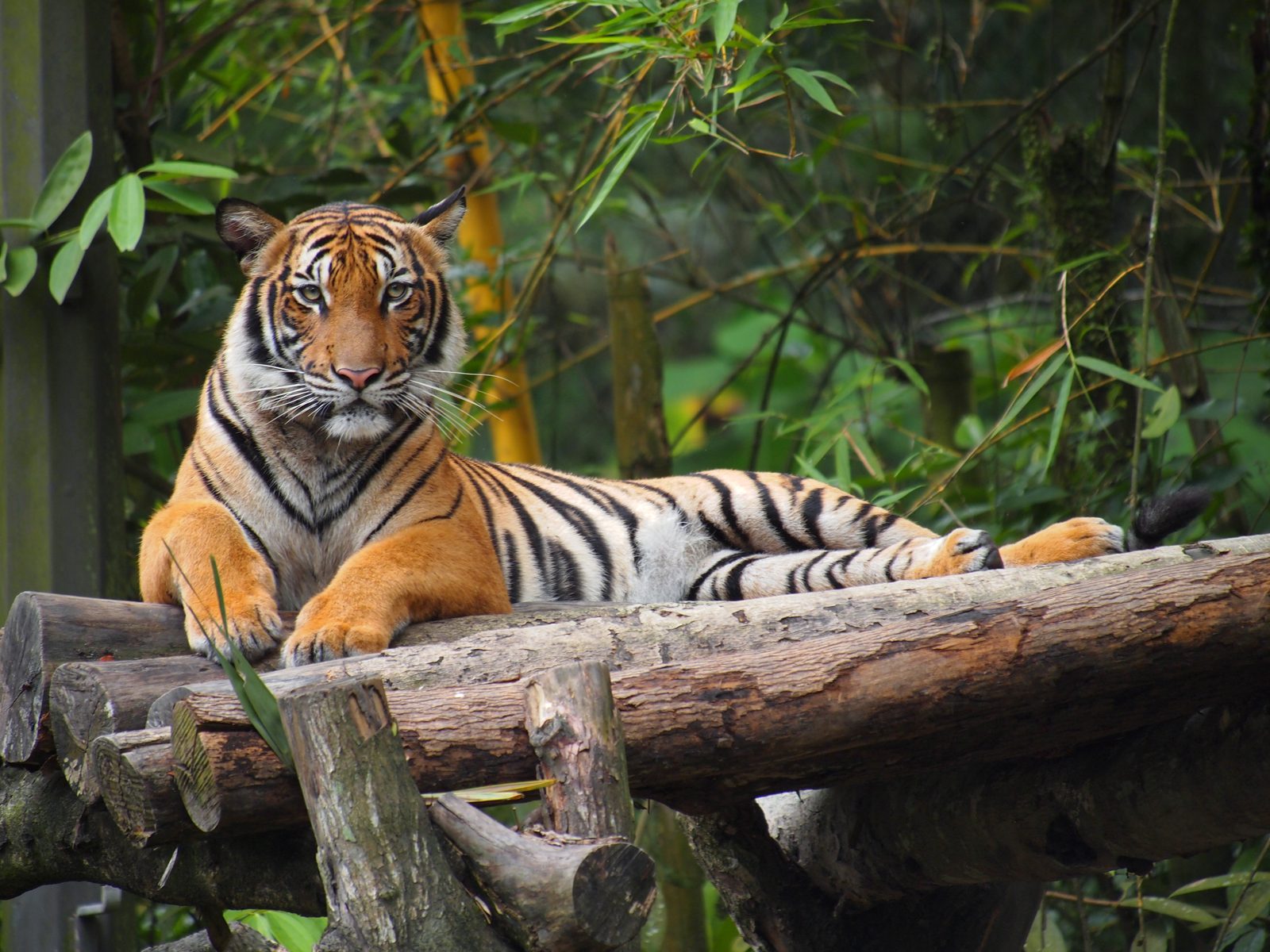
Malaysia’s First National Tiger Survey, carried out from 2016 to 2020, estimated that fewer than 150 Malayan tigers (Panthera tigris jacksoni) were left in the wild. No national figure has been published since. In July 2026 the minister responsible said numbers were rising and that an updated figure would be announced soon. All of the country’s tigers are on the peninsula; Sabah and Sarawak, on Borneo, have none. The animal itself, and the history of its estimates, are on our page on the Malayan tiger. What Malaysia has done since the survey is set out below.
| Status | Wild tiger range state |
|---|---|
| Subspecies | Malayan tiger (Panthera tigris jacksoni) |
| Current wild population | Fewer than 150 (First National Tiger Survey, fieldwork 2016 to 2020, announced January 2022). No newer national figure had been published by November 2026. |
Current status
The survey was led by the Department of Wildlife and National Parks (PERHILITAN) with WWF-Malaysia and other partners. Its result, fewer than 150, was announced by the prime minister on 10 January 2022. The estimate before it, 250 to 340, came from camera traps at seven sites, a method explained on our page on how camera traps count wild tigers. The IUCN assessed the Malayan tiger as Critically Endangered in 2015. The remaining tigers are concentrated in three priority landscapes: Belum-Temengor, Taman Negara and Endau-Rompin.
| Date | What happened | Source |
|---|---|---|
| 2009 | National Tiger Action Plan for Malaysia 2008 to 2020 adopted. Target: 1,000 wild tigers by 2020 | TRAFFIC, 5 November 2009 |
| September 2014 | Wildlife department and MYCAT announce 250 to 340 tigers, from camera traps at seven sites in 2010 to 2013 | Mongabay, September 2014 |
| 18 March 2019 | Minister gives an interim survey figure of fewer than 200 and warns the tiger could be extinct in five to ten years | The Star, 18 March 2019 |
| 3 September 2019 | Ops Bersepadu Khazanah, a joint police and wildlife department operation, begins | TRAFFIC |
| 16 June 2021 | Cabinet agrees nine “extraordinary” strategic actions for the Malayan tiger | Ministry statement, 10 October 2023 |
| 10 January 2022 | First meeting of the National Tiger Conservation Task Force, chaired by the prime minister. Survey result announced: fewer than 150 | Bernama; The Star, 24 March 2022 |
| May 2022 | Wildlife Crime Bureau set up in the Royal Malaysia Police | TRAFFIC |
| 2023 | Al-Sultan Abdullah Royal Tiger Reserve gazetted in Pahang (134,183 hectares) | The Star, 28 July 2026 |
| July 2026 | First survey of the new reserve estimates 10 to 13 tigers, cubs included. Minister says a new national figure is due soon | The Star, 24 July 2026 |
A short history of Malayan tigers
Tigers once lived throughout the peninsula. Estimates fell from about 3,000 in the 1950s to about 500 by the time the first national plan was adopted in 2009. That plan, the National Tiger Action Plan for Malaysia 2008 to 2020, aimed for 1,000 wild tigers by 2020. The survey that closed in 2020 found fewer than 150.
Conservation programmes
After the survey the government changed how it ran tiger protection. The cabinet agreed nine “extraordinary” strategic actions in June 2021, and the National Tiger Conservation Task Force, chaired by the prime minister, first met in January 2022. A Wildlife Crime Bureau was set up within the Royal Malaysia Police in May 2022 and grew from 50 to 78 staff in October 2023. Official statements use more than one name for the current plan, among them the National Tiger Conservation Action Plan and the Malayan Tiger Crisis Action Plan, both dated 2021 to 2030. The ministry’s stated aim is to stabilise the population at 400 by 2030.
In the forest, Ops Bersepadu Khazanah reported 140 arrests, 672 wire snares destroyed and seizures worth RM1.85 million in 2020. In Royal Belum State Park in Perak, the Menraq patrol team, Jahai Orang Asli working with the NGO RIMAU, won an IUCN WCPA International Ranger Award in 2023. Across Belum-Temengor, WWF-Malaysia’s Project Stampede also uses Indigenous patrol teams. WWF has given the fall in active snares there since 2018 as 89 percent, almost 90 percent and 98 percent in different statements; its patrollers found none in 2023 and one in 2024.
Notable tiger habitat
Royal Belum State Park and the Temengor Forest Reserve in Perak form the northern priority landscape. Taman Negara, the country’s largest national park at 4,343 square kilometres, is the central one. Endau-Rompin, straddling Johor and Pahang, is the southern one. The Al-Sultan Abdullah Royal Tiger Reserve in Pahang was gazetted in 2023, and its first survey, reported in July 2026, estimated 10 to 13 tigers, including cubs and juveniles. Roads and plantations separate these forests. The wildlife department recorded five tigers killed on roads between 2023 and 2025, one of them hit by a lorry on the East-West Highway between Gerik and Jeli on 9 November 2024. Taman Negara and Royal Belum are among the sites in our tour of the world’s best-known tiger reserves.
What this means for tiger conservation
The 2008 plan aimed for 1,000 tigers by 2020 and the survey found fewer than 150. The current aim of 400 by 2030 is lower, and still far above the last count. Whether numbers are moving towards it is not yet known. The minister said in July 2026 that the population was rising, without giving a figure. In November 2026 WWF-Malaysia said tigers were struggling to breed and still faced local extinction.
The published evidence that enforcement works is local. In the Kenyir area of Taman Negara, a 2023 study by Panthera and PERHILITAN found that poaching incursions fell by 40 percent between 2015 to 2016 and 2018 to 2019. Tiger density there was 0.48 per 100 square kilometres in 2014 and 0.53 in 2021: stable, and below what the authors judged the forest could support. The same study found Vietnamese poaching crews setting eight times as many snares on each incursion as before. Poaching has not stopped. In September 2025 police in Mersing, Johor, found a tiger carcass with six gunshot wounds in a vehicle and arrested three men.
Related reading
- Poaching and the illegal tiger trade
- Tiger conservation: where things stand
- External authority: WWF Malaysia tiger conservation
Frequently asked questions
How many tigers are left in Malaysia?
Fewer than 150, on the First National Tiger Survey, with fieldwork from 2016 to 2020 and the result announced in January 2022. A new figure was promised in July 2026 and had not been published when this page was checked in November 2026.
Is the Malayan tiger a separate subspecies?
It was named as one in 2004 on genetic evidence. The IUCN Cat Specialist Group’s 2017 revision groups it with the other mainland tigers, and a 2018 genome study again treated it as distinct.
Why are Malayan tigers Critically Endangered?
Snaring, forest loss and roads. Estimates fell from about 500 in the 2000s to 250 to 340 in 2014 and fewer than 150 on the 2016 to 2020 survey.
What is Malaysia doing to save its tigers?
A task force chaired by the prime minister first met in January 2022, a police Wildlife Crime Bureau was set up in May 2022, and joint operations and community patrol teams remove snares in the main tiger forests. The ministry’s stated aim is 400 tigers by 2030.
Where can I see a Malayan tiger in the wild?
Wild sightings are extremely rare given the low density. Camera trap programmes occasionally release footage from Taman Negara and Belum.
More tiger countries
Malaysia is usually looked at on its own, which hides the picture. Thailand, Indonesia, Myanmar and Cambodia are the countries whose tiger numbers connect to it.
- Tigers in Thailand (wild tigers today)
- Tigers in Indonesia (wild tigers today)
- Tigers in Myanmar (wild tigers today)
- Tigers in Cambodia (wild tigers lost)
All 25, grouped by whether tigers still live there: tigers by country.
Hero image: photo by Mehmet Turgut Kirkgoz on Pexels.
Updated 13 September 2026: corrected the action plan dates.
Updated 15 November 2026: corrected the survey and task force dates and the status of the 2021 to 2030 plan; added a dated policy timeline, the 2026 reserve survey and road death figures.