
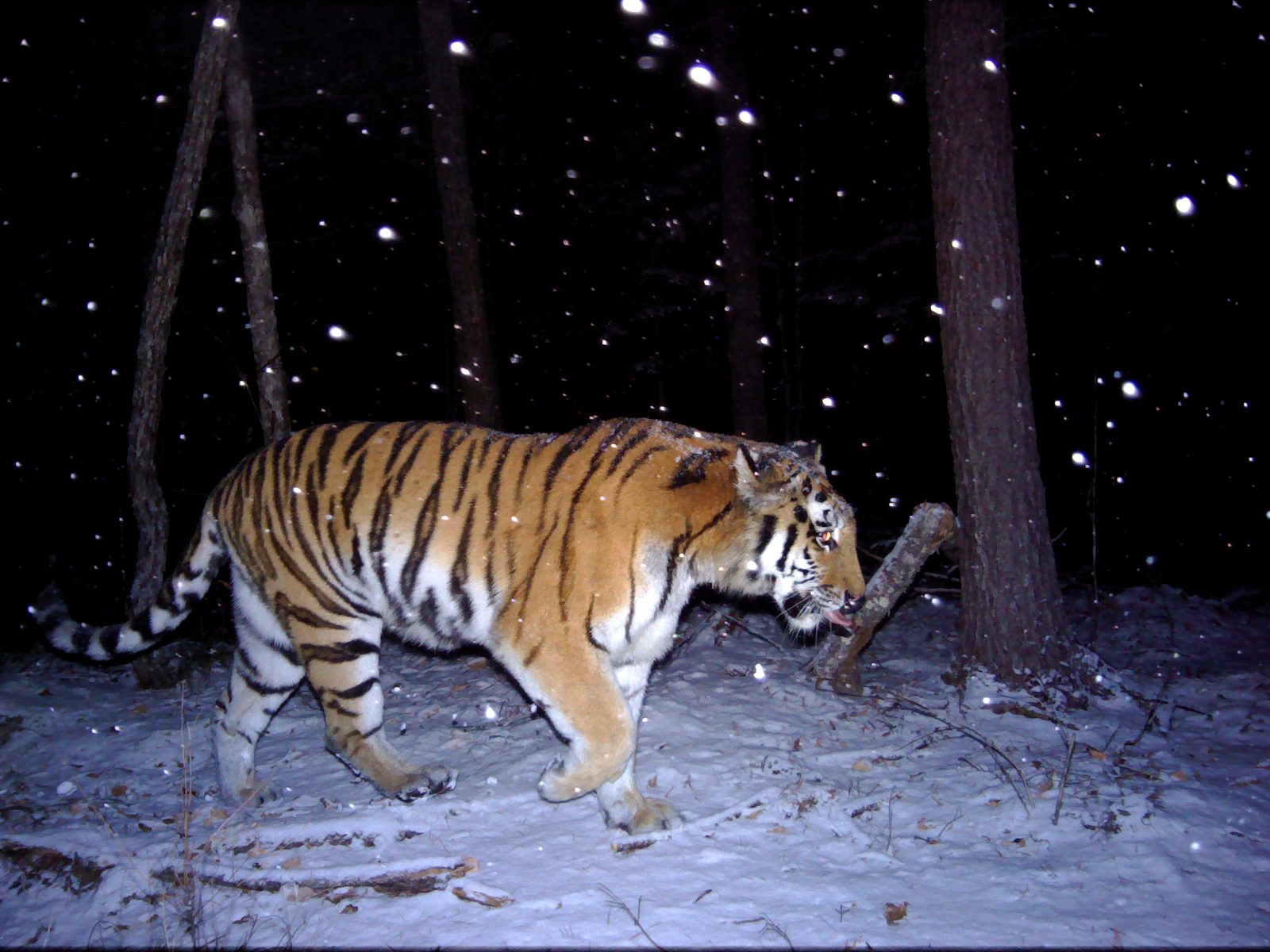
Russia holds most of the world’s Amur tigers, the tiger of long winters and deep snow. They live in the Russian Far East, mainly in Primorsky Krai and the south of Khabarovsk Krai, with a smaller and growing group across the border in China. Russia announced about 750 including cubs in 2022, and the IUCN’s estimate of adults and subadults is 386. This page covers where the tigers are, who protects them and what threatens them now. The story of the counts is in Russia’s Amur tiger recovery.
| Status | Wild tiger range state |
|---|---|
| Subspecies | Amur tiger (Panthera tigris altaica), also called the Siberian tiger |
| Current wild population | About 750 including cubs (Russia, 2021 to 2022 census); 386 adults and subadults, range 265 to 486 (IUCN, 2022) |
| Previous census | 523 to 540 (2015 range-wide count of winter tracks) |
| Across the border | 72 wild tigers reported in Northeast China Tiger and Leopard National Park in July 2026 |
| Legal protection | Hunting banned by the Soviet Union in 1947 |
| Lowest point | 20 to 30 tigers, on a survey around 1940 |
Current status
Russia’s most recent census ran in the winter of 2021 to 2022 over more than 180,000 square kilometres, organised by the Ministry of Natural Resources with the Amur Tiger Centre and the Russian Academy of Sciences. It reported about 750 tigers including roughly 200 cubs. The count before it, in 2015, gave 523 to 540. Russia counts tracks in snow, where India uses camera traps that identify each tiger by its stripes. In December 2025 the Amur Tiger Centre still gave “at least 750”, from the 2022 census, and no new census has been published.
The IUCN’s 2022 assessment gives a lower figure, 386 adults and subadults with a range of 265 to 486, and calls the population stable. It is built from camera-trap densities and leaves out cubs, so it is not a like-for-like check on the census. The core of the range is the Sikhote-Alin mountains, the Bikin valley and the southwest corner of Primorsky Krai.
A short history of Amur tigers in Russia
Amur tigers once ranged across the Russian Far East, northeast China and the Korean Peninsula. Hunting and the capture of cubs cut the Russian population to an estimated 20 to 30 by about 1940, almost all in Primorsky Krai. The Soviet Union banned tiger hunting in 1947, and the ban outlasted the Soviet Union itself.
Conservation programmes
The organisations have changed since 2022. Russia declared WWF an “undesirable organisation” in June 2023, and its former Russian branch cut its ties with the network the next day. Dale Miquelle, who ran the Wildlife Conservation Society’s Siberian Tiger Project for three decades, left Russia in 2022, and the society’s work continued at least into 2025 through a Russian-registered partner. The Amur Tiger Centre, founded in 2013 by the Russian Geographical Society, helps run the census. Land of the Leopard National Park, created in 2012, protects the southwest edge of the range along with most of the world’s wild Amur leopards.
Cross-border work with China has grown. Land of the Leopard and China’s Northeast China Tiger and Leopard National Park signed a cooperation memorandum in early 2019 covering monitoring, ranger training and anti-poaching. In May 2024 the two governments agreed to join the parks into one cross-border reserve, the Land of Big Cats.
Notable tiger habitat
The main protected areas in the tiger’s Russian range are listed below. Tigers also cross from the southwest of Primorsky Krai into Jilin and Heilongjiang in China.
| Protected area | Created | Size | Notes |
|---|---|---|---|
| Sikhote-Alin Biosphere Reserve, Primorsky Krai | 1935 | About 4,000 sq km | The oldest protected core, and the site of the Siberian Tiger Project’s radio-collar study from 1992 |
| Land of the Leopard National Park, Primorsky Krai | 2012 | About 2,600 sq km | On the Chinese border; the crossing point into China |
| Bikin National Park, Primorsky Krai | 2015 | About 11,600 sq km | Korean pine forest on the traditional lands of the Udege. The Russian Geographical Society says it holds more than 40 tigers |
| Anyuisky National Park, Khabarovsk Krai | 2007 | About 4,300 sq km | Towards the north of the range |
| Zov Tigra National Park, Primorsky Krai | 2007 | About 820 sq km | In the south of the Sikhote-Alin range |
What Russia has to hold on to
The pressure now is on prey. African swine fever reached the Russian Far East in 2019, and a 2025 study put the fall in wild boar across the south of the region at 90 to 95 percent. Tigers short of boar go after dogs and livestock. In the northern part of the range the study found conflicts with people rose more than elevenfold after the disease arrived, and the number of tigers killed or removed rose 3.3 times.
The cost is counted in both species. At least three people were killed by tigers in the winter of 2024 to 2025: a logging truck driver in Khabarovsk Krai in November, a fisherman in Primorsky Krai in January and a ranger in Primorsky Krai in March. In 2025 the two regions captured 26 tigers that had come into conflict with people. Poaching for skins and bones continues alongside, driven by demand outside Russia.
Related reading
- Amur tiger profile: size, coat and diet
- The six living tiger subspecies
- The world’s best-known tiger reserves
Frequently asked questions
How many tigers live in Russia?
Russia’s census of 2021 to 2022 reported about 750 including cubs. The IUCN’s 2022 assessment estimates 386 adults and subadults (range 265 to 486). The census before, in 2015, gave 523 to 540. All of them are in the Russian Far East.
Are Russian tigers the same as Siberian tigers?
Yes. Amur tiger and Siberian tiger are two names for the same animal. Its scientific name is Panthera tigris altaica. Under the IUCN Cat Specialist Group’s 2017 revision, mainland tigers are grouped as P. t. tigris and Sunda island tigers as P. t. sondaica.
How large is an Amur tiger?
Amur tigers are the longest tigers and grow the thickest winter coat, but they are not the heaviest today. Wild males weighed since 1970 average about 176 kg, and Bengal males weigh 200 to 260 kg. Records from before 1970 averaged about 215 kg.
Can you see Amur tigers in the wild?
Rarely. The tigers are thinly spread through dense forest. Tracks in snow and camera-trap pictures are what most visitors to the reserves see.
Did tigers ever live elsewhere in Russia?
Yes. The Caspian tiger lived in the Caucasus and across Central Asia, and the IUCN lists the tiger as extinct in Russia’s North Caucasus regions. The last widely accepted record of a Caspian tiger is one killed in eastern Turkey in 1970, and the IUCN assessed it as extinct in 2003.
More tiger countries
Russia does not hold its tigers in isolation. China shares the range, and its camera trap data overlaps with Russia’s. North Korea, Mongolia and Kazakhstan are neighbours with lost or returning tigers.
- Tigers in China (wild tigers today)
- Tigers in North Korea (wild tigers lost)
- Tigers in Mongolia (wild tigers lost)
- Tigers in Kazakhstan (wild tigers returning)
All 25, grouped by whether tigers still live there: tigers by country.
Hero image: photo by Casey Ulesich on Pexels.
Updated 13 September 2026: updated the China count and the status of WWF in Russia.
Updated 15 November 2026: corrected the IUCN figure, the status of WWF and WCS in Russia and the cross-border agreements, added a table of protected areas and the 2024 to 2025 conflict figures.
Updated 18 November 2026: cited the official 2022 announcement and the Amur Tiger Centre’s December 2025 wording.