

The golden tabby tiger, sometimes called the “strawberry tiger” or “golden tiger”, is one of the rarest colour forms of the tiger. Like the white tiger, it is not a separate species or subspecies. It is a recessive trait that has turned up a handful of times in wild Bengal tigers, at Kaziranga in Assam, and is kept going in captivity by breeding relatives for the colour.
Nobody keeps an official count of how many golden tigers are left. The figure quoted most often is fewer than 30, almost all captive, plus the few recorded in the wild at Kaziranga National Park since 2014. That figure has no traceable source.
Key facts
- A golden tabby carries two copies of a recessive change in the CORIN gene. Breeders call the effect “wideband” because it widens the pale band on each hair.
- The coat is pale gold with red-brown stripes in place of black.
- Kaziranga National Park in Assam has the only wild golden tigers known. The first was photographed in 2014, and in 2020 the park said four of its tigers showed the colour.
- The best-documented captive line goes back to a white tiger called Bhim, born at Cincinnati Zoo. That line has both Bengal and Amur ancestry.
- No registry counts them, so every population figure, including the popular “fewer than 30”, is an estimate nobody can check.
What “golden tabby” actually looks like
The 2017 paper that identified the gene describes the golden tiger as having “a blonde color tone with pale golden fur and red-brown rather than black stripes”. The stripes are all there. They are red-brown where a normal tiger’s are black, and the pale areas between them are wider.
The wild animals look a little different from the captive ones. Firoz Ahmed, a tiger biologist with the conservation group Aaranyak, described the Kaziranga tigress as having a lighter, yellowish coat, narrower black stripes and more white on the belly and face. Our page on why tigers have stripes explains how the normal pattern is made.
Where they came from
The captive pedigrees have been pieced together from studbooks and newspaper reports by the cat genetics writer Sarah Hartwell, not by a published study, so they should be read with some caution. On her reconstruction the most prolific golden line goes back to Bhim, a white tiger born at Cincinnati Zoo. He was bred with his sister Sumita, then with an unrelated orange tigress, and then with a daughter from that pairing. Bhim’s father had Amur ancestry, so these golden tigers are a mix of Bengal and Amur and not pure Bengal tigers. Hartwell notes that not every golden tiger descends from Bhim.
A golden cub is said to have been born in the United States in 1983, but that has never been verified. The earliest births with a contemporary record are from 1987, reported in a Florida newspaper. In the wild, a golden tigress catalogued as Kazi 106 F was first photographed during India’s tiger monitoring in 2014 and camera-trapped in the years after. A picture of her taken by the naturalist Mayuresh Hendre went round the world in July 2020. On 24 January 2024 a visitor photographed an adult male golden tiger in the park. Kaziranga is one of India’s tiger reserves, and our page on tigers in India covers the rest.
How the wideband trait works
White tigers were traced to a change in the pigment gene SLC45A2 in a 2013 study. The golden coat followed in 2017, when a study in Cell Research found that all 16 golden tigers it sampled carried two copies of a single change in the CORIN gene. That fits what the pedigrees suggested: the trait is recessive, so a cub is golden only if it inherits the change from both parents.
On a normal tiger the hairs between the stripes are banded, dark at the tip and base with a pale band between. On a golden tiger that pale band is longer, which lightens the whole coat, and the stripe hairs are solid red-brown where they would be black. The same paper looked at snow-white tigers, which have almost no visible stripes, and found that all 22 it sampled carried two copies of the golden change as well.
For tigers as a species, the IUCN Red List tiger assessment and the Panthera tiger programme are the places to start.
Why golden tabbies are almost all in captivity
The usual explanation is camouflage: a pale tiger should be easier for prey to see. Nobody has measured that, and the gene paper says the trait’s effects on the animal “remain unclear”. The Kaziranga tigress lived wild from at least 2014 to 2020, and the male photographed in 2024 was an adult. The simpler reason is arithmetic. A recessive trait shows only when both parents carry it, which is rare in a large wild population and common where relatives breed.
Why Kaziranga has several is not settled. The park’s research officer said in 2020 that the colour “may be due to excessive inbreeding caused by habitat destruction and loss of connectivity”. The geneticist Uma Ramakrishnan told CNN in 2024 that inbreeding or chance in a small population were the only ways it would show up, and that it was still being studied. Kaziranga’s own 2024 estimate was 148 adult tigers. In captivity the answer is plain. The colour sells, so breeders pair the animals that carry it.
The inbreeding problem
To produce a recessive colour reliably from a few carriers, breeders pair close relatives. That is how the founding line was made, and the health problems that follow from it are best documented in white tigers.
No study has reported a defect specific to golden tigers, and Ramakrishnan told CNN the colour itself is not known to harm health. The risk comes from the inbreeding, not the coat.
In June 2011 the Association of Zoos and Aquariums approved a paper telling its members not to breed “for the purpose of producing anomalous phenotypes”. It names white tigers, white lions and king cheetahs and does not mention golden tigers, but the rule covers them. The European association, EAZA, adopted a matching position in 2013. Golden tigers are held mostly outside the accredited zoos as a result.
For the parallel welfare and ethics argument, see our piece on why white tigers should not be bred.
The selfie zoo problem
Unusually coloured tigers draw paying visitors. When Chiang Mai Night Safari in Thailand posted pictures of its golden tigress Ava in November 2024, she and her sister Luna, born there in February 2021, drew crowds. Where photo sessions with cubs are sold, the money pays for more breeding.
The most direct thing a reader can do is not pay for photographs with captive tigers of any colour. Accredited zoos that keep older animals without breeding them, and sanctuaries that take in rescues, are a different case.
How rare is “rare”?
The numbers in circulation do not agree. “Fewer than 30” traces to hobby websites that give no source and no date. CNN in 2024 reported “an estimated 30 golden tigers in captivity” from unnamed sources. Chiang Mai Night Safari put the world total at 50 to 100. No studbook or registry exists to settle it.
What can be said is that golden tigers are rare, and that their rarity is no measure of conservation value. A golden tiger is an ordinary tiger showing an uncommon inherited colour, and breeding more of them does nothing for wild tigers.
If you have first-hand information on where golden tabby tigers are currently held, or on how many exist, we would like to hear it. Leave a comment and we will follow it up.
For the wider picture, see how many wild tigers are left and tiger conservation success stories.
Our tiger gifts are at store.welovetigers.org.
Frequently asked questions
What is a golden tabby tiger?
A tiger carrying two copies of a recessive change in the CORIN gene, known to breeders as wideband. The result is a pale gold coat with red-brown stripes. Almost all are captive, though a few have been recorded in the wild at Kaziranga in India.
How many golden tabby tigers are there?
Nobody knows. There is no registry, and the figures quoted range from fewer than 30 to as many as 100, none with a traceable source.
Are golden tabby tigers and white tigers the same?
No. White tigers were traced in 2013 to a change in the SLC45A2 pigment gene. The golden coat comes from a separate recessive change in the CORIN gene, identified in 2017. Snow-white tigers, which have almost no stripes, carry the golden change too.
Are there wild golden tabby tigers?
A few, all at Kaziranga National Park in Assam. A golden tigress catalogued as Kazi 106 F was first photographed in 2014, the park said in 2020 that four of its tigers showed the colour, and an adult male was photographed in January 2024.
Why is breeding golden tabbies a welfare problem?
Because producing the colour reliably means breeding close relatives. The harm that follows from that is best documented in white tigers. No defect specific to golden tigers has been published.
Do accredited zoos breed golden tabby tigers?
They are told not to. The Association of Zoos and Aquariums approved a paper in June 2011 against breeding for rare colour forms, and the European association EAZA adopted the same position in 2013.
What can I do to help?
Avoid paid photo attractions with captive tigers of any colour, and give to field conservation of wild tigers instead.
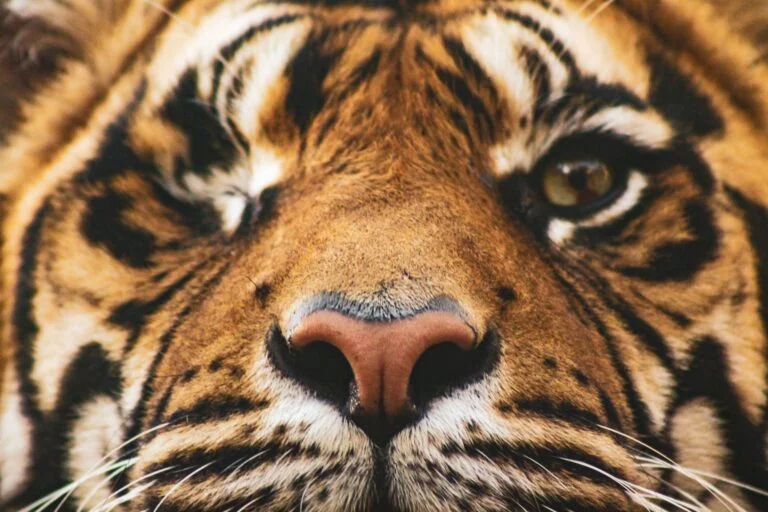
Photo: Mehmet Turgut Kirkgoz on Pexels.
Updated 13 September 2026: corrected the genetics (the golden coat gene, CORIN, was identified in 2017) and added the wild golden tigers recorded at Kaziranga.
Updated 15 November 2026: corrected the Kaziranga record (first photographed in 2014, four reported in 2020, a male in 2024), the hair banding, the source and mixed ancestry of the captive pedigree and the 2011 zoo policy, and removed unsourced eye and nose colour claims.


Saw those Kaziranga photos on insta and just though how pretty. Oh dear.
I must admit I paid for photo with a tiger cub in Thailand in 2012. I did not know then. Now I am ashamed for it.
‘Strawberry tiger’ lol. Who ever came up with that should be in advertising. It’s an inbred tiger.
Pretty much. Even the Kaziranga people talked about it as a warning sign.