
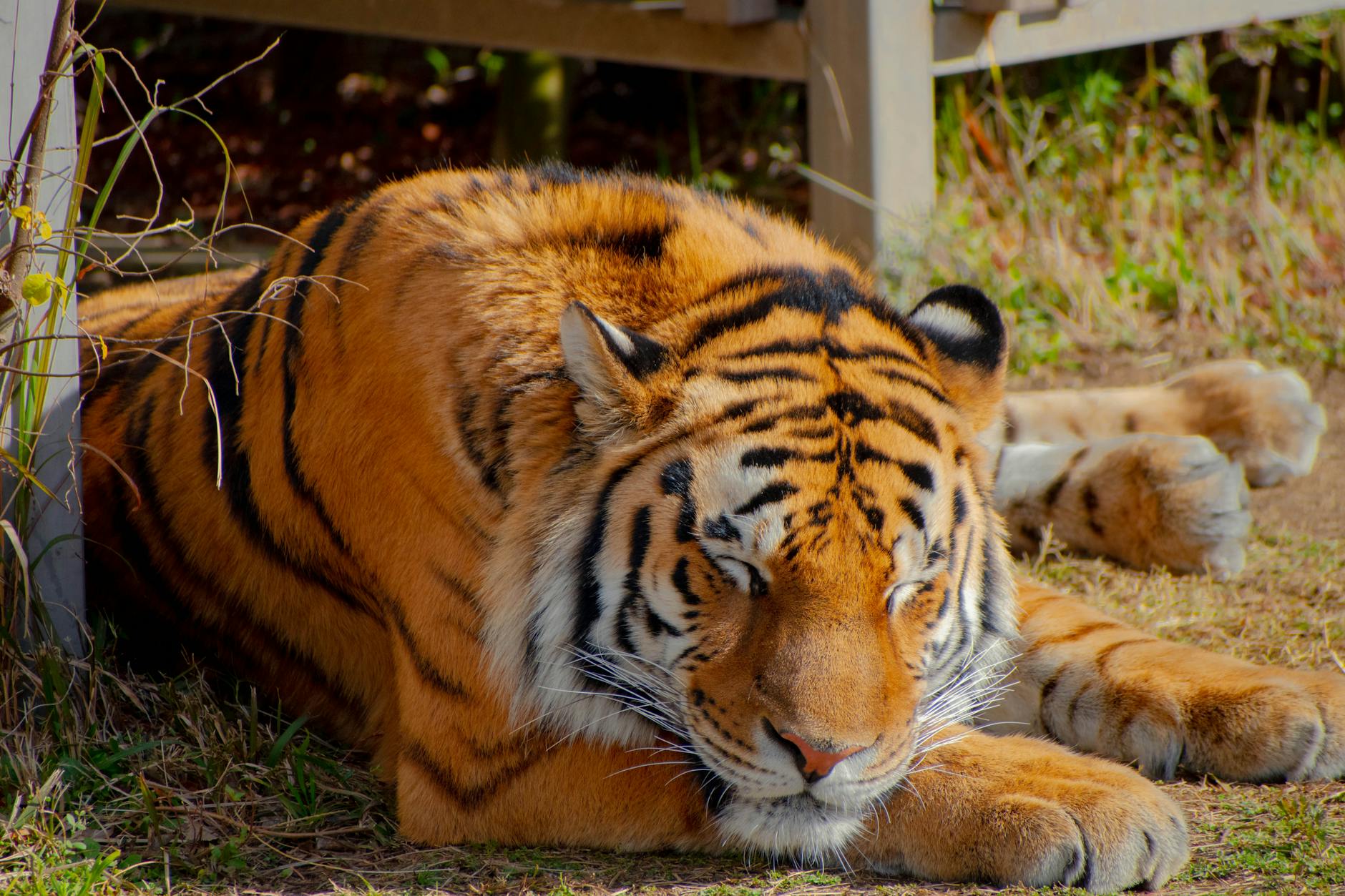
Tigers have never been native to Japan. Ice age big cat fossils from the islands were long catalogued as tigers, but a study published in PNAS in January 2026 tested 26 of them and found that every one that yielded DNA or protein was a cave lion, an extinct relative of the lion (our guide to how tigers and lions differ covers the living cats). The tiger is everywhere in Japanese visual culture all the same, from Zen painting to the zodiac, all of it built on an animal nobody in the country had seen in the wild. Japan’s other connection to tigers is less decorative: during its colonial rule of Korea it ran the campaign that finished off the tigers of the southern peninsula. Today the country’s tigers are in zoos, and keeping one as a pet has been banned since June 2020.
| Status | Not native, captive population only |
|---|---|
| Subspecies | Not native. Amur and Sumatran tigers in member zoos of the Japanese Association of Zoos and Aquariums (JAZA). |
| Current wild population | None, and none historically. In captivity, JAZA’s national studbooks recorded 47 Amur tigers at 23 facilities and 20 Sumatran tigers at 7 zoos on 31 December 2025. |
Current status
Unlike most countries on this site that hold tigers only in captivity, Japan can say how many its zoos keep. JAZA keeps a national studbook for each subspecies, and Tokyo’s zoo press releases quote them: 47 Amur tigers at 23 facilities and 20 Sumatran tigers at 7 zoos on 31 December 2025. Tama Zoological Park in Tokyo keeps Amur tigers in its Asian zone and counted five on 26 August 2026. Ueno Zoo, also in Tokyo, held seven Sumatran tigers on 8 October 2026. Yokohama Zoological Gardens (Zoorasia) keeps the same subspecies in its Asian tropical forest section, where a female arrived from Paignton Zoo in England in June 2026. Osaka’s Tennoji Zoo and Asahiyama Zoo in Hokkaido hold Amur tigers. Animals move between member zoos, and to and from zoos abroad, on breeding recommendations.
Tigers in Japanese culture
The tiger arrived in Japan as an image rather than an animal, which shows in how it was painted. Edo period screen painters, Kano Tanyu among them, produced tigers with distinctly cat-like faces, because their reference material was imported artwork and the occasional pelt. The tiger and dragon pairing in Zen imagery, where the tiger stands for earth and wind against the dragon’s sky and rain, comes into Japan through Chinese Buddhist painting. The animal is also the third sign of the zodiac, which is why it turns up in year-of-the-tiger design every twelve years.
The colonial record in Korea
Under Japanese rule of Korea from 1910 to 1945, the colonial administration classified tigers as vermin and ran an eradication campaign. Government-General statistics record 97 tigers killed between 1919 and 1942, and 624 leopards. The animals were not only shot for policy reasons. Trophy hunting expeditions were organised around them, most famously the 1917 Jeonghogun hunt led by the businessman Yamamoto Tadasaburo, who published an account of it and served tiger meat to more than 200 guests at the Imperial Hotel in Tokyo afterwards.
By the mid 1920s wild tigers were gone from the southern half of the peninsula; the last records there date from 1921 to 1924.
Regulation and private ownership
Tigers fall under Japan’s “specified animals” category, the list of species considered dangerous to humans under the Act on Welfare and Management of Animals. A 2019 amendment to that Act, in force from 1 June 2020, ended the keeping of specified animals as pets. Permits now exist only for purposes such as exhibition and research, which in practice means zoos. An animal already held under a permit before that date may be kept for the rest of its life.
Where to see tigers in Japan
Tama Zoological Park in Tokyo for Amur tigers, Ueno Zoo and Yokohama Zoorasia for Sumatran tigers, plus Osaka Tennoji Zoo and Asahiyama Zoo in Hokkaido. All are JAZA members. Zoo holdings change as animals are transferred on breeding recommendations, so check with the zoo before travelling for a specific animal.
What this means for tiger conservation
Japan’s main link to wild tigers has been trade. TRAFFIC’s 2000 report Far from a Cure called Japan a major importer of tiger-bone medicines from China in the early 1990s. China’s own CITES returns for 1990 to 1992 list 266,500 packages of tiger-bone pills exported, 99 percent of them to Japan. Japan prohibited those imports in April 1993, but selling the medicines inside the country stayed legal until April 2000. TRAFFIC called it “the only major consuming market where domestic trade in Tiger medicines was legal throughout the 1990s”. The demand behind poaching and the illegal tiger trade has included countries with no tigers of their own.
The captive side is more straightforward. Coordinated breeding across JAZA members keeps a managed gene pool, and for the Sumatran tiger JAZA runs one of the five regional programmes in a global plan set up through the World Association of Zoos and Aquariums in 2008. It is an insurance population. No zoo tiger is going back to a Sumatran forest.
Related reading
- Amur tiger profile
- Tigers in folklore and art
- External authority: Japanese Association of Zoos and Aquariums
Frequently asked questions
Are tigers native to Japan?
No. There is no record of wild tigers on the Japanese islands, and the ice age fossils once labelled as tigers were identified as cave lions in 2026. The animal entered Japanese culture through Chinese art and Buddhism.
How many tigers are in Japanese zoos?
At the end of 2025, 47 Amur tigers at 23 facilities and 20 Sumatran tigers at 7 zoos, according to the national studbooks kept by JAZA and quoted in Tokyo’s zoo press releases. Holdings change with births, deaths and transfers.
What was Japan’s role in the extinction of Korean tigers?
The colonial administration classified tigers as harmful animals and ran an eradication campaign. Government-General statistics record 97 tigers killed between 1919 and 1942, with organised trophy hunts running alongside the official policy.
Is private tiger ownership legal in Japan?
No. Tigers are “specified animals” under the Act on Welfare and Management of Animals, and a 2019 amendment in force from June 2020 ended keeping them as pets. Permits are limited to purposes such as exhibition and research.
Where can I see a tiger in Japan?
Tama Zoological Park for Amur tigers, Ueno Zoo and Yokohama Zoorasia for Sumatran tigers, and Osaka Tennoji Zoo and Asahiyama Zoo in Hokkaido. Check with the zoo first, as animals move between facilities.
More tiger countries
Japan counts its captive tigers through national studbooks, which most countries on this list do not. South Korea, China, Canada and Australia make the useful comparison.
- Tigers in South Korea (wild tigers lost)
- Tigers in China (wild tigers today)
- Tigers in Canada (captive only)
- Tigers in Australia (captive only)
All 25, grouped by whether tigers still live there: tigers by country.
Hero image: photo by Rashed Almasri on Pexels.
Updated 13 September 2026: removed an unsourced claim.
Updated 15 November 2026: added the 2026 finding that Japan’s ice age tiger fossils were cave lions and the national studbook counts for 31 December 2025, and corrected the dates of the colonial kill statistics.