
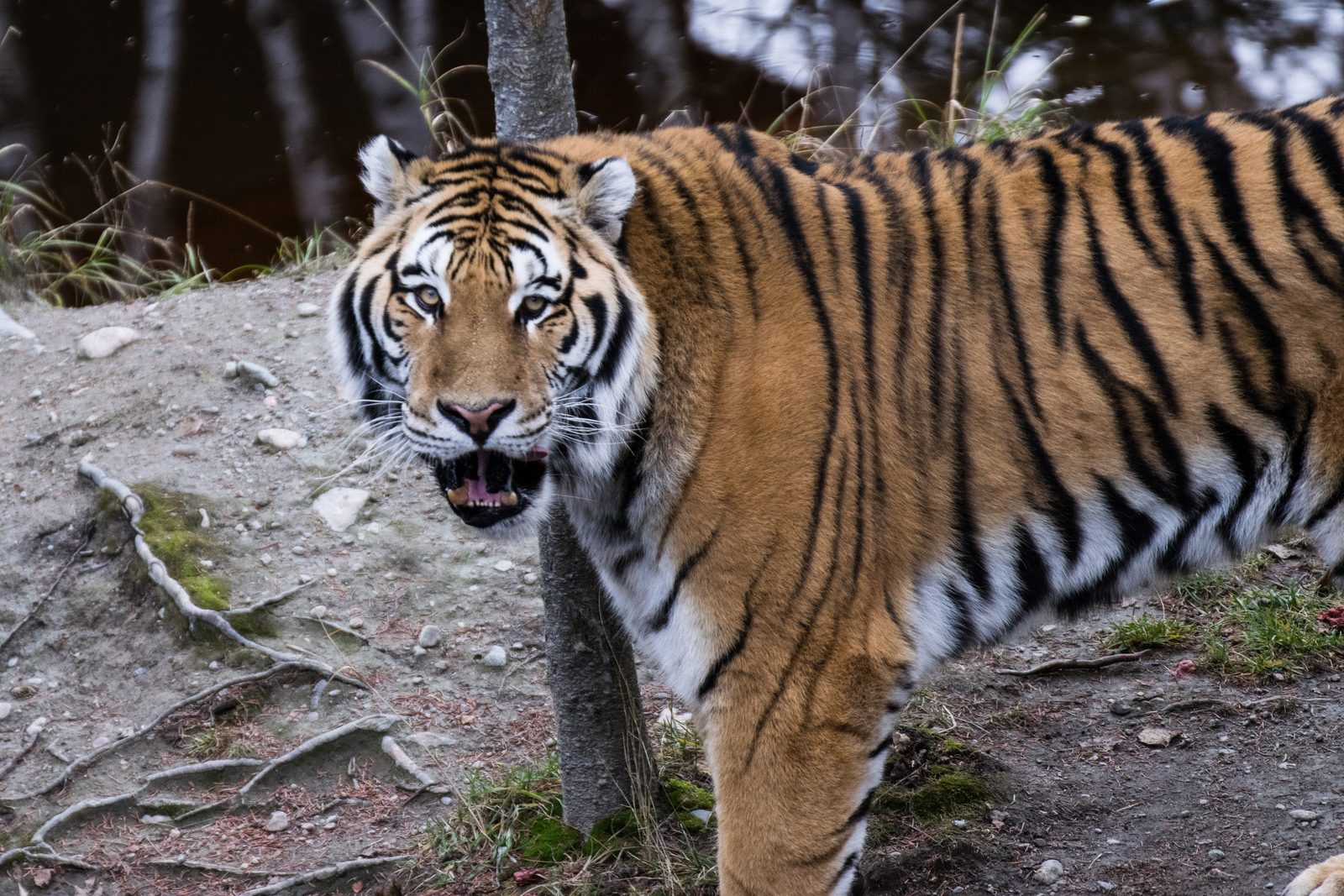
Tigers have never been native to Canada, and nobody publishes a count of the captive ones. There is no federal registry, and wild animal ownership is a provincial matter. The tigers that can be traced are in zoos, eight of them at the last check. Beyond those lies a tail of private and roadside holdings that nobody counts, and Ontario still does not license zoos or restrict who may keep a tiger.
| Status | Not native, captive population only |
|---|---|
| Subspecies | Not native. Amur tigers at eight zoos; Toronto Zoo has also kept Sumatran tigers. |
| Current wild population | None, ever. The captive population is split between accredited zoos and private and roadside facilities, with no national registry and so no reliable total. |
Current status
The zoos are the part that can be listed, and the table below is that list. The other part leaves fewer records. Bowmanville Zoo in Ontario closed in October 2016, ten months after an undercover video appeared to show its owner whipping a tiger in training. Cruelty charges were laid and then stayed in 2017 without reaching trial. Roadside facilities have held tigers under the same weak provincial rules, and no agency publishes how many remain.
Where to see tigers in Canada
| Zoo | Province | Tigers at the last check |
|---|---|---|
| Toronto Zoo | Ontario | Amur and Sumatran. The Sumatran male, Hari, was euthanised in February 2026 aged 17. |
| Zoo de Granby | Quebec | Amur |
| Zoo sauvage de Saint-Félicien | Quebec | Amur |
| Wilder Institute/Calgary Zoo | Alberta | Amur |
| Edmonton Valley Zoo | Alberta | Amur: one female, Amba, at the last report we found (August 2024) |
| Assiniboine Park Zoo, Winnipeg | Manitoba | Amur, one male and one female |
| Magnetic Hill Zoo, Moncton | New Brunswick | Amur: a male, Alik |
| Greater Vancouver Zoo | British Columbia | Amur: one female, Hana |
We checked each row in November 2026 against the zoo’s own website or recent local news. Toronto has been the only Canadian zoo with Sumatran tigers, and Hari’s death at 17, a long life for a tiger (see how long tigers live), left it with one elderly female at most.
Accredited zoos are inspected on a cycle and roadside attractions are not. If a facility lets you hold a tiger cub, the cub will be too big to handle within months and the operation then needs a replacement, which means it has to keep breeding. Check accreditation before you buy a ticket.
Who can keep a tiger in Canada
Canada has no federal law on keeping big cats, so the answer depends on the province.
| Jurisdiction | Rule |
|---|---|
| British Columbia | Controlled Alien Species Regulation, in force since 16 March 2009: nobody may possess a tiger without a permit, and breeding is limited to accredited zoos and certified institutions. |
| Alberta | The Wildlife Regulation lists the big cats of the genus Panthera as controlled animals. Only permitted zoos and research facilities may hold them. |
| Ontario | No provincial zoo licence and no ban on private keeping. The Provincial Animal Welfare Services Act, in force since 1 January 2020, sets care standards. The rest is left to municipal bylaws. |
| Quebec | A new regulation on animals in captivity replaced the old one on 6 September 2018, with a separate licensing regulation. |
| Federal | None. Two Senate bills on captive wildlife lapsed in 2024 and 2025. |
British Columbia wrote its rule after a death. In May 2007 a woman was killed by a privately kept tiger at Bridge Lake, near 100 Mile House, and the regulation followed in March 2009.
Ontario is the gap. World Animal Protection says nearly half of the province’s municipalities have no bylaw on exotic animals. A private member’s bill to license zoos, the Captive Wildlife Protection Act (Bill 35), had its first reading on 29 May 2025 and had not reached second reading by November 2026. An earlier version died when the 2025 election was called.
Ottawa has not filled it. The Jane Goodall Act (Bill S-241), which by most accounts would have covered big cats, was dropped from the Senate order paper in February 2024. The government’s own bill, S-15, covered only elephants and great apes. It passed the Senate in December 2024 and died when Parliament was prorogued on 6 January 2025. Nothing had replaced either by November 2026.
Breeding programmes
Canadian zoos that breed tigers do it through the Tiger Species Survival Plan, run by the US-based Association of Zoos and Aquariums, so their animals are managed as part of one North American population. Tigers move between zoos on its recommendations: in 2021 the male Samkha went from Assiniboine Park Zoo in Winnipeg to Calgary to pair with a female, Sarma. Toronto’s Hari belonged to the internationally managed Sumatran programme. Tigers outside the accredited zoos are in no such programme.
Related reading
- Amur tiger profile
- Sumatran tiger profile
- External authority: Canadian Association of Zoos and Aquariums
Frequently asked questions
Are tigers native to Canada?
No. Tigers have never been native to Canada.
How many tigers are in Canada?
Nobody publishes a reliable total. There is no federal registry, provincial licensing rules differ, and while accredited zoos report what they hold, private and roadside facilities largely do not.
Is private tiger ownership legal in Canada?
It depends on the province. British Columbia has required a permit since 2009, and Alberta treats big cats as controlled animals that only permitted zoos and research facilities may hold. Ontario has care standards but no provincial licence or ban, and there is no federal law.
Where can I see a tiger in Canada?
Toronto Zoo, Zoo de Granby, Zoo sauvage de Saint-Félicien, the Calgary Zoo, Edmonton Valley Zoo, Assiniboine Park Zoo, Magnetic Hill Zoo and the Greater Vancouver Zoo all held tigers at the last check.
Which tiger subspecies are in Canada?
Amur tigers at every zoo that holds them. Toronto Zoo has also kept Sumatran tigers, though its male, Hari, died in February 2026.
More tiger countries
Canada is one of several countries holding tigers it never had in the wild. The United States, the United Kingdom, Japan and Australia answer the regulation question differently.
- Tigers in the United States (captive only)
- Tigers in the United Kingdom (captive only)
- Tigers in Japan (captive only)
- Tigers in Australia (captive only)
All 25, grouped by whether tigers still live there: tigers by country.
Hero image: photo by Picography on Pexels.
Updated 13 September 2026: corrected what Ontario’s 2019 law does.
Updated 15 November 2026: updated Toronto Zoo’s Sumatran tigers after Hari’s death in February 2026, corrected how Canadian zoos take part in the AZA breeding plan, and added the provincial rules and the two lapsed federal bills.