
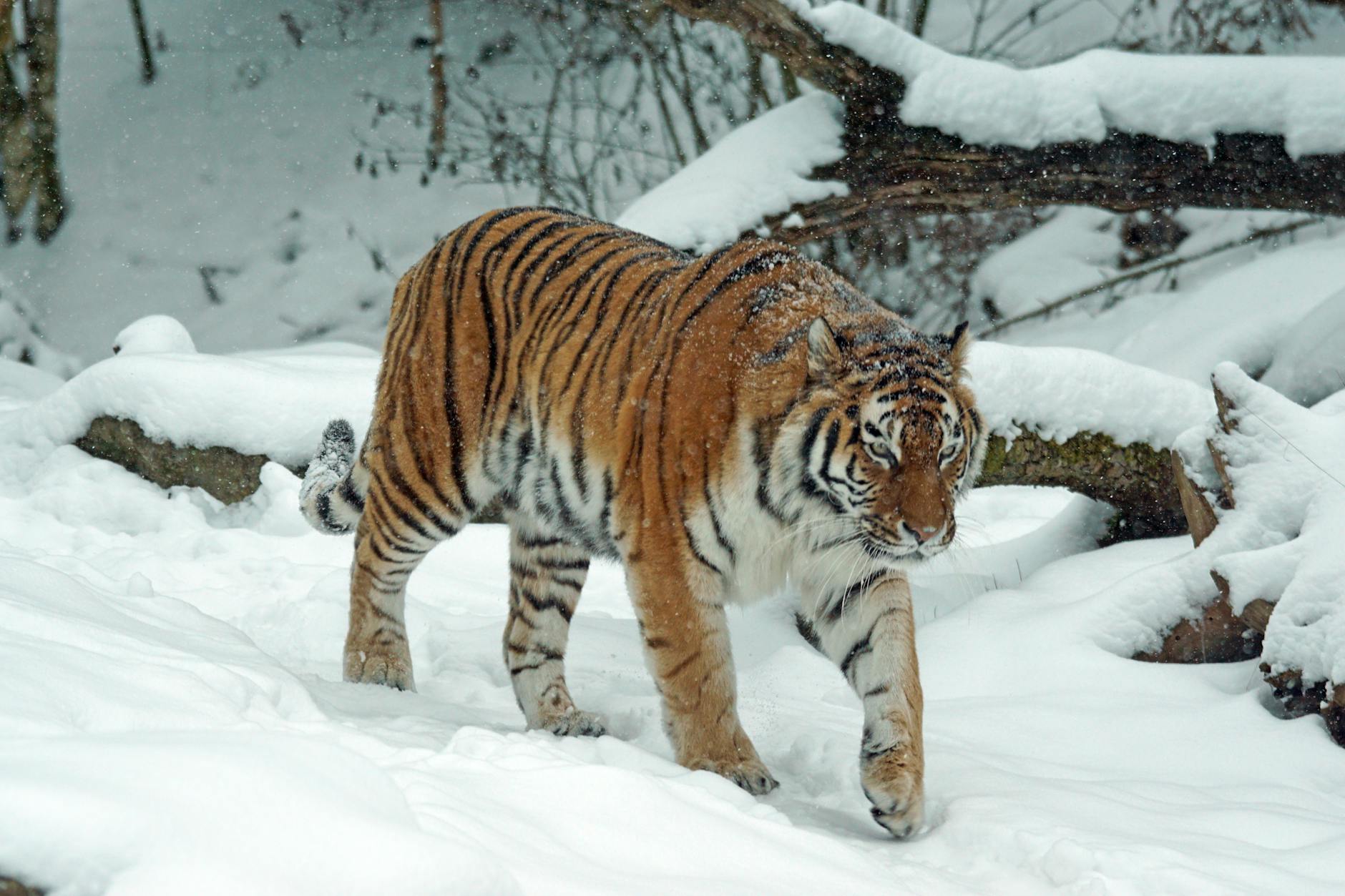
Around 1940 a survey of the Russian Far East found 20 to 30 Amur tigers. The last count published with a range, in 2015, gave 523 to 540, and in 2022 Russia announced about 750 including cubs. This page sets out the main counts, who made them and how far it can be trusted, and what allowed the Amur tiger, also called the Siberian tiger, to come back.
The recovery has also crossed a border. Tigers from Russia have resettled forest in northeast China, where the official count rose from 27 in 2017 to 72 in 2026.
Key facts
- Lev Kaplanov’s survey around 1940 estimated that 20 to 30 Amur tigers were left in the Russian Far East.
- The Soviet Union banned tiger hunting in 1947, which the WildCats Conservation Alliance describes as the first full legal protection any country gave the tiger.
- Range-wide counts gave 415 to 476 tigers in 1996, 428 to 502 in 2005 and 523 to 540 in 2015. Russia announced about 750 including cubs in 2022.
- The IUCN’s 2022 assessment estimated 386 adult and subadult tigers in Russia (range 265 to 486) from camera-trap data, and called the population stable.
- Northeast China Tiger and Leopard National Park, piloted from 2017 and formally established in 2021, held 72 wild tigers on the official July 2026 count, up from 27 in 2017.
The low point: 20 to 30 tigers
Amur tigers once ranged across the Russian Far East, northeast China and the Korean Peninsula. Decades of hunting, and the capture of cubs for zoos, emptied most of it. The zoologist Lev Kaplanov tracked the survivors on foot at the end of the 1930s and estimated 20 to 30, a figure published in 1948. The report on the 2005 census suggests the true number was no more than 50. WWF’s figure for the 1940s is no more than 40.
The Soviet Union banned tiger hunting in 1947 and restricted the capture of cubs in the 1950s. Sources differ by a few years on both dates.
What the surveys actually say
Russia counts its tigers by their tracks in snow. Fieldworkers cover set routes in winter and measure the paw prints, and specialists work out how many animals made them. A range-wide count has been run about once a decade. The results, with the IUCN’s separate camera-trap estimate for comparison:
| When | Tigers | What was counted | Source |
|---|---|---|---|
| About 1940 | 20 to 30 | An estimate from tracking on foot | Kaplanov 1948, in Miquelle et al. 2005 |
| 1959 | 90 to 100 | Regional survey of Primorsky and Khabarovsk krais | Abramov 1962, in Miquelle et al. 2005 |
| 1970 | 149 to 151 | Survey of Primorsky Krai plus a Khabarovsk estimate | Yudakov and Nikolaev 1973; Kazarinov 1979, in Miquelle et al. 2005 |
| 1979 | 206 to 229 | Survey of Primorsky Krai plus a Khabarovsk estimate | Pikunov et al. 1983; Kazarinov 1979, in Miquelle et al. 2005 |
| 1985 | 240 to 250 | Survey of Primorsky Krai, extrapolated to the whole Russian Far East | Pikunov 1990, in Miquelle et al. 2005 |
| 1995 to 1996 | 415 to 476 | 330 to 371 adults and subadults plus 85 to 105 cubs, from winter tracks | Range-wide survey, Matyushkin et al. 1996, in Miquelle et al. 2005 |
| 2004 to 2005 | 428 to 502 | 331 to 393 adults and subadults plus 97 to 109 cubs, from winter tracks | Range-wide survey, Miquelle et al. 2005 |
| 2014 to 2015 | 523 to 540 | All tigers including cubs, from winter tracks | Amur Tiger Centre, 16 June 2015 |
| 2015 to 2020 | 386 (265 to 486) | Adults and subadults only, from camera-trap densities | IUCN Red List assessment, 2022 |
| 2021 to 2022 | About 750 | All tigers including cubs, from winter tracks | President Putin, 5 September 2022 |
Download this table: Amur tiger counts in Russia, 1940 to 2022 (CSV). Free to reuse. The counts before 1995 come from regional surveys with different coverage and methods, so they show the direction of the recovery, not exact growth from one survey to the next.
The 2021 to 2022 census was run by the Ministry of Natural Resources with the Amur Tiger Centre and the Russian Academy of Sciences, over more than 180,000 square kilometres. Its headline figure, about 750 including cubs, was announced in September 2022. The Amur Tiger Centre’s own 2023 report still described the results as preliminary, and only the count for southwest Primorye has appeared in a peer-reviewed journal.
The IUCN’s 386 is not a rival count of the same thing. It leaves out cubs, uses camera-trap data from 2015 to 2020, and comes with a wide range. Its authors also note that the track surveys rest on expert assessment and not on statistical analysis, which makes one survey hard to compare with the next. Read together, the figures support a plain statement: there are several hundred Amur tigers in Russia where there were a few dozen, and the exact number is not known. Our guide to how camera traps count tigers explains the method India and Nepal use instead.
What made the recovery possible
The land. The Russian Far East is large, thinly populated and mostly forest. The 2021 to 2022 census put the tiger’s range at about 206,000 square kilometres of Primorsky and Khabarovsk krais. Other tiger countries have had to rebuild habitat. Here it was still standing.
Long protection. The 1947 ban has stayed in force for nearly eighty years, through the end of the Soviet Union. Sikhote-Alin has been a reserve since 1935. The Amur Tiger Centre, founded in 2013 by the Russian Geographical Society, paid the running costs of the 2021 to 2022 census.
Prey. Amur tigers live mainly on red deer and wild boar, with sika and roe deer. Enough of them survived to feed a growing tiger population. That is now in question: African swine fever arrived in 2019, and a 2025 study put the loss of wild boar across the south of the Russian Far East at 90 to 95 percent.
The IUCN Red List tiger assessment of 2022 covers every population, and the Panthera tiger programme publishes field research.
Land of the Leopard and the southern stronghold
Land of the Leopard National Park was created in April 2012 in the far southwest of Primorsky Krai, on the border with China’s Jilin Province. It covers about 2,600 square kilometres and holds most of the world’s wild Amur leopards as well as tigers.
Its position matters most. Tigers and leopards walk from here into Hunchun and the Chinese national park beyond. The two parks signed a cooperation memorandum in early 2019, and in May 2024 Russia and China agreed to join them, with the Kedrovaya Pad reserve, into a single cross-border reserve called the Land of Big Cats, about 18,000 square kilometres in all.
The poaching pressure that did not go away
The 1947 ban ended legal hunting, not killing. Poaching for skins and bones rose sharply in the early 1990s, when border controls weakened after the Soviet collapse, and it has never stopped.
The sharper recent problem is hunger. After swine fever cut wild boar numbers, tigers began coming into villages for dogs and livestock. In the northern part of the range, conflicts with people rose more than elevenfold and the number of tigers killed or removed rose 3.3 times, according to the 2025 study. At least three people were killed by tigers in the Russian Far East in the winter of 2024 to 2025.
Across the border in China
Northeast China Tiger and Leopard National Park covers 14,100 square kilometres of Jilin and Heilongjiang, more than five times the area of Land of the Leopard. China’s official counts there are 27 tigers in 2017, 50 in 2021 and 72 in July 2026.
China also has a very large captive tiger industry, which is a separate subject. It is covered on our page on tigers in China.
For the animal itself, its size, coat and diet, see our Amur tiger profile. For reserves and current threats see tigers in Russia. Other countries that have rebuilt tiger numbers are covered in tiger conservation success stories, and global numbers by country in how many wild tigers are left.
Frequently asked questions
How many Amur tigers are there?
Russia announced about 750 including cubs in 2022. The last count published with a range, in 2015, gave 523 to 540. The IUCN’s 2022 assessment estimated 386 adults and subadults. China counted 72 in its border national park in July 2026.
Where do Amur tigers live now?
Almost all are in Primorsky Krai and southern Khabarovsk Krai in the Russian Far East, with a growing group in northeast China. The IUCN lists the tiger as extinct in North Korea, and there is no confirmed recent record there.
Why did the Amur tiger nearly go extinct?
Hunting for skins and the capture of cubs for zoos, over several decades. By about 1940 an estimated 20 to 30 were left in Russia.
What is Northeast China Tiger and Leopard National Park?
China’s national park for Amur tigers and Amur leopards, in Jilin and Heilongjiang, covering 14,100 square kilometres. It ran as a pilot from 2017 and was formally established in 2021. China reported 72 wild tigers there in July 2026, up from 27 in 2017.
Is the Amur tiger population still growing?
In China, yes: from 27 in 2017 to 72 in 2026. In Russia it is unclear. The 2022 announcement of about 750 is higher than the 523 to 540 of 2015, but the IUCN’s 2022 assessment judged the Russian population stable, and the loss of wild boar to swine fever since 2019 has raised tiger deaths in the north of the range.
Photo: Pixabay on Pexels.
Updated 13 September 2026: corrected the 2015 census figure, Amur tiger weights, captive tiger numbers and the China park count.
Updated 15 November 2026: replaced the survey list with a dated table, corrected the IUCN figure (386 adults and subadults), the Land of the Leopard area and the cross-border agreements, and added the swine fever findings.
Updated 18 November 2026: cited the official announcement of the 2022 census, added the counts from 1959 to 1985, linked a source for every row and added a CSV of the table.


You wrote only one sentence about African swine fever. I think it should be more. After 2019 the wild boar almost disappeared in many parts of Primorye and then tigers started to come to villages and take dogs. My sister lives there, everybody talks about it.
Came here after a documentary used Siberian and Amur in the same breath. Took me embarrassingly long to work out it’s one animal. They don’t even live in Siberia really, do they?