
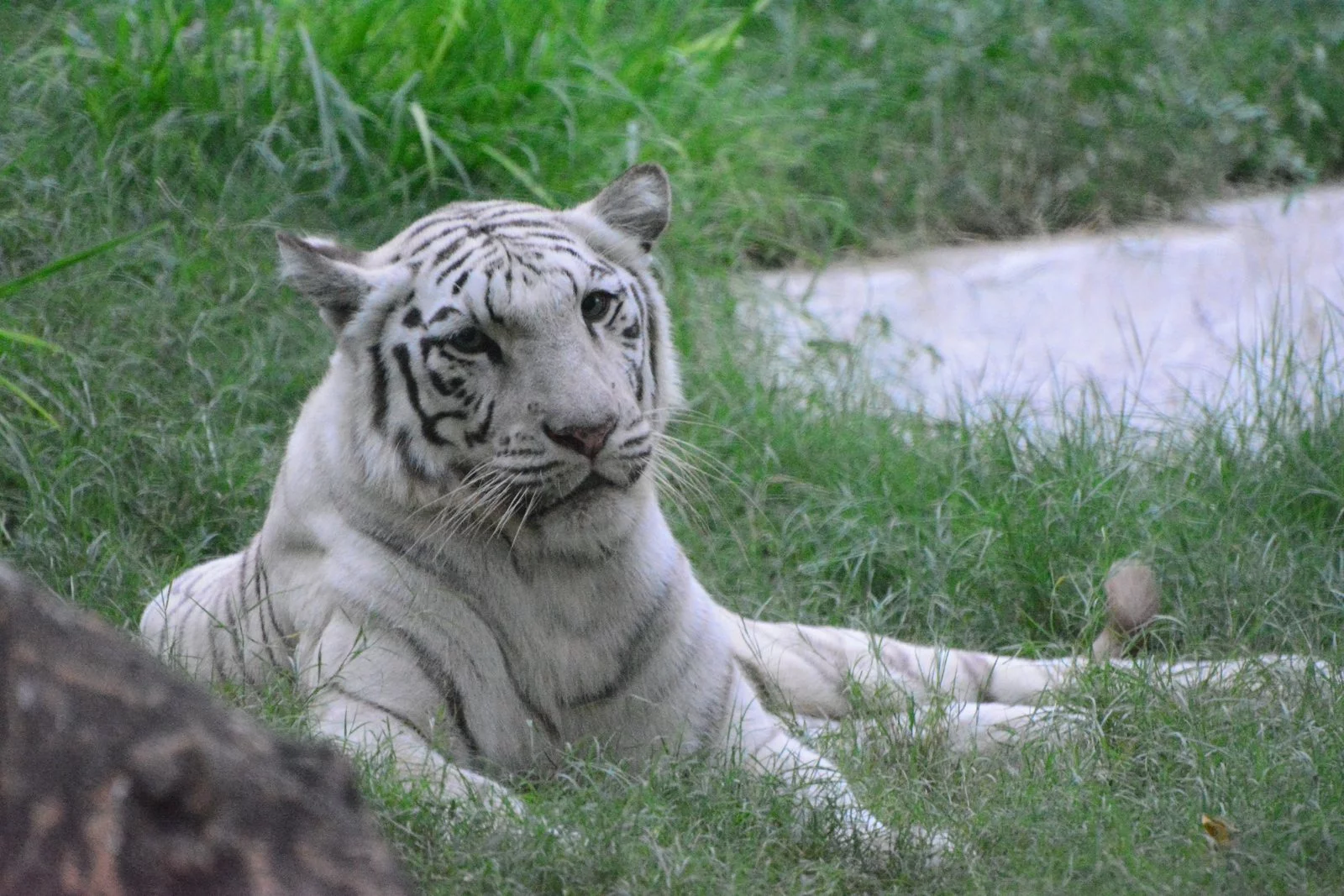
The tigers of Pakistan were Bengal tigers, and they lived along the Indus. A continuous belt of tamarisk and tall grass, four to twelve miles wide in places, ran down the river and carried tigers through Sindh and up into Bahawalpur and the Punjab plains. Sport shooting and the conversion of that belt to irrigated farmland removed them inside two generations. The last documented kill was in 1906, a few miles below Panjnad. There are no wild tigers in Pakistan today and no reintroduction plan.
| Status | Former range state, no current wild tigers |
|---|---|
| Subspecies | Bengal tiger (Panthera tigris tigris), the western edge of the Indian population. Pakistan lay outside the range of the Caspian tiger, which reached east only as far as northern Afghanistan and Xinjiang. |
| Current wild population | None. The last documented tiger was shot below Panjnad in 1906. Captive tigers are held in Pakistani zoos and, in Punjab, on private breeding farms. |
Current status
No wild tigers in Pakistan, and the country sits outside the range of every surviving tiger population. Captive tigers are kept at Lahore Zoo, Bahawalpur Zoo and in private hands, and none of it is connected to any reintroduction work. The private side is large. After a pet lion escaped in Lahore in July 2025, Reuters reported 584 lions and tigers in homes and breeding farms in Punjab alone. The province had brought big cats under its Wildlife Act that January, with a licence fee of 50,000 rupees per animal and a rule that they be kept outside city limits. Islamabad’s Marghazar Zoo, still listed as a big cat collection in older sources, was ordered closed by the Islamabad High Court in May 2020 and its animals removed; the site now operates as a wildlife rescue centre under the Islamabad Wildlife Management Board.
A short history of tigers in Pakistan
The habitat was the riverine forest of the Indus: tamarisk scrub and stands of tall sarkanda grass running in an unbroken strip along the river and its lower tributaries. The records were collected by T. J. Roberts in The Mammals of Pakistan (1977). Khairpur State’s river tracts in Sindh were the last stronghold there, and a tigress shot in 1886 by Colonel McRae is recorded as the last Sindhi tiger. Further north the shooting went on longer. The Amir of Bahawalpur told Roberts in 1965 that his father had shot thirteen tigers in the state’s Indus jungles, the last of them in 1906 a few miles below Panjnad, where the joined Punjab rivers meet the Indus.
British officers and princely rulers shot tigers as trophies whenever the chance came up, and canal irrigation from the late 19th century onward converted the riverine forest to cropland. That took the cover, and with it the deer and wild pig that tigers eat.
Conservation context
There is no wild tiger conservation in Pakistan because there is nothing left to conserve. The nearest wild tigers are in the tiger reserves of Rajasthan and Madhya Pradesh, across a closed border and a fully farmed plain. Kazakhstan’s Ile-Balkhash programme is the working example of putting tigers back into a country that lost them. It took a reserve of about 450,000 hectares, eight years of prey restoration and money from WWF, UNDP and the state before the first tiger was released in July 2026. Nothing on that scale has been proposed for the Indus, and the floodplain no longer has the room for it.
Historical tiger habitat
Almost all of the Indus riverine forest has gone under canal irrigation and cropland since the late 19th century. The places the historical record actually names are Khairpur’s river tracts in Sindh, the Bahawalpur jungles on the lower Indus, and the country around the Panjnad confluence. What survives of that forest is fragmentary and mostly unprotected.
What this means for tiger conservation
Nobody decided to exterminate the Indus tiger. Korea’s tigers and Kazakhstan’s were hunted out as policy. Pakistan’s went in about two generations as a by-product of two ordinary things: men with rifles taking a trophy when one presented itself, and engineers turning riverine jungle into irrigated fields.
The habitat is the part that is still live. The Indus floodplain forests continue to shrink, and the hog deer that shared them with the tiger is now listed as Endangered by the IUCN. The river’s own mammal has done better: the Indus river dolphin rose from about 1,200 animals in 2001 to 1,987 in 2017 on WWF-Pakistan’s survey figures. Riverine habitat, not any tiger plan, is where Pakistani conservation effort sensibly goes.
Related reading
- Bengal tiger profile
- Tigers in India
- Habitat loss and tiger survival
- External authority: IUCN Cat Specialist Group on the tiger
Frequently asked questions
Were tigers ever native to Pakistan?
Yes. Bengal tigers lived in the riverine forest along the Indus and its lower tributaries, through Sindh and up into Bahawalpur and the Punjab plains.
Which tiger lived in Pakistan, the Bengal or the Caspian?
The Bengal. The Caspian tiger’s range ran from eastern Turkey and northern Iran through Central Asia to northern Afghanistan and Xinjiang, and did not extend into what is now Pakistan.
When did tigers go extinct in Pakistan?
Effectively in 1906, with the last documented animal shot a few miles below Panjnad. Sindh’s last tiger was a tigress shot in 1886 in the Khairpur river tracts. We have found no sourced record after 1906.
Are there wild tigers in Pakistan today?
No. The country falls outside the range of every surviving tiger population.
Could tigers be reintroduced to Pakistan?
Nothing is planned. The Indus riverine forest that held them is largely gone, and a reintroduction on the Kazakh model would need a very large protected block and years of prey recovery first.
Are tigers kept in Pakistani zoos?
Yes, at Lahore Zoo and Bahawalpur Zoo among others, and far more big cats sit in private collections: Reuters reported 584 privately held lions and tigers in Punjab in July 2025. Islamabad’s zoo was closed by court order in 2020 and no longer holds them.
More tiger countries
Pakistan lost its wild tigers, and India, Kazakhstan, Nepal and Sri Lanka tell the neighbouring parts of the same retreat.
- Tigers in India (wild tigers today)
- Tigers in Kazakhstan (wild tigers returning)
- Tigers in Nepal (wild tigers today)
- Tigers in Sri Lanka (captive only)
All 25, grouped by whether tigers still live there: tigers by country.
Hero image: photo by Faiz ur Rehman on Pexels.
Updated 15 November 2026: removed an unsourced claim that tigers survived into the 1930s, corrected the Indus dolphin comparison (its numbers are rising) and added Punjab’s 2025 figures on privately kept big cats.